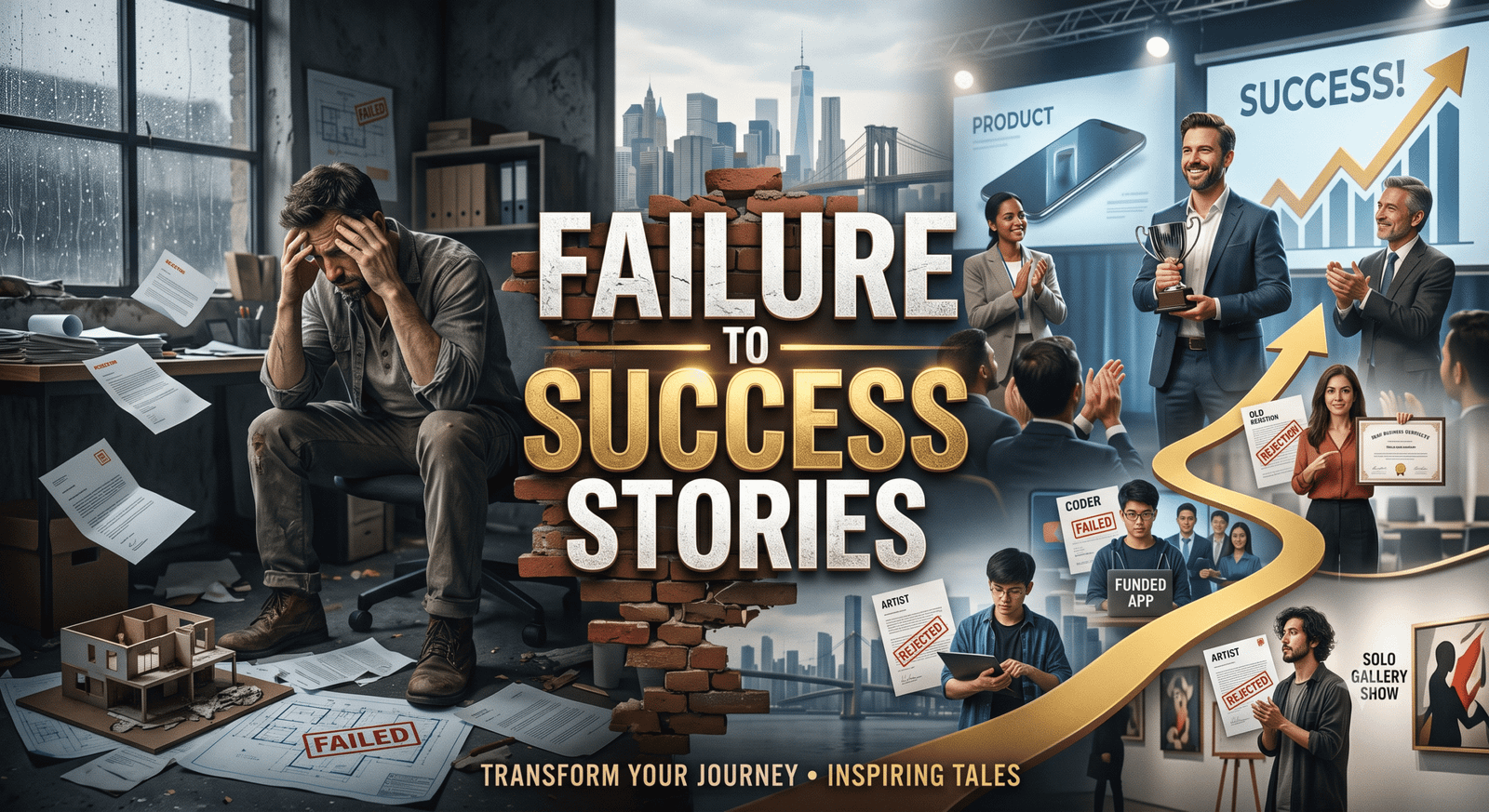
Failure rarely feels useful when you are experiencing it. A rejected application, unsuccessful business idea, poor exam result, or career setback can make months of effort seem wasted. Yet history shows that one unsuccessful attempt does not necessarily predict what happens next.
Some of the most valuable failure to success stories are not really about people who simply “tried harder.” They are about people who learned, changed their methods, developed new skills, and continued despite uncertainty.
Here are seven well-known examples—and, more importantly, the practical lessons hidden behind their achievements.
Why Failure to Success Stories Matter
Success stories can be misleading when we only see the final result. A successful company, bestselling book, scientific breakthrough, or sporting achievement often hides years of uncertainty.
Psychological research into resilience and growth mindset has helped popularize an important idea: setbacks can become opportunities for learning when people examine what went wrong and adjust their response.
That does not mean every failure automatically leads to success. The difference often lies in what happens afterward.
1. J.K. Rowling: Rejection Before Harry Potter
Before Harry Potter and the Philosopher’s Stone reached bookstores, J.K. Rowling faced financial hardship and multiple publisher rejections.
Rather than interpreting those rejections as proof that the story had no future, she continued approaching publishers. Bloomsbury eventually published the first Harry Potter book in 1997, beginning a series that became a global publishing phenomenon.
Practical lesson: Rejection is an opinion or decision at a particular moment. When you believe your work has potential, use constructive criticism to improve it without allowing one “no” to become your final answer.
2. Walt Disney: Early Business Failure Before an Entertainment Empire
Walt Disney’s career did not begin with Disneyland or Mickey Mouse. One of his early animation businesses, Laugh-O-Gram Films, encountered serious financial problems and eventually went bankrupt.
Disney subsequently moved to Hollywood and started again with his brother Roy. Their work eventually developed into one of the world’s most recognizable entertainment companies.
The important part of this story is not failure itself. Disney carried skills, experience, and creative knowledge from one venture into the next.
Lesson: A failed business does not erase what you learned while building it.
3. Colonel Sanders: Success Did Not Arrive Early
Harland Sanders is a useful example for anyone who believes they have “missed” the right age for success.
Sanders worked in numerous jobs and operated a roadside restaurant before developing the business model associated with Kentucky Fried Chicken. He was already in his 60s when he began extensively franchising his chicken concept.
His journey challenges the idea that entrepreneurship belongs only to young founders.
What Failure to Success Stories Teach About Starting Again
Starting again does not necessarily mean returning to zero. Skills, professional contacts, industry knowledge, and lessons from previous mistakes travel with you.
Sanders had decades of experience dealing with customers and food before his franchise expanded.
Practical lesson: Instead of asking whether you are too late, ask which skills and experiences you already possess that could support your next move.
4. Thomas Edison: Experimentation Instead of Instant Success
Thomas Edison is frequently associated with persistence during the development of practical electric lighting.
The simplified version of the story says Edison “failed thousands of times.” The reality is more useful: Edison and his research team systematically experimented with materials and designs while working toward a commercially viable incandescent lighting system.
Each unsuccessful experiment narrowed the possibilities.
This is a valuable distinction. Repeating exactly the same mistake is not persistence. Testing, learning, and changing the next attempt is.
Lesson: Treat failure as data. Ask what the result tells you before trying again.
Failure to Success Stories From India
India also offers powerful examples of people whose achievements followed difficult beginnings, professional obstacles, or circumstances beyond their control.
5. Amitabh Bachchan: Career Setbacks Before a Remarkable Comeback
Amitabh Bachchan’s career is often remembered for his enormous success, but it has also included serious setbacks.
His early film career did not produce immediate stardom. Decades later, his business venture, Amitabh Bachchan Corporation Limited (ABCL), experienced major financial difficulties.
Bachchan returned to acting and took on television work, including Kaun Banega Crorepati, which became an important chapter in his professional comeback.
Practical lesson: Previous success does not protect anyone from future setbacks—and a setback does not cancel previous ability.
6. Arunima Sinha: Redefining What Was Possible
Arunima Sinha’s story differs from a traditional business or career failure.
In 2011, the Indian athlete lost a leg after being thrown from a moving train during a robbery incident. During her recovery, she set herself an extraordinary objective: climbing Mount Everest.
After intensive training, she reached the summit in 2013, becoming the first female amputee to do so.
Her story demonstrates an important form of resilience: when circumstances permanently change, progress may require creating a new definition of what your life can become.
Lesson: Sometimes moving forward is not about restoring the past. It is about building a different future.
7. Dhirubhai Ambani: Building From Modest Beginnings
Dhirubhai Ambani did not begin his professional life with a large corporate organization. Born in Gujarat, he worked in Aden before returning to India and entering business.
He started trading commodities and eventually built Reliance into a major Indian enterprise.
His journey involved calculated risk, recognizing opportunities, building commercial relationships, and scaling gradually rather than achieving instant success.
Practical lesson: Large ambitions become more realistic when they are converted into smaller commercial decisions that can be executed one at a time.
How to Turn Failure Into Useful Feedback
Reading failure to success stories is motivating, but applying their lessons is more valuable.
When something goes wrong, first identify whether the problem came from your strategy, skills, timing, resources, or factors outside your control. Separate what you can change from what you cannot.
Then make the next attempt different.
For example, if you were rejected after a job interview, do not simply submit another 50 identical applications. Review your CV, improve the skills employers repeatedly request, practice interviews, and target positions that better match your experience.
That turns persistence into informed persistence.
Common Mistakes People Make After Failure
One mistake is treating a single setback as evidence of permanent inability. Another is continuing with exactly the same strategy because changing direction feels like “giving up.”
The opposite can also happen. Some people romanticize persistence and continue investing time or money in an approach that clearly is not working.
Successful persistence requires judgment. Know when to continue, when to improve, and when to change direction entirely.
Conclusion: What Failure to Success Stories Really Teach Us
The most useful failure to success stories are not promises that everyone who persists will become famous or wealthy. Their real value is showing that setbacks do not always have to become endpoints.
J.K. Rowling kept submitting her manuscript. Walt Disney rebuilt after an early business failure. Arunima Sinha created an entirely new goal after a life-changing injury. Amitabh Bachchan rebuilt his professional career after financial difficulties.
Their circumstances were very different, but the underlying principle is practical: examine what happened, learn what you can, adapt your approach, and make the next decision deliberately.