India’s history is filled with women who entered spaces where opportunities were limited, expectations were restrictive, or success seemed unusually difficult. Their achievements matter not simply because they were “firsts,” but because many helped expand what later generations could imagine doing.
The best inspirational stories of Indian women reveal more than impressive accomplishments. They show the preparation, persistence, education, risk-taking, and difficult decisions behind those achievements.
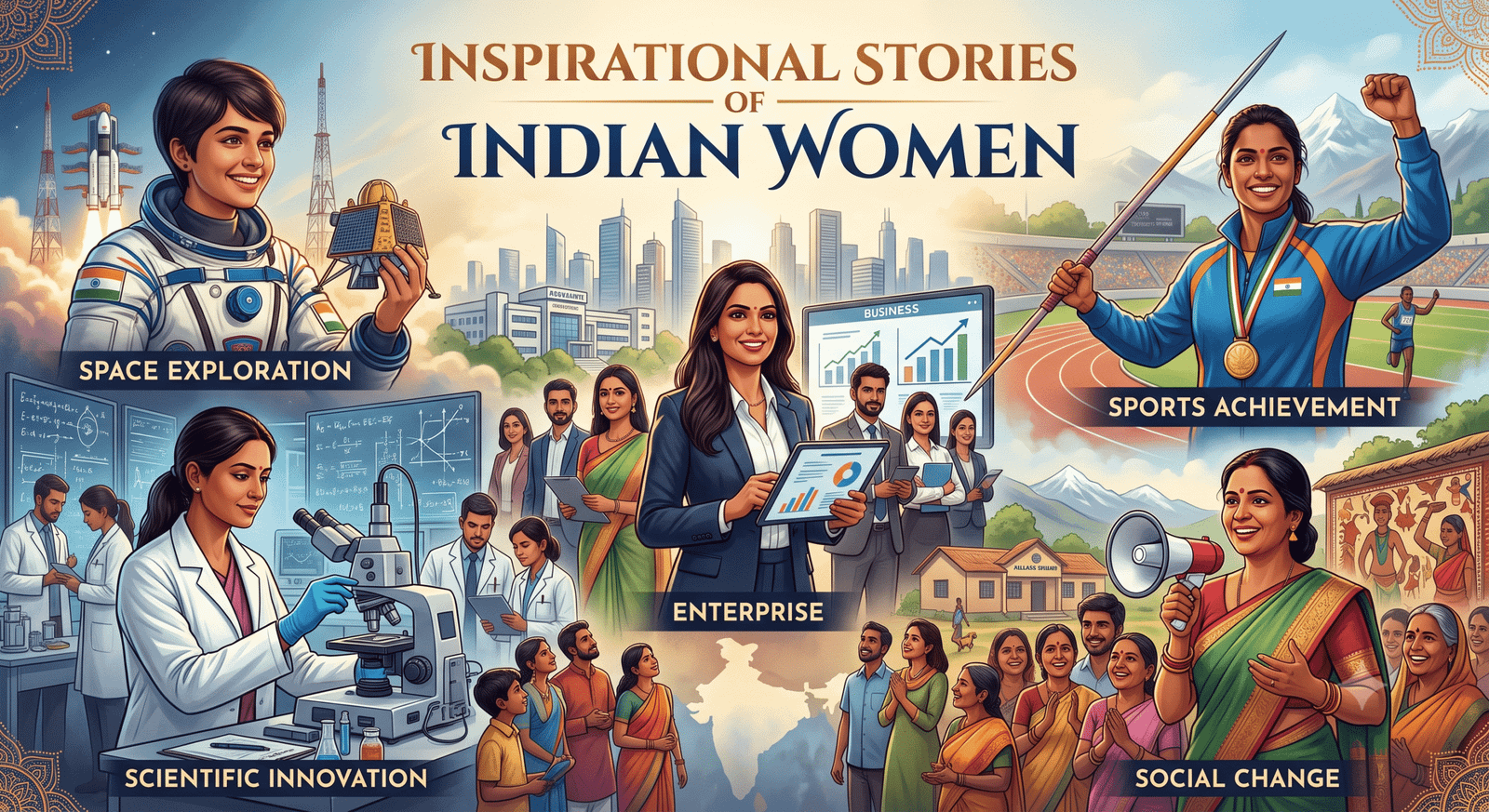
From space exploration and aviation to boxing, business and social change, these ten women followed very different paths. Each offers a practical lesson worth carrying into our own lives.
Why Inspirational Stories of Indian Women Still Matter
Social progress changes opportunities, but barriers do not disappear at the same speed everywhere. Women may still encounter stereotypes, unequal access to resources, family expectations, financial constraints, or limited representation in certain professions.
That is why real stories matter.
They demonstrate that ambition works best when supported by skills, preparation, mentors, access to opportunities, and the confidence to enter unfamiliar territory.
1. Kalpana Chawla: From Karnal to Space
Born in Karnal, Haryana, Kalpana Chawla became fascinated with aviation at an early age. She studied aeronautical engineering in India and later continued her education in the United States.
After joining NASA, Chawla became the first woman of Indian origin to travel into space when she flew aboard Space Shuttle Columbia in 1997.
She died along with six other crew members when Columbia disintegrated during re-entry in 2003.
Her journey continues to inspire young people interested in aerospace, engineering and science.
Lesson: A distant goal becomes more achievable when you identify the qualifications, skills and smaller milestones required to reach it.
2. Mary Kom: Fighting Her Way to the Top
Mangte Chungneijang Mary Kom grew up in Manipur and went on to become one of India’s most accomplished boxers.
Her career included multiple world championship titles and an Olympic bronze medal at the 2012 London Games. She also returned to elite competition after becoming a mother.
Mary Kom’s story is especially useful because athletic achievement depends on much more than motivation. Training schedules, recovery, coaching, nutrition and consistent practice all contribute to performance.
Lesson: Long-term success is usually built through routines that continue after initial enthusiasm disappears.
3. Arunima Sinha: Rebuilding Life After a Devastating Injury
In 2011, athlete Arunima Sinha lost a leg after being thrown from a moving train during a robbery incident.
She later chose an extraordinary goal: climbing Mount Everest. Following rehabilitation and mountaineering training, she reached the summit in 2013, becoming the first female amputee to accomplish the feat.
Her achievement is not simply a story about “thinking positively.” It involved physical rehabilitation, technical training, preparation and calculated risk.
Lesson: When circumstances permanently change, progress may require building a new future rather than trying to recreate the old one.
Inspirational Stories of Indian Women Who Changed Their Fields
Breaking a barrier is rarely an individual achievement alone. When someone enters a field where few people like them have succeeded before, their visibility can influence who comes next.
4. Kiran Bedi: What Inspirational Stories of Indian Women Teach About Leadership
Kiran Bedi joined the Indian Police Service in 1972 and became India’s first woman IPS officer.
Her career placed her in a profession traditionally dominated by men and included roles in policing, prison administration and public service.
Her journey also illustrates something important about leadership: being the first often brings greater scrutiny along with greater opportunity.
Practical lesson: Leadership requires competence, but it also requires the willingness to make decisions when those decisions may be closely examined or challenged.
5. Tessy Thomas: Building a Career in Defence Science
Known for her work on India’s missile programmes, Tessy Thomas built a distinguished career as a scientist with the Defence Research and Development Organisation (DRDO).
She became closely associated with the Agni missile programme and is often highlighted as an example of women’s growing participation in Indian science and defence technology.
For students, her career offers a useful reminder that STEM success starts long before a major project. Mathematics, engineering fundamentals, problem-solving and years of technical experience create the foundation.
Lesson: Expertise is accumulated. Focus on mastering fundamentals before worrying about recognition.
6. Falguni Nayar: Starting Nykaa at 49
Falguni Nayar had already established a successful career in investment banking when she left Kotak Mahindra Capital and founded Nykaa in 2012.
She was 49.
Nykaa developed into a major beauty and lifestyle retail platform and later became a publicly listed company.
Nayar’s journey challenges the common assumption that entrepreneurship has an age limit.
Lesson: Professional experience can become an entrepreneurial advantage. Industry knowledge, financial understanding and leadership skills acquired over decades can support a new venture.
7. Avani Chaturvedi: Reaching the Fighter Cockpit
Avani Chaturvedi became one of the first three women commissioned into the fighter stream of the Indian Air Force, alongside Bhawana Kanth and Mohana Singh.
In 2018, she became the first Indian woman fighter pilot to fly a fighter aircraft solo.
Her achievement came through demanding professional training rather than symbolic participation.
Lesson: When a previously closed opportunity opens, preparation determines what you can do with it.
8. Deepa Malik: Redefining Competitive Sport
Deepa Malik made history at the 2016 Rio Paralympics when she won silver in the women’s shot put, becoming the first Indian woman to win a Paralympic medal.
Her sporting career demonstrates why disability should not be automatically equated with an absence of competitive ambition.
Elite para-sport demands training, technical ability, coaching and mental discipline just as other high-performance sport does.
Lesson: Focus on capability and adaptation instead of defining people primarily by limitations.
More Inspirational Stories of Indian Women Who Created Change
Achievement is not limited to medals, corporate valuations or professional titles. Some of India’s most influential women changed society by questioning systems that others had learned to accept.
9. Sindhutai Sapkal: Creating a Family for Children in Need
Sindhutai Sapkal experienced severe personal hardship, including poverty and abandonment. Over time, she dedicated her life to caring for orphaned and vulnerable children.
Often known as the “Mother of Orphans,” she helped provide shelter and support to large numbers of children through organizations associated with her work.
Her life shows how personal suffering can sometimes create a deeper understanding of another person’s needs.
Lesson: Impact can begin with a problem you understand personally and a willingness to help one person before trying to help thousands.
10. Bachendri Pal: Reaching the Summit
Bachendri Pal became the first Indian woman to summit Mount Everest in 1984.
Her achievement came at a time when professional mountaineering opportunities for Indian women were considerably less visible than they are today.
Reaching Everest required technical training, endurance, teamwork and the ability to operate in an environment where small mistakes can carry serious consequences.
Her accomplishment helped establish a powerful precedent for Indian women in adventure sports.
Lesson: Being the first is difficult, but it can make the second and third person’s journey easier.
Practical Lessons You Can Apply
These stories become more valuable when they influence action.
If you are a student, identify the qualifications required for the career you want and work backward to create a learning plan. If you are considering entrepreneurship, study the problem before investing heavily in the solution. If you are returning after a career break, identify which existing skills remain valuable and which need updating.
Most importantly, measure progress against your own previous position rather than someone else’s public achievements.
A Common Mistake When Reading Inspirational Stories
One mistake is focusing entirely on the extraordinary outcome.
We remember Everest, Olympic medals, space missions and successful companies because they make compelling headlines. But those achievements can hide years of education, practice, unsuccessful attempts and support from other people.
Another mistake is assuming that determination alone solves structural barriers. Access to education, supportive institutions, mentors, financial resources and policy changes also matter.
Good inspirational stories should acknowledge both individual effort and the circumstances surrounding it.
Conclusion: What Inspirational Stories of Indian Women Teach Us
These inspirational stories of Indian women show that there is no single formula for achievement.
Kalpana Chawla pursued advanced education before reaching space. Mary Kom built excellence through sustained training. Falguni Nayar used decades of professional experience to enter entrepreneurship. Arunima Sinha adapted after a life-changing injury, while Bachendri Pal entered territory where few Indian women had gone before.
Their stories are different, but each demonstrates the value of preparation, persistence, adaptability and opportunity.
The useful question is not, “Can I achieve exactly what they achieved?” It is, “What can their decisions teach me about my next step?”