Why Naval Power Matters
More than 90% of India’s trade travels by sea.
India sits at the center of the Indian Ocean Region (IOR)—one of the most important maritime corridors in the world.
Any nation that wants to be a global power must control the seas.
For India, the symbol of that control is INS Vikrant.
The First INS Vikrant (1961–1997): Birth of Indian Sea Power
Origins
India’s first aircraft carrier, INS Vikrant (R11), was originally a British-built ship. India acquired and commissioned it in 1961.
At the time, India had:
-
Limited naval reach
-
Minimal carrier aviation experience
-
A defensive maritime posture
INS Vikrant changed everything.
1971 Indo-Pak War – Vikrant’s Moment
During the 1971 war, INS Vikrant was deployed in the Bay of Bengal.
Its aircraft:
-
Attacked Pakistani naval bases
-
Destroyed fuel depots and ports
-
Blockaded East Pakistan (now Bangladesh)
The result:
-
Pakistan’s eastern naval forces collapsed
-
The war ended in 13 days
-
Bangladesh was born
👉 This proved aircraft carriers win wars without invading land.
Legacy of the First Vikrant
-
Established carrier-based aviation
-
Trained generations of Indian naval pilots
-
Made India a blue-water navy
INS Vikrant was decommissioned in 1997, but its legacy lived on.
The New INS Vikrant (IAC-1): India Enters an Elite Club
A Historic Achievement
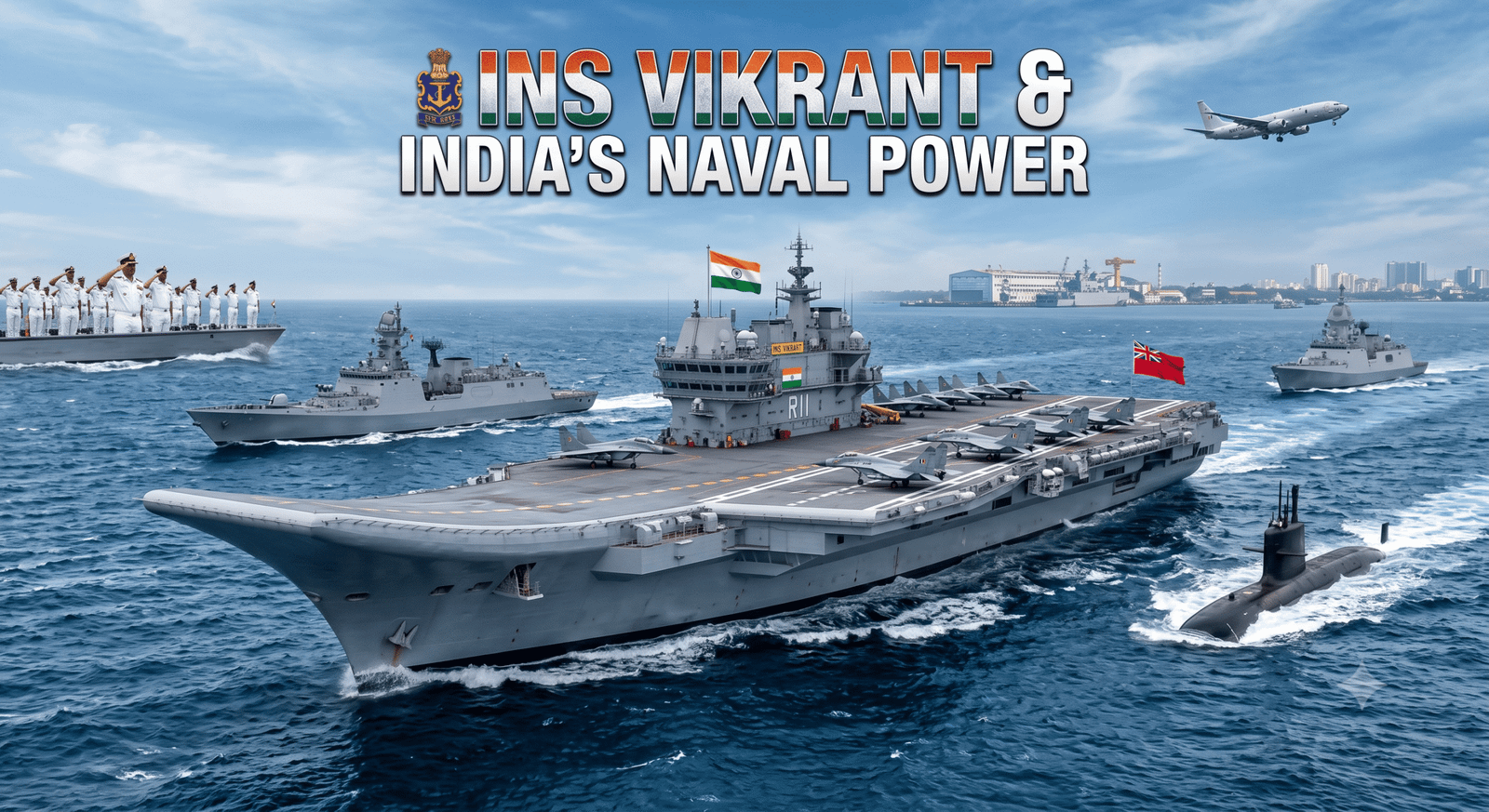
On 2 September 2022, India commissioned the new INS Vikrant (IAC-1).
With this, India became one of only a handful of countries capable of:
-
Designing
-
Building
-
Operating aircraft carriers indigenously
This is not just a ship—it is strategic independence.
Technical Power (Simplified)
-
Length: ~262 meters
-
Displacement: ~45,000 tons
-
Aircraft capacity: ~30 (MiG-29K, helicopters, future jets)
-
Speed: ~28 knots
-
Indigenous content: ~75%
It can operate:
-
Fighter jets
-
Anti-submarine helicopters
-
Surveillance aircraft
What Makes Vikrant Special
-
STOBAR system (Short Take-Off But Arrested Recovery)
-
Advanced radar & combat management
-
Network-centric warfare capability
-
Integrated with satellites and submarines
INS Vikrant is designed for modern, multi-domain warfare.
India’s Aircraft Carrier Doctrine
India currently operates two aircraft carriers:
-
INS Vikramaditya
-
INS Vikrant
Together, they allow:
-
One carrier on east coast
-
One carrier on west coast
-
Continuous operational readiness
Each carrier forms the core of a Carrier Battle Group (CBG):
-
Destroyers
-
Frigates
-
Submarines
-
Supply ships
This is floating sovereign territory.
Naval Power & China Factor
China’s navy (PLA Navy) is expanding rapidly:
-
Aircraft carriers
-
Submarines
-
Overseas bases (Gwadar, Djibouti)
China seeks influence in the Indian Ocean.
India’s response:
-
INS Vikrant
-
Strengthened Andaman & Nicobar Command
-
Partnerships with Quad nations (US, Japan, Australia)
Vikrant ensures sea denial and sea control.
Submarines: The Silent Strength
India’s naval power is not just visible—it is hidden.
Nuclear Submarines
-
INS Arihant (SSBN)
-
Second-strike nuclear capability
-
Ensures nuclear deterrence
Conventional Submarines
-
Kalvari-class (Scorpene)
-
Stealth, endurance, precision
Submarines protect carriers and threaten adversaries silently.
Missiles at Sea
Indian warships carry:
-
BrahMos supersonic missiles
-
Barak air-defense systems
-
Anti-submarine torpedoes
A carrier strike group can neutralize threats hundreds of kilometers away.
Indian Navy’s Strategic Roles
-
Deterrence – Prevent war by strength
-
Sea Control – Dominate key routes
-
Sea Denial – Block enemy movement
-
Humanitarian Assistance – Disaster relief
-
Power Projection – Influence without invasion
From evacuations to anti-piracy patrols, the Navy operates quietly—but decisively.
Future of Indian Naval Power
Next Goals
-
Indigenous aircraft carrier IAC-2 (Vishal) (planned)
-
Deck-based fighter (TEDBF)
-
More nuclear submarines
-
Unmanned naval systems
India is moving from regional power to global maritime power.
Why INS Vikrant Matters Beyond War
-
Symbol of self-reliance (Atmanirbhar Bharat)
-
Strategic autonomy
-
Technological maturity
-
Global respect
An aircraft carrier is diplomacy backed by steel.
FINAL MESSAGE
“Battles may be won on land,
but wars are decided at sea.”
INS Vikrant represents:
-
Past sacrifice
-
Present strength
-
Future dominance
India’s naval power is no longer defensive—it is decisive.