Indian Folk Tales That Almost Disappeared From Their Own Villages
Introduction: The Stories That Villages Nearly Forgot
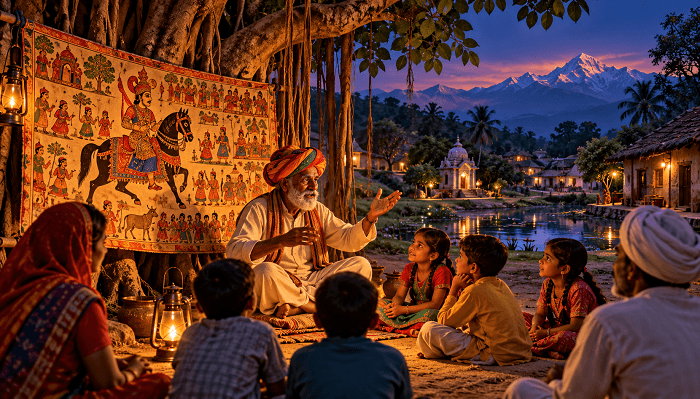
In many Indian villages, stories once travelled without books, television, or the internet. Grandparents narrated tales beside cooking fires, farmers exchanged legends during breaks, and travelling performers carried local histories from one settlement to another. Some stories explained unusual landscapes, while others taught children about courage, kindness, greed, and the consequences of breaking community rules.
Today, many of these narratives survive only in fragments. A village may remember a character but forget the ending. An elder may know a song associated with a local legend, while younger generations recognise neither the song nor its meaning. These forgotten Indian folk tales reveal a lesser-known side of India’s cultural heritage.
Exploring regional folklore India offers more than an entertaining journey into the past. It helps preserve local languages, community memories, traditional beliefs, and oral storytelling traditions that rarely receive the attention given to famous epics.
Rather than treating every tale as a verified historical event, we can appreciate these stories as living cultural expressions shaped by generations of storytellers.
Forgotten Indian Folk Tales and the Voices Behind Them
India’s folklore is not one uniform collection. Stories change across languages, landscapes, castes, communities, and generations. The following regional traditions offer useful starting points for discovering narratives that deserve closer documentation.
1. Forgotten Indian Folk Tales from the Himalayan Villages
Region: Uttarakhand and the Central Himalayas
In Himalayan communities, local legends often connect people with forests, springs, mountain paths, and village deities. Stories associated with the jagar tradition of Uttarakhand are particularly important. Jagar is a ritual performance in which trained singers, often accompanied by percussion, invoke local deities or ancestral figures through narrative songs.
These performances preserve community memories that may not appear in written histories. A story about a forgotten shrine, a spirit associated with a mountain, or an ancestor who protected a settlement can carry meanings related to belonging, responsibility, and respect for the natural environment.
Who should be credited? When documenting a specific village version, record the name of the jagariya (ritual singer), the village, the local language, and the date of the performance. The singer’s own account is essential; a general description of jagar cannot establish the details of an individual legend.
2. Bengal’s Village Legends Beyond Famous Ghost Stories
Region: Rural West Bengal
Bengali folklore extends far beyond familiar ghost stories. Village storytelling includes bratakatha (stories associated with religious vows and observances), local spirit narratives, animal tales, and stories connected with ponds, old trees, and household traditions.
Some tales explain why a particular custom is followed or why a place is treated with respect. Others use supernatural characters to explore everyday anxieties, family relationships, and social expectations.
A useful research lead is the work of Dakshinaranjan Mitra Majumder, whose Thakurmar Jhuli helped preserve Bengali folktales in print. His collection is a documented literary source, although a printed version should not automatically be presented as the exact story told in a particular village today.
To recover lesser-known variants, interview older residents and ask how a story was told when they were children. Differences in characters, endings, and local expressions are valuable evidence of how folklore evolves.
3. The Forgotten Oral Stories of Rajasthan’s Desert Communities
Region: Rajasthan
Rajasthan’s storytelling heritage includes heroic ballads, devotional narratives, genealogical recitations, and tales associated with local rulers and community protectors.
The Pabuji ki Phad tradition offers a particularly important example. Phad is a painted cloth scroll used as a visual narrative aid by performers who sing or recite the story of Pabuji, a revered folk hero. The tradition combines music, visual art, performance, and collective memory.
Its survival demonstrates how a story can depend on more than words. The painted scroll, the singer’s performance, the audience, and the occasion all contribute to its meaning.
Smaller village narratives connected to wells, abandoned settlements, and local heroes may receive less attention than celebrated ballads. Researchers should distinguish documented traditions from newly invented stories and credit performers, painters, and community knowledge holders individually.
4. Northeast India’s Community-Based Storytelling Traditions
Region: Nagaland and neighbouring northeastern communities
Across Northeast India, oral narratives preserve relationships between communities, ancestors, animals, forests, and the origins of customary practices. These traditions vary considerably between ethnic and linguistic groups, so it would be misleading to describe them as a single folklore system.
Among Ao Naga communities, the work of Temsula Ao, particularly The Ao-Naga Oral Tradition, provides a valuable documented entry point into oral narratives and cultural memory.
For village-level research, elders and recognised community storytellers can explain the local context behind stories about migration, origins, moral choices, or relationships with the land. Researchers should ask permission before recording or publishing culturally sensitive narratives, especially where a story has ceremonial significance or is not intended for public circulation.
These examples show why preserving regional folklore India requires collaboration with the people who carry the tradition, rather than simply collecting stories from a distance.
Why Forgotten Indian Folk Tales Are Disappearing
Several changes can weaken oral storytelling traditions:
- Language loss: Younger residents may understand a dominant language better than the language in which older stories were composed.
- Changing family routines: Shared evenings and community gatherings may no longer provide regular opportunities for storytelling.
- Migration: When younger people move away, fewer listeners remain to learn local narratives.
- Limited documentation: Stories may never have been written down, recorded, or translated.
- Oversimplification: Short online retellings can remove regional expressions, cultural context, and important details.
Not every unwritten story is disappearing, and oral traditions have always changed. The concern arises when a community loses both the opportunity to transmit a story and the knowledge needed to understand it.
How to Preserve Indian Village Legends Responsibly
Anyone interested in traditional Indian stories can help document them without turning living cultural knowledge into generic internet content.
- Interview the right people. Speak with elders, folk performers, local historians, and community-recognised storytellers.
- Record the original language. Keep the original audio alongside a carefully translated transcript whenever permission is granted.
- Document the source. Note the storyteller’s preferred name or attribution, location, date, language, and whether the account is firsthand or remembered.
- Preserve different versions. If two storytellers remember different endings, document both instead of declaring one incorrect.
- Respect ownership and consent. Obtain permission before publishing recordings, photographs, names, or culturally restricted material.
For example, a blogger documenting a legend about an old village well could publish the storyteller’s account, explain the well’s local significance, and identify which details are community tradition rather than independently verified history.
Common Mistakes When Writing About Regional Folklore
Avoid inventing an elder’s name, claiming a story is centuries old without evidence, or describing a modern adaptation as an authentic ancient legend. Do not merge traditions from different communities simply because they share a similar character.
Credibility comes from transparent sourcing, respectful representation, and a clear distinction between documented facts and interpretation.
Conclusion: Keep Forgotten Indian Folk Tales Alive
Forgotten Indian folk tales are more than entertaining legends. They preserve local vocabulary, environmental knowledge, community identity, and ways of understanding the world that formal histories may overlook.
From Himalayan ritual songs to Bengal’s village narratives, Rajasthan’s painted ballads, and Northeast India’s oral literature, these traditions remind us that cultural heritage lives through people as much as through books.
The best way to preserve them is to listen carefully, credit storytellers, document local variations, and share stories with permission and context.
Explore more cultural stories on StoryAccount, and help keep India’s oral storytelling traditions alive by sharing a meaningful local legend with your family or community.
Frequently Asked Questions
1. What are forgotten Indian folk tales?
They are local stories, legends, songs, and traditional narratives that have received little documentation or are no longer regularly passed between generations. Some survive through elders, performers, and community rituals.
2. Which regions of India have distinctive oral storytelling traditions?
Every region has its own traditions. Examples include jagar performances in Uttarakhand, Bengali folk narratives, Rajasthan’s Pabuji ki Phad, and oral literature preserved by communities across Northeast India.
3. How can I find authentic Indian village legends?
Speak with local elders, folk artists, librarians, community historians, and cultural organisations. Record the storyteller’s account only with permission and document where the story was heard.
4. Are Indian folk tales historically accurate?
Not necessarily. Some preserve memories of people, places, or customs, while others are symbolic, religious, imaginative, or supernatural. Historical claims should be checked against independent evidence.
5. Why should we preserve traditional Indian stories?
They help maintain linguistic diversity, cultural identity, local knowledge, artistic traditions, and connections between generations. Responsible documentation also gives future researchers access to narratives that might otherwise be lost.