A Bulwark of South Indian Power, Culture, and Hindu Renaissance
Introduction
The Vijayanagara Empire was one of the most powerful and enduring kingdoms in medieval South India. Founded in 1336 CE, it emerged as a political, military, and cultural response to the expansion of the Delhi Sultanate and later the Deccan Sultanates into the southern regions of the Indian subcontinent. For more than three centuries, Vijayanagara served as a defender of South Indian traditions, a center of economic prosperity, and a vibrant hub of art, architecture, religion, and literature.
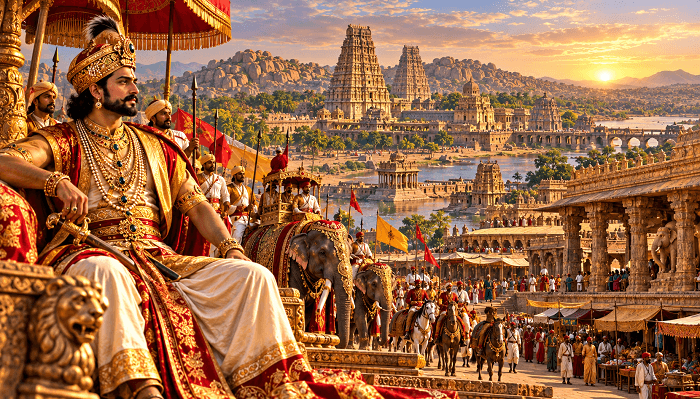
At its height, the empire controlled most of South India, extending from the Krishna River in the north to Cape Comorin in the south. Its capital, Vijayanagara (modern Hampi), was described by foreign travelers as one of the largest and richest cities in the world. This chapter examines the origin, political history, administration, economy, society, religion, cultural achievements, and decline of the Vijayanagara Empire, emphasizing its significance in Indian history.
1. Historical Background and Foundation
Political Conditions in South India
By the early 14th century, South India faced:
-
Repeated invasions by the Delhi Sultanate
-
Decline of the Hoysalas, Kakatiyas, and Yadavas
-
Political instability and economic disruption
These invasions threatened:
-
Hindu religious institutions
-
Temple economies
-
Local ruling elites
Foundation of the Empire (1336 CE)
The Vijayanagara Empire was founded by Harihara I and Bukka Raya I, who were originally associated with the Hoysala court.
Key influences:
-
Guidance of the sage Vidyaranya
-
Desire to resist Islamic expansion
-
Restoration of political stability
The capital was established on the banks of the Tungabhadra River, in a naturally fortified region.
2. Dynasties of the Vijayanagara Empire
The empire was ruled by four major dynasties:
-
Sangama Dynasty (1336–1485)
-
Saluva Dynasty (1485–1505)
-
Tuluva Dynasty (1505–1570)
-
Aravidu Dynasty (1570–1646)
Sangama Dynasty
Early rulers like:
-
Harihara I
-
Bukka Raya I
-
Deva Raya I and II
consolidated territory, strengthened administration, and promoted Hindu culture.
Deva Raya II expanded the empire and maintained diplomatic relations with Sri Lanka, Burma, and Persia.
Saluva and Tuluva Dynasties
The Tuluva dynasty marked the golden age of Vijayanagara.
Krishnadevaraya (1509–1529)
Krishnadevaraya was the greatest ruler of the empire.
Achievements:
-
Defeated Deccan Sultanates
-
Expanded empire into Odisha
-
Promoted agriculture and trade
-
Patronized arts and literature
His reign represented political stability, military success, and cultural brilliance.
3. Administration and Governance
Central Administration
The king was the supreme authority, assisted by:
-
Council of ministers
-
Military commanders
-
Provincial governors (Nayakas)
The ruler upheld dharma, ensuring justice and social order.
Provincial Administration (Nayankara System)
-
Empire divided into provinces (rajyas)
-
Governed by Nayakas
-
Nayakas collected revenue and maintained troops
-
System similar to feudalism but under royal control
Judicial System
-
Based on Hindu law and customs
-
Local courts handled disputes
-
Severe punishments ensured law and order
4. Military Organization
The Vijayanagara army was one of the largest in medieval India.
Components:
-
Infantry
-
Cavalry
-
War elephants
-
Artillery (later period)
Foreign mercenaries and imported horses strengthened the army.
Fortifications and watchtowers protected the capital.
5. Economy and Trade
Agriculture
Agriculture was the backbone of the economy:
-
Extensive irrigation systems
-
Tank and canal construction
-
Cultivation of rice, cotton, sugarcane, spices
The state actively supported farmers.
Trade and Commerce
Vijayanagara was a major trading power.
Internal trade:
-
Markets and fairs
-
Guilds of merchants
Overseas trade:
-
Ports like Goa, Calicut, Machilipatnam
-
Trade with Arabs, Persians, Chinese, and Europeans
Exports:
-
Spices
-
Textiles
-
Precious stones
Currency and Revenue
-
Gold coins (varaha)
-
Well-organized revenue system
-
Land tax as primary income
6. Society and Social Life
Caste System
Society was caste-based but flexible:
-
Brahmins held religious authority
-
Kshatriyas dominated administration
-
Vaishyas controlled trade
-
Shudras engaged in agriculture and crafts
Position of Women
Women enjoyed relatively better status:
-
Participation in religious rituals
-
Education among elite women
-
Royal women influenced politics
However, practices like sati and child marriage existed.
7. Religion and Religious Policy
Hindu Revival
Vijayanagara rulers strongly patronized:
-
Shaivism
-
Vaishnavism
-
Shakta traditions
Large temples received generous grants.
Religious Tolerance
Despite being a Hindu state:
-
Muslims held administrative posts
-
Mosques existed
-
Religious tolerance prevailed
Bhakti Movement
The empire supported Bhakti saints:
-
Purandara Dasa
-
Kanaka Dasa
Bhakti promoted devotion, equality, and social harmony.
8. Art, Architecture, and Culture
Architecture
Vijayanagara architecture was a blend of:
-
Chola
-
Hoysala
-
Deccan styles
Key features:
-
Massive gopurams
-
Mandapas
-
Stone pillars with yali figures
Important monuments:
-
Virupaksha Temple
-
Vittala Temple (Stone Chariot)
Literature
Languages flourished:
-
Sanskrit
-
Telugu
-
Kannada
-
Tamil
Krishnadevaraya himself authored Amuktamalyada.
Music and Dance
-
Development of Carnatic music
-
Purandara Dasa regarded as father of Carnatic music
-
Temple dance traditions flourished
9. Foreign Accounts
Foreign travelers provided valuable descriptions:
-
Domingo Paes
-
Fernao Nuniz
-
Abdur Razzaq
They praised:
-
City wealth
-
Administration
-
Cultural life
10. Decline of the Vijayanagara Empire
Battle of Talikota (1565 CE)
A coalition of Deccan Sultanates defeated Vijayanagara forces.
Consequences:
-
Destruction of capital
-
Loss of political supremacy
-
Fragmentation of empire
Later Period
The Aravidu dynasty ruled from different capitals but with reduced power.
By 1646 CE, the empire ceased to exist.
Conclusion
The Vijayanagara Empire was a pillar of South Indian civilization during medieval times. It safeguarded Hindu culture, encouraged economic prosperity, fostered artistic excellence, and maintained political stability for centuries. Even after its fall, its cultural and architectural legacy continued to shape South India.
The ruins of Hampi stand today as a monument to one of India’s greatest medieval empires, reminding us of its power, prosperity, and cultural brilliance.