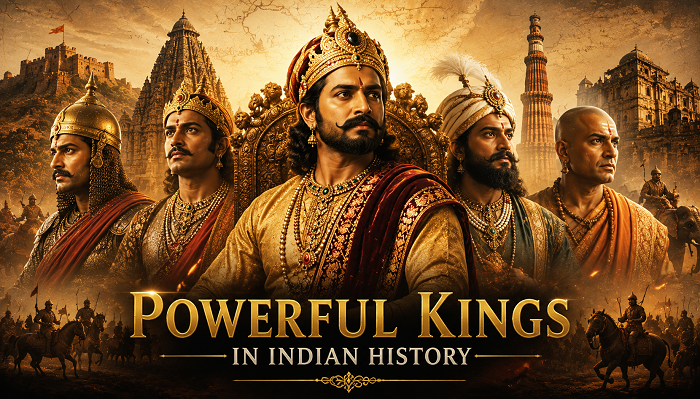
Looking across more than two millennia of Indian history, one lesson becomes clear: political power cannot be measured by battlefield victories alone. Some rulers built enormous empires, while others created administrative systems, trade networks, cultural institutions, or military structures that survived long after their deaths.
That makes ranking the powerful kings in Indian history challenging. Comparing Chandragupta Maurya with Rajaraja Chola I, for example, means comparing rulers separated by more than a thousand years and very different political environments.
Rather than creating a simple strongest-to-weakest ranking, this list examines ten rulers through the scale of their kingdoms, military achievements, governance, diplomacy, economic influence, and historical legacy.
How Do We Identify the Most Powerful Kings in Indian History?
Historians rarely judge a ruler’s importance through territory alone. A more useful approach considers several factors: the ability to establish or consolidate a kingdom, defend it, administer diverse populations, generate revenue, influence neighbouring regions, and leave institutions that endured.
Using those broader measures provides a more balanced picture of royal power in Indian history.
1. Chandragupta Maurya – Founder of the Mauryan Empire
Reign: c. 321–297 BCE
Empire: Mauryan Empire
Chandragupta Maurya established one of the first great territorial empires of the Indian subcontinent.
With the guidance traditionally associated with Chanakya, or Kautilya, Chandragupta overthrew the Nanda dynasty and consolidated power in northern India. He later fought Seleucus I Nicator, one of Alexander the Great’s successors.
The settlement that followed strengthened Mauryan control in the northwest and demonstrated the empire’s diplomatic as well as military power.
2. Ashoka – Emperor Who Transformed Mauryan Rule
Reign: c. 268–232 BCE
Empire: Mauryan Empire
Ashoka inherited and expanded an already formidable empire. His conquest of Kalinga became a defining episode of his reign.
What distinguishes Ashoka, however, is what followed. His inscriptions record his commitment to dhamma, ethical governance, welfare measures, and religious tolerance.
The survival of his rock and pillar edicts gives historians unusually direct evidence about how an ancient Indian emperor communicated political and moral ideas across a vast territory.
3. Samudragupta – Architect of Gupta Expansion
Reign: c. 335–375 CE
Empire: Gupta Empire
Samudragupta substantially expanded Gupta political influence through military campaigns and diplomacy.
Much of what historians know about his conquests comes from the Prayaga Prashasti, or Allahabad Pillar inscription, composed by his court poet Harisena.
The inscription describes defeated rulers, tributary relationships, and different forms of political control. This suggests a sophisticated strategy: direct annexation was not always necessary when tribute and allegiance could extend imperial influence.
Powerful Kings in Indian History Who Built Lasting Empires
India’s strongest rulers did more than conquer territory. Maintaining power required taxation, administration, infrastructure, alliances, and control over strategic trade routes.
4. Harshavardhana – A Powerful King in Indian History
Reign: 606–647 CE
Kingdom: Pushyabhuti/Vardhana realm
Harshavardhana established a major kingdom across much of northern India after political turmoil affected his family.
His reign is particularly valuable to historians because the Chinese Buddhist traveller Xuanzang visited India during this period and recorded observations about the kingdom.
Harsha also supported scholarship and religious institutions, showing how royal authority could combine military, political, and cultural influence.
5. Rajaraja Chola I – Builder of Chola Imperial Power
Reign: 985–1014 CE
Empire: Chola Empire
Rajaraja Chola I transformed the Chola kingdom into a major imperial power in southern India.
His campaigns extended Chola authority across parts of southern India and Sri Lanka, while naval activity strengthened influence over maritime routes.
His reign is also remembered for the magnificent Brihadisvara Temple at Thanjavur. Chola inscriptions provide valuable evidence about taxation, donations, local administration, and temple-centered economic activity.
6. Rajendra Chola I – The Emperor Who Looked Overseas
Reign: 1014–1044 CE
Empire: Chola Empire
Rajendra Chola I carried forward his father’s expansionist policies.
His armies campaigned northward toward the Ganges, while his naval expedition against the Srivijaya realm in Southeast Asia demonstrated the Cholas’ remarkable maritime capabilities.
He established Gangaikonda Cholapuram as an imperial capital, symbolizing the geographic reach and ambitions of Chola power.
7. Krishnadevaraya – Greatest Ruler of Vijayanagara
Reign: 1509–1529 CE
Empire: Vijayanagara Empire
Krishnadevaraya presided over a period of military strength and cultural achievement in southern India.
He successfully fought rival powers, including the Deccan sultanates and the Gajapati rulers of Odisha. His reign also benefited agriculture, commerce, architecture, and literary patronage.
Krishnadevaraya himself was a scholar and is associated with the Telugu work Amuktamalyada.
8. Akbar – Master of Imperial Consolidation
Reign: 1556–1605 CE
Empire: Mughal Empire
Akbar inherited the Mughal throne as a teenager and eventually created one of South Asia’s strongest imperial systems.
Military expansion was only part of his achievement. His administration incorporated diverse regional elites, including Rajput rulers, while the mansabdari system helped organize imperial service.
Revenue reforms associated with Raja Todar Mal further strengthened Mughal administration.
Akbar’s policies toward religious communities and political integration became defining characteristics of his reign.
9. Shivaji Maharaj – Founder of Maratha Power
Reign as Chhatrapati: 1674–1680 CE
Kingdom: Maratha Kingdom
Shivaji established an independent Maratha state while confronting powerful regional rivals, including the Mughal Empire and the Adil Shahi Sultanate.
He is particularly associated with strategic use of hill forts, mobile warfare, intelligence, and carefully chosen military engagements.
His coronation at Raigad in 1674 formally established his position as Chhatrapati. His political and military foundations later contributed to the wider expansion of Maratha power.
10. Maharaja Ranjit Singh – The Lion of Punjab
Reign: 1801–1839 CE
Empire: Sikh Empire
Ranjit Singh unified competing Sikh misls and established a powerful state centred in Punjab.
His empire eventually extended across strategically important territories including Lahore, Multan, Kashmir, and Peshawar.
Ranjit Singh also modernized his army, employing European officers to help train sections of his forces while maintaining a diverse administration. His ability to balance military strength with diplomacy made the Sikh Empire a major nineteenth-century power.
Common Mistakes When Comparing Indian Kings
One frequent mistake is declaring a single ruler the “greatest king of India” using modern national boundaries. Ancient and medieval kingdoms operated within very different political systems.
Another is relying entirely on legends, films, or viral social-media claims. Serious historical comparison should examine inscriptions, coins, archaeological evidence, chronicles, contemporary accounts, and modern scholarship.
For students, a useful method is to create a timeline and compare rulers according to territory, military strategy, administration, economy, diplomacy, architecture, and cultural influence. This produces a far more meaningful analysis than comparing battle counts alone.
Conclusion: Understanding Powerful Kings in Indian History
The powerful kings in Indian history built their influence in remarkably different ways. Chandragupta Maurya established imperial foundations, Ashoka experimented with ethical governance, the Cholas projected power across maritime networks, Akbar consolidated a diverse empire, Shivaji created the foundations of Maratha power, and Ranjit Singh built a formidable state in Punjab.
Their achievements should be studied in their own historical contexts rather than reduced to a simple ranking.
Explore inscriptions, archaeological sites, museums, academic histories, and primary sources to learn more about these rulers. Understanding how they governed—not simply what they conquered—offers a much richer view of India’s political history.