The modern history of India is best understood through connections rather than isolated dates. Colonial expansion changed political authority, taxation, trade, education, and administration. Those changes generated different forms of resistance, which eventually developed into organized movements for political rights and independence.
Historians generally examine this period using government records, newspapers, speeches, letters, memoirs, economic data, and accounts produced by Indian reformers and political leaders. Comparing these sources is important because colonial officials, nationalist leaders, revolutionaries, and ordinary citizens often experienced the same events differently.
From the Battle of Plassey in 1757 to independence in 1947, several turning points fundamentally changed India’s political and social landscape.
Early Modern History of India and British Expansion
European trading companies arrived in India primarily for commerce. Over time, however, the English East India Company became increasingly involved in regional politics.
The Battle of Plassey (1757) was an important turning point. Robert Clive’s forces defeated Siraj-ud-Daulah, the Nawab of Bengal. The Battle of Buxar (1764) further strengthened Company influence, and in 1765 the Company obtained Diwani rights to collect revenue in Bengal, Bihar, and Orissa.
British territorial expansion continued through warfare, alliances, annexations, and policies such as the Subsidiary Alliance and Doctrine of Lapse.
These developments mattered beyond politics. New revenue systems affected agriculture, while colonial trade policies reshaped traditional industries and India’s relationship with global markets.
The Revolt of 1857: A Turning Point
The Revolt of 1857 was one of the most significant events of nineteenth-century India. It began among Company soldiers at Meerut in May and quickly spread to important centers including Delhi, Kanpur, Lucknow, and Jhansi.
The causes were complex. Military grievances contributed to the outbreak, but political annexations, economic pressures, social anxieties, and dissatisfaction among sections of rulers, soldiers, landholders, and civilians also played important roles.
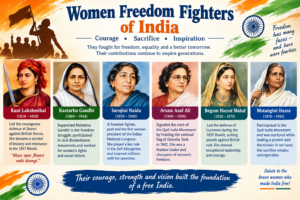
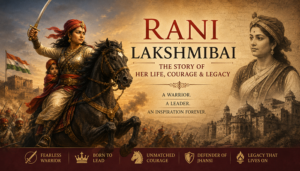
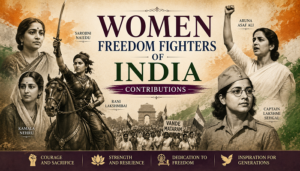
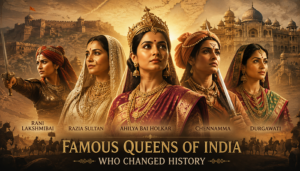
Figures associated with the uprising include Rani Lakshmibai, Bahadur Shah Zafar, Nana Sahib, Tantia Tope, and Begum Hazrat Mahal.
After the rebellion was suppressed, the British Parliament passed the Government of India Act 1858. Company rule ended, and authority was transferred directly to the British Crown.
Rise of Nationalism in the Modern History of India
The later nineteenth century witnessed the growth of political associations, newspapers, public debate, and demands for greater Indian participation in government.
The Indian National Congress was established in 1885. Early leaders such as Dadabhai Naoroji, Gopal Krishna Gokhale, and Surendranath Banerjee often used petitions, public meetings, and constitutional methods to seek reform.
The Partition of Bengal in 1905 intensified nationalist politics. The Swadeshi movement encouraged people to support Indian-made goods and boycott selected British products.
Major Movements in the Modern History of India
Mahatma Gandhi’s return to India in 1915 introduced new methods of mass political mobilization. His early campaigns at Champaran, Ahmedabad, and Kheda connected political action with local grievances.
The Non-Cooperation Movement (1920–22) encouraged withdrawal from colonial institutions. The Civil Disobedience Movement, launched in 1930, became closely associated with Gandhi’s Salt March to Dandi.
In August 1942, the Indian National Congress launched the Quit India Movement, demanding an end to British rule. Its senior leadership was quickly arrested, but protests continued in different parts of the country.
Other political forces also shaped the independence struggle, including revolutionary organizations, Subhas Chandra Bose and the Indian National Army, socialist groups, workers’ movements, princely-state movements, and the All-India Muslim League.
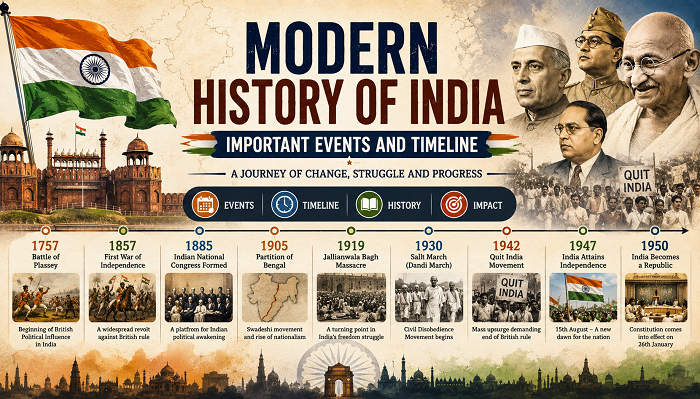
Important Timeline of Modern Indian History
A simple timeline helps readers connect major developments:
- 1757: Battle of Plassey
- 1764: Battle of Buxar
- 1857: Major uprising against Company rule
- 1858: British Crown assumes direct control
- 1885: Indian National Congress founded
- 1905: Partition of Bengal and Swadeshi agitation
- 1919: Jallianwala Bagh massacre
- 1920: Non-Cooperation Movement begins
- 1930: Dandi March and Civil Disobedience Movement
- 1942: Quit India Movement
- 1947: Independence and Partition
This chronology is useful for students because it shows how colonial expansion gradually gave way to increasingly organized resistance.
Social Reform, Education and Intellectual Change
The period was not defined by political movements alone. Reformers debated practices related to education, caste, women’s rights, widow remarriage, religion, and social inequality.
Raja Ram Mohan Roy campaigned against sati and supported educational and social reform. Ishwar Chandra Vidyasagar advocated widow remarriage and women’s education. Jyotirao and Savitribai Phule challenged caste discrimination and worked to expand education among marginalized communities.
These reform efforts demonstrate that modern India’s transformation occurred socially and intellectually as well as politically.
Common Mistakes When Studying Modern Indian History
One common mistake is treating the independence movement as the work of a single leader or organization. India’s freedom struggle involved people with different political ideas, regional experiences, and methods.
Another is memorizing dates without understanding cause and effect. For example, instead of remembering 1857 alone, examine why the revolt happened and how its aftermath changed colonial governance.
Reliable historical study should also distinguish evidence from popular myths. Primary documents are valuable, but expert historical interpretation helps explain their context and limitations.
Conclusion
The modern history of India traces a profound transformation from East India Company expansion and British Crown rule to mass nationalism, social reform, political negotiation, independence, and Partition in 1947. Events such as Plassey, the Revolt of 1857, the Swadeshi movement, Civil Disobedience, and Quit India become far more meaningful when studied as connected developments.
To deepen your understanding, explore historical maps, archival documents, biographies, speeches, newspapers, and scholarly research alongside a chronological timeline. This evidence-based approach makes modern Indian history easier to remember, evaluate, and understand.