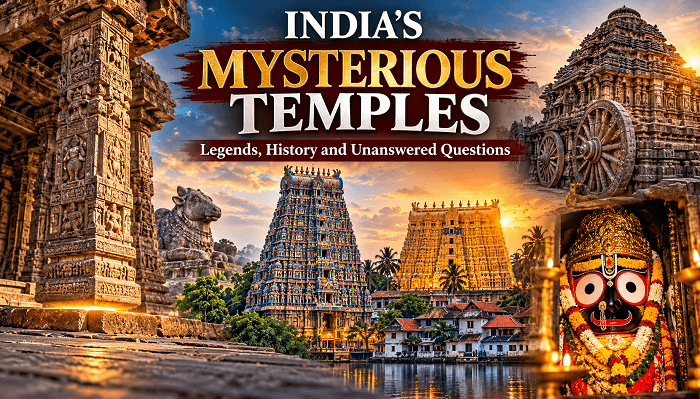
India’s Mysterious Temples: Legends, History and Unanswered Questions
India’s temples are more than places of worship. They preserve centuries of craftsmanship, religious traditions, local legends, and architectural achievements that continue to fascinate historians and travellers. Some contain unusual structural features, while others are surrounded by stories passed down through generations.
The mysterious temples in India attract curious visitors because they bring together documented history and questions that still inspire investigation. From the famous hanging pillar at Lepakshi to the ancient traditions of Padmanabhaswamy Temple, each site offers a different perspective on India’s cultural heritage.
But what makes these temples mysterious? Let’s explore five remarkable examples, separating historical evidence from popular beliefs.
1. Lepakshi Temple: The Mystery of the Hanging Pillar
Located in Andhra Pradesh, the Veerabhadra Temple at Lepakshi is renowned for its intricate sculptures, colourful ceiling paintings, and extraordinary stonework. The temple flourished during the Vijayanagara period in the 16th century.
Its most famous feature is the hanging pillar, which appears to leave a gap between its base and the floor. Visitors are often intrigued by how such a massive stone structure can look almost suspended.
What makes Lepakshi unusual?
The pillar demonstrates the remarkable construction skills of its builders. Popular accounts describe people passing thin objects beneath it to demonstrate the gap, although the pillar’s exact structural behaviour should not be judged from a brief visit.
Another attraction is the enormous monolithic Nandi statue nearby. Local legends also connect Lepakshi with Jatayu, the mythical bird from the Ramayana.
Historical perspective: Rather than assuming supernatural forces explain the pillar, examining the temple’s construction, load distribution, and architectural design offers a more reliable starting point.
2. Padmanabhaswamy Temple: Secrets Behind Its Sacred Vaults
Situated in Thiruvananthapuram, Kerala, Sree Padmanabhaswamy Temple is dedicated to Lord Vishnu, depicted reclining on the serpent Ananta. The temple has a long religious history, with traditions preserved in sacred texts and historical records.
The temple gained international attention because of the valuable objects discovered in its underground vaults during inventories in 2011.
Are all the Indian temples hidden secrets still unknown?
The temple’s vaults have inspired widespread speculation about undiscovered treasures and sealed chambers. However, it is important to distinguish documented discoveries from rumours about what might remain inside.
The mystery is especially compelling because the temple combines religious significance, royal history, and questions about the preservation of valuable objects.
Visitors should also remember that access is governed by temple rules. Respecting restrictions is essential when exploring this sacred site.
3. Jagannath Temple, Puri: Ancient Rituals and Unusual Traditions
The Jagannath Temple is one of India’s most important pilgrimage destinations. Dedicated to Lord Jagannath, a form of Lord Vishnu, it is particularly famous for the annual Rath Yatra, during which the deities are taken out in enormous ceremonial chariots.
The temple’s traditions, wooden deities, and elaborate rituals have fascinated devotees for generations.
Stories about unusual experiences at the temple circulate widely, including claims about its flag, architecture, and the behaviour of its surroundings. Some are presented as unexplained phenomena, but many lack sufficient independent evidence to establish them as scientific anomalies.
Why visit? Focus on the temple’s documented history, ritual practices, and the craftsmanship behind the Rath Yatra chariots. These provide meaningful insights into a living religious tradition without relying on sensational claims.
4. Meenakshi Temple: The Sacred Legends of Madurai
In Madurai, Tamil Nadu, the Meenakshi Amman Temple stands out for its towering gateways, colourful sculptures, and elaborate halls.
According to Hindu tradition, Goddess Meenakshi married Lord Shiva, who is worshipped here as Sundareswarar. This divine wedding remains central to the temple’s religious identity and annual celebrations.
What secrets lie within its architecture?
The temple’s many sculpted figures and architectural details reward careful observation. Its layout reflects religious symbolism and the artistic traditions that developed over centuries.
For visitors, the real fascination lies in understanding how mythology, public worship, sculpture, and urban life became closely connected. These are among the most interesting Indian temples hidden secrets to investigate through historical research rather than unsupported supernatural claims.
5. Konark Sun Temple: The Stone Chariot Mystery
The Konark Sun Temple was designed as a monumental stone chariot dedicated to Surya, the Sun God. Its carved wheels, horses, and detailed stonework make it one of India’s most extraordinary architectural achievements.
The temple’s surviving structures reveal the technical skill of medieval Indian artisans. Its original grandeur, partial ruin, and complex sculptures have also encouraged legends about lost construction techniques and mysterious forces.
Although popular stories sometimes attribute its decline to curses or supernatural events, such explanations should not replace historical investigation. Weathering, structural damage, and the temple’s documented past are more appropriate subjects for archaeological study.
Tips for Exploring Mysterious Temples in India
If you want to explore these destinations, a little preparation will make your journey more rewarding.
- Check visiting rules: Confirm opening hours, photography restrictions, dress codes, and entry requirements before travelling.
- Research the history: Consult official tourism information and credible archaeological sources.
- Separate legends from facts: Enjoy local stories while checking whether historical evidence supports them.
- Respect religious practices: Follow instructions from temple authorities and avoid disturbing worshippers.
- Plan your route: Group nearby attractions together to reduce travel time and costs.
A common mistake is believing every viral claim about an ancient temple. The most interesting discoveries often come from observing the architecture, reading inscriptions, and understanding the cultural context.
Conclusion: Discover the Mysterious Temples in India
Why the Mysterious Temples in India Deserve Your Attention
From Lepakshi’s hanging pillar to Konark’s remarkable stone chariot, the mysterious temples in India reveal the depth of the country’s architectural, artistic, and spiritual heritage. Some questions remain open to investigation, while others become clearer through historical research and scientific understanding.
The best way to appreciate these sacred places is to approach them with curiosity, respect, and a willingness to distinguish evidence from legend.
Ready to explore India’s fascinating heritage? Start planning your temple journey, discover the stories behind these extraordinary monuments, and explore more Indian history and travel guides on StoryAccount.com.