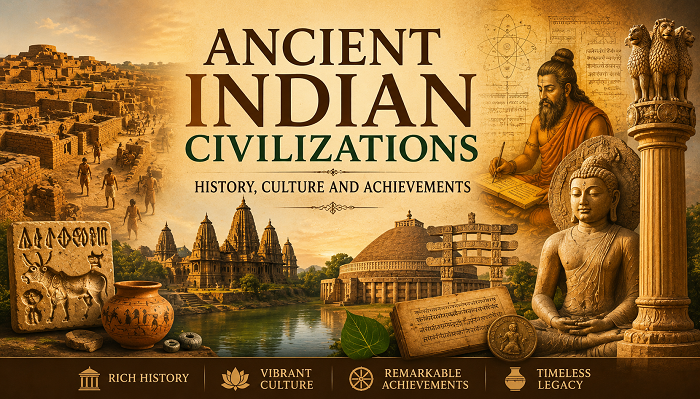
When historians study early urban societies, philosophical traditions, mathematics, medicine, and systems of governance, India occupies an important place in the discussion. The ancient Indian civilization was not a single culture that appeared at one moment. It developed through different regions, communities, kingdoms, languages, and intellectual traditions over thousands of years.
Archaeological remains from Harappa and Mohenjo-daro reveal sophisticated urban planning, while later literary and material evidence provides insight into Vedic society, expanding kingdoms, religious thought, trade, education, and scientific inquiry.
Understanding this history is valuable because many ideas associated with Indian culture today have roots in these early periods, even though they evolved considerably over time.
Origins and Development of Ancient Indian Civilization
One of the earliest major chapters is the Indus or Harappan Civilization, which flourished mainly during approximately 2600–1900 BCE. Its settlements extended across parts of present-day India and Pakistan.
Excavations at Harappa, Mohenjo-daro, Dholavira, and other sites demonstrate impressive knowledge of city planning. Many settlements featured carefully arranged streets, drainage infrastructure, standardized bricks, storage areas, craft production, and systems for managing water.
Dholavira is particularly important for understanding how communities adapted to challenging environments through sophisticated water conservation and storage.
What Makes Ancient Indian Civilization Historically Important?
The significance of ancient Indian civilization goes far beyond its age. Archaeological and textual evidence points to long-distance trade, specialized crafts, changing political institutions, philosophical debate, and increasingly complex social structures.
A useful way to study the period is to avoid treating ancient India as one uninterrupted empire. Instead, readers should examine different periods independently—the Harappan era, Vedic period, Mahajanapadas, Mauryan Empire, Gupta period, and numerous regional kingdoms.
This approach provides a more accurate picture of how Indian civilization changed over centuries.
Culture, Religion and Philosophy in Ancient Indian Civilization
The Vedic period contributed substantially to the development of religious, social, and philosophical traditions in South Asia. The Vedas became foundational texts, while later works such as the Upanishads explored questions about knowledge, consciousness, existence, and the nature of reality.
Buddhism and Jainism also emerged in ancient India and offered influential approaches to ethics, spiritual practice, non-violence, and liberation. Their ideas spread far beyond their places of origin through teachers, merchants, monasteries, and political patronage.
Ancient India was therefore not intellectually uniform. Different philosophical schools debated subjects ranging from metaphysics and logic to ethics and methods of acquiring reliable knowledge.
Major Scientific and Intellectual Achievements
Mathematics became one of ancient India’s most influential intellectual fields. Indian scholars made major contributions to numeral systems, arithmetic, algebra, geometry, and astronomical calculation.
Aryabhata, writing in the fifth and sixth centuries CE, produced important work on mathematics and astronomy. Later Indian mathematical traditions further developed systematic rules involving zero and negative numbers.
Medicine also developed through Ayurveda. Classical works associated with Charaka and Sushruta discuss diagnosis, medicinal substances, anatomy, disease management, and surgical procedures. These texts demonstrate attempts to organize medical knowledge systematically, although ancient treatments should be understood in their historical context rather than automatically equated with modern clinical medicine.
Art, Architecture and Literature
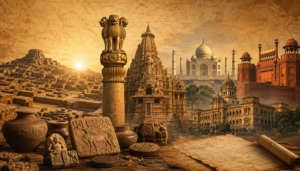
Ancient Indian art provides another window into social and religious life. The pillars associated with Emperor Ashoka, Buddhist stupas, rock-cut caves, sculptures, coins, and temple traditions illustrate changing artistic techniques and beliefs.
Sites such as Sanchi and the Ajanta caves remain particularly valuable for studying Buddhist architecture and visual culture.
Literature was equally diverse. Sanskrit, Prakrit, Pali, Tamil, and other linguistic traditions produced religious texts, poetry, philosophical works, drama, grammar, political thought, and scientific literature.
Practical Tips for Studying Ancient Indian History
Students and general readers should compare archaeology with written evidence rather than relying on a single source. Create a chronological timeline and connect important sites, rulers, texts, and developments to their approximate periods.
For example, place Harappan urbanism before the major Mauryan political expansion rather than discussing both as though they were contemporary.
Another useful technique is to use maps. Locating Dholavira, Pataliputra, Sanchi, Taxila, and other important centers makes patterns of trade, political expansion, and cultural exchange much easier to understand.
Common Mistakes to Avoid
A frequent mistake is describing every historical achievement as belonging to the same period. Ancient Indian history covers a vast span of time, and developments occurred in different centuries and regions.
Readers should also be cautious about sensational claims circulated online. Reliable understanding comes from comparing archaeological findings, inscriptions, manuscripts, peer-reviewed scholarship, and research from recognized historical institutions.
Conclusion
The ancient Indian civilization represents a long and diverse historical journey encompassing urban development, philosophy, religion, mathematics, medicine, literature, governance, trade, and artistic expression. From Harappan cities to later intellectual and cultural traditions, ancient India contributed ideas and institutions whose influence can still be studied today.
For a deeper understanding, explore individual archaeological sites, primary texts, museum collections, and scholarly histories rather than stopping at broad summaries. Each offers another piece of the complex story of India’s ancient past.