Indian history becomes far more interesting when we look beyond dynasties and battles to examine the people who actually exercised power. Among them were women who governed kingdoms, commanded armies, negotiated political crises, supported architecture and trade, and resisted invading or colonial forces.
The famous queens of India were not all rulers in the same sense. Some governed independently, others acted as regents, and several emerged as military leaders during moments of extraordinary political instability. Their stories span centuries and regions, from Delhi and Gondwana to Kittur, Travancore and Jhansi.
Looking at what these women actually accomplished, rather than relying solely on legends, gives us a richer understanding of women’s political leadership in Indian history.
Why Are the Famous Queens of India Historically Important?
Queens often operated within political structures dominated by men, yet some managed to exercise considerable authority. Their influence can be seen in military strategy, taxation, diplomacy, succession, public works and cultural patronage.
Historians assess these rulers using inscriptions, chronicles, coins, administrative records, architecture and other surviving evidence. Such sources also help distinguish documented achievements from stories added to popular memory centuries later.
Here are some of India’s most remarkable queens and women rulers.
1. Razia Sultan – A Woman on the Delhi Throne
Razia, who ruled the Delhi Sultanate from 1236 to 1240, occupies a distinctive place in medieval Indian history. Although commonly called Razia Sultana today, historical accounts indicate that she ruled as a sovereign rather than simply as a royal consort.
She succeeded her father, Iltutmish, but faced resistance from sections of the Turkish nobility.
Her reign was short, yet her attempt to exercise direct sovereign authority challenged established political expectations and made her one of medieval India’s most notable female rulers.
2. Rani Durgavati – Defender of Gondwana
Rani Durgavati became associated with the Gond kingdom after marrying Dalpat Shah. Following his death, she governed as regent for their young son, Vir Narayan.
Her administration is remembered alongside her military leadership.
In 1564, Mughal forces led by Asaf Khan invaded her territory. Durgavati resisted despite facing a stronger army and died during the conflict rather than surrender.
Her story remains particularly important to the history of central India.
3. Rani Abbakka Chowta – The Queen Who Resisted the Portuguese
Among the famous queens of India, Abbakka Chowta deserves greater recognition for her resistance to Portuguese expansion on India’s western coast.
Associated with Ullal in present-day Karnataka, she resisted Portuguese attempts to dominate the region and its maritime trade.
Accounts of her struggle reflect the importance of coastal politics and commerce during the sixteenth century. Her resistance also reminds us that India’s encounters with European powers began centuries before British colonial dominance.
Famous Queens of India Known for Courageous Leadership
Some queens became historically significant because a political crisis forced them to assume responsibilities normally controlled by male rulers.
Rani Lakshmibai: One of the Most Famous Queens of India
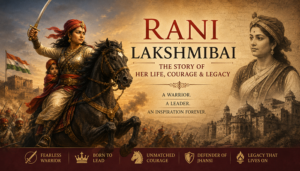
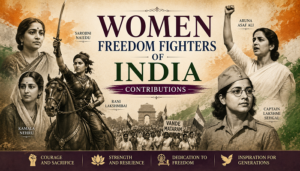
Rani Lakshmibai of Jhansi became one of the defining figures of the Revolt of 1857.
After her husband Maharaja Gangadhar Rao died, the East India Company refused to recognize their adopted son Damodar Rao as the legitimate successor and annexed Jhansi under the Doctrine of Lapse.
During the uprising of 1857–58, Lakshmibai eventually became a leading figure in armed resistance. She defended Jhansi against British forces, escaped after the city’s fall and continued fighting alongside other rebel leaders.
She died near Gwalior on 18 June 1858. Her courage subsequently made her an enduring symbol of resistance to colonial rule.
5. Ahilyabai Holkar – A Remarkable Administrator
Not every powerful queen built her reputation through warfare.
Ahilyabai Holkar ruled the Malwa kingdom from 1767 until 1795 and became respected for her administration, public works and religious patronage.
From Maheshwar, she governed her territory while supporting the construction and restoration of temples, ghats, wells and other facilities in different parts of India.
Her reign demonstrates an important historical principle: effective governance can leave a legacy just as significant as military conquest.
6. Kittur Rani Chennamma – An Early Anti-British Leader
Decades before the Revolt of 1857, Kittur Rani Chennamma resisted British interference in her kingdom.
Following succession problems after the deaths of her husband and son, she sought recognition for an adopted heir. The East India Company refused to accept the succession.
Conflict followed in 1824. Although Chennamma’s forces initially achieved success, the British ultimately defeated the resistance. She was captured and imprisoned at Bailhongal, where she died in 1829.
Her struggle makes her an important early figure in resistance to Company expansion.
7. Begum Hazrat Mahal – Leading Awadh’s Resistance
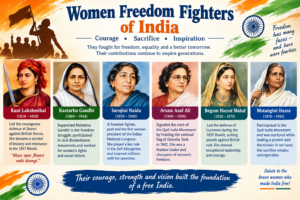
Begum Hazrat Mahal played a major political role during the uprising of 1857 after her husband, Wajid Ali Shah, had been exiled following the British annexation of Awadh.
During the rebellion, her son Birjis Qadr was proclaimed ruler, while Hazrat Mahal helped lead resistance in Lucknow.
After British forces regained control, she eventually took refuge in Nepal.
Her contribution shows how women could become central political actors during periods when established systems of authority collapsed.
8. Rani Velu Nachiyar – Resistance in Southern India
Velu Nachiyar was an eighteenth-century ruler associated with Sivaganga in present-day Tamil Nadu.
After her husband was killed during conflict involving East India Company forces and their allies, she spent years building alliances and preparing to regain her kingdom.
She eventually returned to power.
Her story is especially valuable because it places organized resistance to Company influence in southern India well before the major nineteenth-century uprisings.
9. Rani Gaidinliu – Young Leader Against British Rule
Rani Gaidinliu came from the Zeliangrong Naga community and joined the movement associated with Haipou Jadonang while still very young.
After Jadonang’s execution, she emerged as an important leader opposing British authority.
She was arrested in 1932 and sentenced to life imprisonment. Jawaharlal Nehru later met her in prison and referred to her as the “Rani” of the Nagas.
She was released after Indian independence in 1947.
10. Rani Sethu Lakshmi Bayi – Reform and Administration
Rani Sethu Lakshmi Bayi served as Regent Maharani of Travancore between 1924 and 1931.
Unlike warrior queens remembered primarily for battlefield resistance, her historical significance lies in governance and social change. Her regency was associated with administrative modernization and reforms affecting women’s lives and public institutions.
Including rulers like her provides a broader understanding of female leadership beyond warfare.
Common Mistakes When Studying Indian Queens
One common mistake is treating every royal woman as a warrior queen. Their influence was much more diverse.
Ahilyabai Holkar’s administrative legacy, for example, should not be judged using the same criteria as Lakshmibai’s military leadership.
Another problem is relying on movies and viral stories as historical evidence. Popular retellings frequently combine fact, folklore and later interpretation.
For better research, compare museum resources, inscriptions, academic histories, archival documents and archaeological evidence. Creating a timeline of each ruler’s reign, kingdom, major challenge and contribution is also a practical way for students to understand how their historical roles differed.
Conclusion: Remembering the Famous Queens of India
The famous queens of India demonstrate that women’s political influence appeared across many periods of the subcontinent’s history.
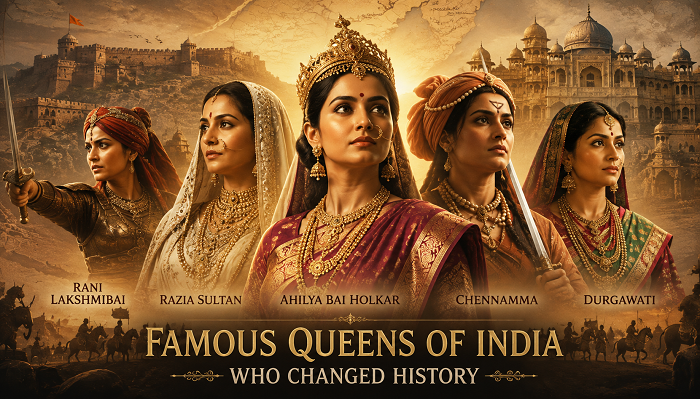
Razia exercised sovereign authority in Delhi, Durgavati defended Gondwana, Abbakka challenged Portuguese ambitions, Ahilyabai became known for governance, Chennamma resisted Company expansion, and Lakshmibai became an enduring symbol of the 1857 uprising.
Their achievements deserve to be understood through evidence rather than legend alone.
Explore credible biographies, historical museums, archives and monuments connected with these remarkable women. Their stories offer a deeper understanding of how leadership, resistance and governance shaped India’s past.