Political Authority, Administrative Innovation, Cultural Synthesis, and Social Transformation
Introduction
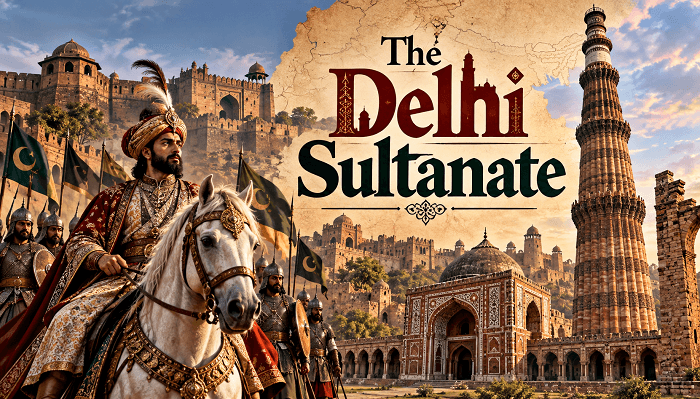
The establishment of the Delhi Sultanate in 1206 CE marked a decisive turning point in Indian history. For the first time, a series of Islamic dynasties ruled large parts of the Indian subcontinent from Delhi, introducing new systems of governance, military organization, architecture, culture, and social interaction. The Delhi Sultanate laid the foundations of medieval Indian polity and prepared the ground for the rise of the Mughal Empire in the sixteenth century.
Spanning more than three centuries, the Delhi Sultanate was not a monolithic regime but a succession of five distinct dynasties—the Slave (Mamluk), Khalji, Tughlaq, Sayyid, and Lodi dynasties. Despite frequent political instability, invasions, and rebellions, the Sultanate profoundly reshaped India’s political structure and cultural landscape.
This chapter examines the origins, dynastic developments, administrative system, economy, society, religion, culture, and decline of the Delhi Sultanate, highlighting its historical significance and enduring legacy.
1. Background: The Turkish Invasions and the Road to Delhi
Early Muslim Contacts with India
Arab traders had interacted with India since ancient times, but political incursions began in the late 10th century with the Turkish invasions from Central Asia. These invasions were driven by:
-
Expansionist ambitions
-
Religious zeal
-
Economic motivations
-
Strategic control of trade routes
Muhammad of Ghazni
Between 1000 and 1027 CE, Mahmud of Ghazni conducted several raids into India:
-
Targeted wealthy temples and cities
-
Did not establish permanent rule
-
Introduced Islam to northern India politically
His invasions weakened Indian kingdoms and paved the way for later conquest.
Muhammad of Ghor
Unlike Ghazni, Muhammad of Ghor aimed to establish permanent political control. His general Qutbuddin Aibak defeated Prithviraj Chauhan in the Second Battle of Tarain (1192 CE), marking the beginning of Muslim rule in North India.
2. Foundation of the Delhi Sultanate (1206 CE)
After Muhammad of Ghor’s death in 1206 CE, Qutbuddin Aibak, a former slave, declared himself Sultan and founded the Delhi Sultanate.
This event marked:
-
The end of fragmented Turkish rule
-
The beginning of a centralized Islamic state in India
-
Delhi’s emergence as a political capital
3. The Slave (Mamluk) Dynasty (1206–1290 CE)
Qutbuddin Aibak (1206–1210)
-
Founded the Sultanate
-
Began construction of Qutb Minar
-
Ruled briefly and died in an accident
Iltutmish (1211–1236)
Iltutmish was the true consolidator of the Delhi Sultanate.
Achievements:
-
Secured recognition from the Abbasid Caliph
-
Organized the iqta system
-
Introduced a stable currency (silver tanka)
-
Defended India against Mongol invasions
Razia Sultana (1236–1240)
-
First and only female ruler of the Sultanate
-
Faced opposition from nobles
-
Symbolized challenges to orthodox norms
Balban (1266–1287)
Balban strengthened royal authority by:
-
Introducing theory of kingship
-
Crushing nobles and rebellions
-
Emphasizing law and order
4. The Khalji Dynasty (1290–1320 CE)
Alauddin Khalji (1296–1316)
Alauddin Khalji was the most powerful ruler of the Delhi Sultanate.
Military Achievements
-
Repelled Mongol invasions
-
Conquered Gujarat, Malwa, Rajasthan
-
Subjugated the Deccan (Yadavas, Kakatiyas, Hoysalas)
Administrative Reforms
Alauddin introduced revolutionary measures:
-
Market control system to regulate prices
-
Direct collection of land revenue
-
Strict control over nobles
-
Large standing army
These reforms strengthened the Sultanate economically and militarily.
5. The Tughlaq Dynasty (1320–1414 CE)
Ghiyasuddin Tughlaq
-
Restored order after Khalji chaos
-
Strengthened fortifications
Muhammad bin Tughlaq
One of the most controversial rulers in Indian history.
His ambitious but failed experiments included:
-
Transfer of capital from Delhi to Daulatabad
-
Introduction of token currency
-
Excessive taxation in the Doab
Despite his intelligence, poor execution led to revolts and instability.
Firoz Shah Tughlaq
-
Focused on welfare measures
-
Built canals, hospitals, and cities
-
Encouraged agriculture
However, his policies weakened central authority.
6. Sayyid and Lodi Dynasties (1414–1526 CE)
These were weaker dynasties ruling a shrinking Sultanate.
Lodi Dynasty
-
Afghan origin
-
Introduced greater Afghan participation
-
Internal conflicts weakened the state
The dynasty ended with Ibrahim Lodi’s defeat by Babur in the First Battle of Panipat (1526).
7. Administrative System of the Delhi Sultanate
Central Administration
The Sultan was the supreme authority, assisted by:
-
Wazir (finance)
-
Diwan-i-Arz (military)
-
Qazi (judiciary)
-
Barid (intelligence)
Iqta System
-
Officers were assigned land (iqta)
-
Revenue collected in lieu of salary
-
Helped maintain army and administration
Judicial System
-
Based on Islamic law (Sharia)
-
Qazis administered justice
-
Hindu customs allowed in civil matters
8. Economy and Trade
Agriculture
-
Land revenue was the main source of income
-
Introduction of measurement and assessment reforms
-
Irrigation expanded
Trade and Urbanization
-
Growth of cities: Delhi, Multan, Lahore
-
Trade with Central Asia, Middle East, China
-
Gold and silver currency promoted commerce
9. Society and Religion
Social Structure
-
Society became culturally diverse
-
Interaction between Hindus and Muslims
-
Emergence of composite culture
Position of Hindus
-
Allowed to practice religion
-
Paid jizya (poll tax)
-
Participated in administration at lower levels
Women
-
Limited public roles
-
Elite women had some influence
-
Practices like purdah increased
10. Cultural Developments
Architecture
The Sultanate introduced Indo-Islamic architecture:
-
Arches
-
Domes
-
Minarets
Major monuments:
-
Qutb Minar
-
Alai Darwaza
-
Tughlaqabad Fort
Literature and Language
-
Persian became official language
-
Development of Urdu
-
Historical chronicles flourished
Sufism and Bhakti
Sufi saints:
-
Nizamuddin Auliya
-
Moinuddin Chishti
Promoted tolerance, love, and devotion, influencing Indian society deeply.
11. Causes of Decline
-
Weak successors
-
Economic strain
-
Rebellions and invasions (Timur)
-
Afghan-Turkish conflicts
-
Rise of regional powers
Conclusion
The Delhi Sultanate was a transformative phase in Indian history. It introduced new political ideas, administrative systems, military organization, and cultural traditions. Despite its limitations and conflicts, the Sultanate created a composite Indo-Islamic civilization that shaped the medieval Indian world and prepared the stage for the Mughal Empire.
Its legacy endures in India’s architecture, language, governance traditions, and cultural diversity.