Spiritual Democracy, Social Reform, and the Making of a Composite Culture
Introduction
The Bhakti and Sufi movements represent one of the most profound spiritual and social transformations in medieval Indian history. Emerging between the eighth and seventeenth centuries, these movements transcended rigid religious boundaries, challenged social hierarchies, and emphasized personal devotion, love, tolerance, and inner spirituality over ritualism and dogma.
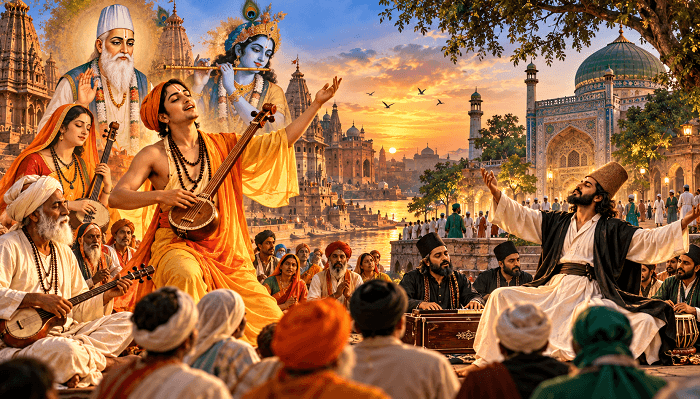
While Bhakti arose within the framework of Hinduism and emphasized devotion (bhakti) to a personal god, Sufism developed within Islam as a mystical tradition focusing on divine love and spiritual union with God. Despite their different religious origins, both movements shared striking similarities in their humanistic outlook, rejection of orthodoxy, and appeal to the common people.
Together, Bhakti and Sufi traditions played a crucial role in shaping India’s composite culture, promoting social harmony, linguistic growth, and ethical values that continue to influence Indian society.
1. Historical Background
Social and Religious Conditions
By the early medieval period, Indian society was marked by:
-
Rigid caste divisions
-
Dominance of Brahmanical rituals
-
Social inequality
-
Religious formalism
Similarly, within Islam:
-
Legalistic interpretations dominated
-
Rulers and ulema emphasized orthodoxy
-
Spiritual needs of the masses were often neglected
These conditions created fertile ground for spiritual reform movements that emphasized inner faith over external practices.
Philosophical Roots
-
Bhakti drew inspiration from the Upanishads, Bhagavad Gita, and Puranas
-
Sufism evolved from Islamic mysticism, influenced by Persian spiritual traditions
Both traditions emphasized:
-
Love for God
-
Renunciation of ego
-
Equality of all human beings
-
Moral living
2. The Bhakti Movement
Origins and Development
The Bhakti movement began in South India between the 7th and 9th centuries CE, later spreading to North India.
Early Bhakti saints:
-
Alvars (devotees of Vishnu)
-
Nayanars (devotees of Shiva)
They composed devotional hymns in Tamil, making religion accessible to the masses.
Core Principles of Bhakti
-
Intense personal devotion to God
-
Salvation through love, not rituals
-
Rejection of caste discrimination
-
Use of vernacular languages
-
Guru-disciple tradition
Bhakti emphasized emotional surrender rather than intellectual theology.
Saguna and Nirguna Bhakti
Bhakti developed into two major philosophical streams:
Saguna Bhakti
-
Worship of God with form and attributes
-
Associated with Rama and Krishna
-
Emphasized temple worship and idols
Saints:
-
Ramanuja
-
Tulsidas
-
Mirabai
Nirguna Bhakti
-
Worship of a formless, abstract God
-
Rejected idol worship
-
Influenced by monistic philosophy
Saints:
-
Kabir
-
Guru Nanak
-
Dadu Dayal
Major Bhakti Saints
Ramanuja (11th century)
-
Philosopher of Vishishtadvaita
-
Promoted Vaishnavism
-
Emphasized devotion with knowledge
Kabir (15th century)
-
Criticized religious hypocrisy
-
Rejected caste and ritualism
-
Bridged Hindu-Muslim traditions
Mirabai
-
Devotee of Krishna
-
Symbol of spiritual freedom and devotion
-
Challenged patriarchal norms
Chaitanya Mahaprabhu
-
Popularized Krishna Bhakti in Bengal
-
Emphasized ecstatic devotion
3. The Sufi Movement
Origins of Sufism
Sufism originated within Islam as a mystical path emphasizing:
-
Inner purification
-
Love for God
-
Spiritual discipline
Sufis sought closeness to God through meditation, music, poetry, and service.
Arrival of Sufism in India
Sufism entered India around the 11th century through:
-
Traders
-
Missionaries
-
Migrating mystics
Sufi saints established khanqahs (spiritual centers) across India.
Major Sufi Orders in India
Chishti Order
-
Most influential in India
-
Emphasized love, tolerance, and service
-
Avoided political power
Prominent saints:
-
Khwaja Moinuddin Chishti
-
Nizamuddin Auliya
Suhrawardi Order
-
Accepted state patronage
-
Active in Punjab and Bengal
Qadiri and Naqshbandi Orders
-
Spread during Mughal period
-
Naqshbandis emphasized orthodoxy
Sufi Teachings
-
God is love
-
Humanity is one
-
Service to people is service to God
-
Spiritual equality
Sufis welcomed people of all religions to their shrines.
4. Bhakti–Sufi Interaction and Syncretism
Shared Ideals
Both movements emphasized:
-
Devotion over ritual
-
Equality of all humans
-
Moral living
-
Inner spirituality
This common ground encouraged inter-religious dialogue.
Cultural Synthesis
-
Shared devotional music traditions (bhajans, qawwalis)
-
Development of Urdu and Hindi
-
Mixed philosophical ideas
Saints like Kabir embodied this synthesis.
Popular Religious Practices
-
Pilgrimage to dargahs
-
Collective singing
-
Storytelling traditions
These practices fostered communal harmony.
5. Social Impact
Challenge to Caste System
Bhakti and Sufi saints:
-
Condemned caste discrimination
-
Welcomed lower castes and women
-
Emphasized spiritual equality
Though caste did not disappear, its moral legitimacy weakened.
Empowerment of Women
-
Mirabai, Lalleshwari, and others gained prominence
-
Women participated actively in devotional traditions
6. Political and Economic Context
Rulers often patronized saints to:
-
Gain legitimacy
-
Promote social harmony
Sufi shrines became:
-
Centers of charity
-
Cultural hubs
-
Economic institutions
7. Literature, Music, and Language
Vernacular Literature
Bhakti saints composed in:
-
Hindi
-
Bengali
-
Marathi
-
Tamil
-
Kannada
This democratized religious knowledge.
Music and Performance
-
Bhajans
-
Kirtans
-
Qawwalis
Music became a spiritual tool.
8. Criticism and Limitations
-
Movements did not dismantle caste system completely
-
Over time, rituals crept back
-
Some sects became institutionalized
Despite limitations, their moral influence endured.
9. Legacy and Historical Significance
The Bhakti and Sufi movements:
-
Promoted religious tolerance
-
Shaped India’s pluralistic culture
-
Influenced later reform movements
-
Contributed to national integration
They humanized religion and made spirituality accessible.
Conclusion
The Bhakti and Sufi movements were not merely religious phenomena but powerful social and cultural revolutions. By emphasizing love, devotion, and humanity, they softened rigid social structures and fostered a shared spiritual heritage. Their teachings transcended religious boundaries and laid the foundations for India’s enduring tradition of pluralism and tolerance.
In the medieval world of conflict and hierarchy, Bhakti and Sufi saints offered a vision of unity, reminding humanity that the path to the divine lies through compassion, humility, and love.