Imperial Authority, Administrative Excellence, Cultural Synthesis, and the Making of Early Modern India
Introduction
The Mughal Empire represents one of the most significant and transformative phases in Indian history. Established in 1526 CE by Babur, the Mughals created a vast empire that unified much of the Indian subcontinent under a centralized authority. Over nearly two centuries, Mughal rulers built a state characterized by efficient administration, military strength, economic prosperity, cultural brilliance, and religious diversity.
The Mughal period marked the transition from medieval to early modern India. It witnessed the consolidation of political power, expansion of agriculture and trade, flourishing of art and architecture, and the emergence of a rich composite Indo-Islamic culture. This chapter traces the foundation, expansion, administration, society, economy, culture, and decline of the Mughal Empire, highlighting its enduring legacy in Indian history.
1. Background and Foundation of the Mughal Empire
Central Asian Origins
The Mughals were of Turko-Mongol origin, tracing their lineage to:
-
Timur (Tamerlane) on Babur’s paternal side
-
Genghis Khan on his maternal side
Babur inherited the traditions of Central Asian kingship, combining military skill with a refined cultural outlook.
Babur and the First Battle of Panipat (1526)
Babur defeated Ibrahim Lodi, the last ruler of the Delhi Sultanate, at the First Battle of Panipat.
Key factors in Babur’s victory:
-
Use of artillery and firearms
-
Superior military tactics
-
Weak Afghan leadership
This battle marked the end of the Delhi Sultanate and the beginning of Mughal rule in India.
2. Babur (1526–1530): The Founder
Babur:
-
Established Mughal authority in North India
-
Defeated Rajput confederacy under Rana Sanga at Khanwa (1527)
-
Introduced gunpowder warfare
Though his reign was short, Babur laid the military foundations of the empire. His autobiography, Tuzuk-i-Baburi, is a valuable historical source.
3. Humayun (1530–1556): Struggle and Restoration
Humayun faced:
-
Internal rebellions
-
Afghan opposition under Sher Shah Suri
He was defeated and temporarily expelled from India in 1540.
Sher Shah Suri and the Sur Interregnum
Sher Shah Suri established an efficient administration:
-
Land revenue reforms
-
Road construction (Grand Trunk Road)
-
Standardized currency
His policies deeply influenced later Mughal administration.
Humayun’s Return
With Persian support, Humayun regained the throne in 1555 but died soon after, leaving the empire to his young son Akbar.
4. Akbar (1556–1605): Architect of the Mughal Empire
Akbar was the greatest Mughal ruler and the true builder of the empire.
Military Expansion
Akbar:
-
Conquered Rajputana, Gujarat, Bengal, and the Deccan
-
Integrated Rajputs into Mughal nobility
-
Established political stability
Administrative Reforms
Akbar introduced a highly centralized system:
-
Mansabdari system: ranking of nobles
-
Jagirdari system: assignment of revenue lands
-
Reorganized provinces (subas)
Revenue System
Under Todar Mal, Akbar introduced:
-
Scientific land measurement
-
Fixed revenue assessment
-
Cash revenue system
Religious Policy
Akbar followed a policy of religious tolerance:
-
Abolished jizya
-
Appointed non-Muslims to high offices
-
Encouraged interfaith dialogue
His experiment with Din-i-Ilahi reflected his quest for spiritual unity.
5. Jahangir (1605–1627): Justice and Stability
Jahangir:
-
Maintained imperial stability
-
Known for his sense of justice
-
Encouraged arts and painting
He was influenced by his wife Nur Jahan, who played a major political role.
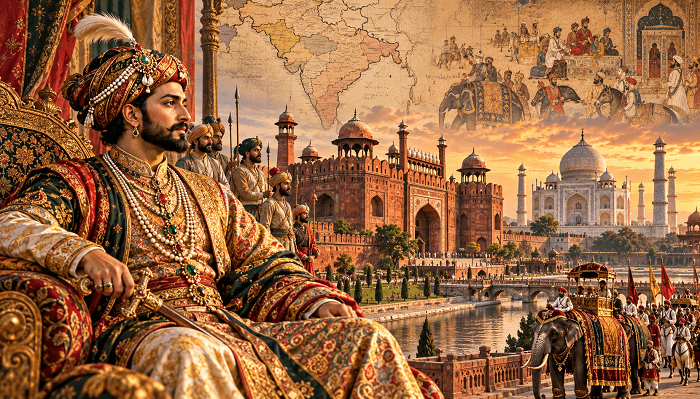
6. Shah Jahan (1628–1658): The Age of Splendor
Shah Jahan’s reign marked the golden age of Mughal architecture.
Architectural Achievements
-
Taj Mahal
-
Red Fort (Delhi)
-
Jama Masjid
Administration and Economy
-
Strong central control
-
Prosperous agriculture and trade
-
Lavish court life increased expenses
7. Aurangzeb (1658–1707): Expansion and Strain
Aurangzeb expanded the empire to its greatest territorial extent.
Military Campaigns
-
Conquest of Deccan Sultanates
-
Long wars against Marathas
Religious Policy
Aurangzeb:
-
Reimposed jizya
-
Followed orthodox Islam
-
Restricted some non-Islamic practices
These policies alienated sections of society.
Administrative Challenges
-
Continuous warfare
-
Overextension of resources
-
Rising rebellions
8. Mughal Administration
Central Government
The emperor was supreme, assisted by:
-
Wazir (finance)
-
Mir Bakshi (military)
-
Sadr-us-Sudur (religious affairs)
Provincial Administration
Empire divided into subas, governed by:
-
Subedar
-
Diwan
-
Faujdars
9. Economy and Trade
Agriculture
-
Backbone of economy
-
Expansion of cultivation
-
Cash crops like cotton and indigo
Trade and Commerce
-
India was a major exporter of textiles
-
Trade with Europe, Central Asia, and Southeast Asia
-
Growth of urban centers
Currency
-
Standardized silver rupee
-
Stable monetary system
10. Society and Culture
Social Structure
-
Caste system continued
-
Growth of urban elite
-
Interaction between communities
Women
-
Royal women influenced politics
-
Practices like purdah prevalent
-
Education among elite women
11. Art, Architecture, and Literature
Architecture
Mughal architecture blended:
-
Persian
-
Indian
-
Central Asian styles
Painting
-
Miniature painting flourished
-
Themes: court life, nature, battles
Literature
-
Persian as court language
-
Growth of Urdu
-
Historical chronicles produced
12. Decline of the Mughal Empire
After Aurangzeb:
-
Weak successors
-
Economic strain
-
Rise of regional powers
-
European intervention
By the 18th century, Mughal authority had largely collapsed.
Conclusion
The Mughal Empire was a turning point in Indian history. It created political unity, administrative efficiency, economic prosperity, and cultural synthesis. Despite its decline, Mughal institutions, art, architecture, and governance left a lasting legacy that shaped modern India.
The Mughal era stands as a testament to India’s ability to absorb diverse influences and create a rich, pluralistic civilization.