Fragmentation of Empire and the Emergence of New Political Forces in India
Introduction
The death of Aurangzeb in 1707 CE marked a decisive turning point in Indian history. With the weakening of central Mughal authority, India entered a new political phase characterized by the rise of powerful regional states. Among these emerging powers, the Marathas rose to prominence as the most formidable force, challenging Mughal supremacy and establishing a vast confederacy that dominated much of the Indian subcontinent during the eighteenth century.
This chapter examines the origins, expansion, administration, and decline of Maratha power, along with the emergence of other regional states such as the Nizam of Hyderabad, Nawabs of Bengal and Awadh, Mysore, Sikhs, and Rajputs. Together, these regional powers reshaped Indian politics and laid the groundwork for the eventual rise of European colonial rule.
1. Decline of the Mughal Empire and Political Fragmentation
Causes of Mughal Decline
Several factors contributed to the weakening of the Mughal Empire:
-
Weak successors after Aurangzeb
-
Continuous wars and financial exhaustion
-
Breakdown of administrative machinery
-
Rise of powerful zamindars and nobles
-
Regional revolts and invasions
As imperial control loosened, provincial governors and military leaders asserted autonomy, transforming Mughal provinces into independent or semi-independent states.
2. Origins of the Marathas
Geographical and Social Background
The Marathas emerged from the Deccan plateau, a region characterized by:
-
Rugged terrain
-
Scattered forts
-
Warrior peasantry
This environment favored guerrilla warfare and decentralized political organization.
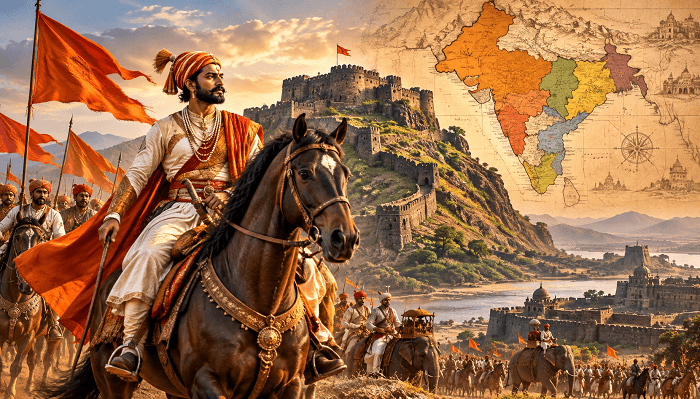
Shivaji (1630–1680): Founder of Maratha Power
The rise of the Marathas is inseparable from Chhatrapati Shivaji Maharaj, who laid the foundations of Maratha sovereignty.
Achievements of Shivaji
-
Established an independent Maratha kingdom (1674)
-
Built a strong navy
-
Developed efficient administration
-
Promoted religious tolerance
-
Introduced the Ashta Pradhan council
Shivaji’s coronation symbolized the emergence of indigenous resistance against Mughal domination.
3. Marathas after Shivaji: Struggle and Survival
After Shivaji’s death, the Marathas faced:
-
Mughal invasions
-
Internal succession disputes
Despite temporary setbacks, they survived due to:
-
Strong military traditions
-
Local support
-
Flexible political structures
4. The Peshwas and the Expansion of the Maratha Confederacy
Rise of the Peshwas
The transformation of the Marathas into a major imperial power occurred under the Peshwas, hereditary prime ministers.
Key Peshwas:
-
Balaji Vishwanath
-
Baji Rao I
-
Balaji Baji Rao
Baji Rao I (1720–1740): The Great Expansionist
Baji Rao I:
-
Extended Maratha influence across central and northern India
-
Defeated Mughal armies repeatedly
-
Popularized fast cavalry warfare
He famously declared that the Maratha flag would fly from the Indus to the southern seas.
Maratha Confederacy
The Marathas developed a confederate structure, with powerful chiefs ruling semi-independent territories:
-
Scindias of Gwalior
-
Holkars of Indore
-
Gaekwads of Baroda
-
Bhonsles of Nagpur
This system allowed rapid expansion but weakened central control.
5. Maratha Administration and Revenue System
Chauth and Sardeshmukhi
The Marathas collected:
-
Chauth (25% of revenue)
-
Sardeshmukhi (10% surcharge)
These taxes financed the Maratha military and administration.
Military Organization
-
Highly mobile cavalry
-
Guerrilla tactics
-
Fort-based defense
-
Limited artillery compared to Europeans
Limitations of Administration
-
Lack of centralized bureaucracy
-
Heavy taxation burdened peasants
-
Conflicts among Maratha chiefs
6. The Third Battle of Panipat (1761)
The Third Battle of Panipat was a turning point.
Opponents
-
Marathas vs Ahmad Shah Abdali (Afghan ruler)
Outcome
-
Crushing defeat of the Marathas
-
Loss of leadership and morale
-
End of Maratha expansion in North India
Though the Marathas recovered politically, their imperial ambitions were permanently weakened.
7. Other Regional Powers in Eighteenth-Century India
The Nizam of Hyderabad
Founded by Asaf Jah, Hyderabad:
-
Became the most stable Deccan state
-
Maintained autonomy while recognizing Mughal authority
-
Balanced relations with Marathas and Europeans
Nawabs of Bengal
Under rulers like:
-
Murshid Quli Khan
-
Alivardi Khan
Bengal became:
-
Economically prosperous
-
Politically independent
The Battle of Plassey (1757) later marked its fall to the British.
Nawabs of Awadh
Awadh:
-
Developed strong administration
-
Patronized culture and architecture
-
Became vulnerable to British intervention
Kingdom of Mysore
Under:
-
Haider Ali
-
Tipu Sultan
Mysore:
-
Built a modern army
-
Resisted British expansion
-
Promoted economic reforms
The Sikhs
The Sikhs:
-
Organized into misls
-
Later unified by Maharaja Ranjit Singh
-
Established a strong state in Punjab
Rajput States
Rajputs:
-
Maintained autonomy
-
Played diplomatic roles
-
Declined militarily due to internal divisions
8. Society and Economy under Regional Powers
Economic Conditions
-
Agriculture remained dominant
-
Trade continued but faced instability
-
Heavy taxation by competing powers
Social Structure
-
Zamindars gained power
-
Peasantry faced exploitation
-
Urban centers declined in some regions
9. Role of European Powers
The rise of regional states coincided with the expansion of:
-
British
-
French
-
Dutch
Indian rulers often sought European military support, unintentionally facilitating colonial dominance.
10. Reasons for Failure of Regional Powers
Despite initial success, regional powers failed to prevent colonial rule due to:
-
Lack of unity
-
Military inferiority
-
Absence of modern institutions
-
Rivalries and short-term alliances
Conclusion
The rise of the Marathas and other regional powers marked a dynamic but unstable phase in Indian history. While these states filled the vacuum left by the Mughals, they lacked the cohesion and resources to establish long-lasting political unity.
The Marathas, in particular, represented the last major indigenous challenge to foreign domination. Their legacy of resistance, administration, and military innovation remains central to India’s historical memory.
This period ultimately paved the way for British colonial rule, transforming India’s political destiny.