Meaning of Indian Festival Decorations
Why Indian Homes Use Rangoli, Torans and Diyas During Festivals
Introduction: The Cultural Meaning Behind Indian Festival Decorations
As festivals approach, many Indian homes begin to look different. Colourful patterns appear near doorways, mango leaves hang above entrances, and small clay lamps illuminate balconies, courtyards, and windowsills. These familiar sights are beautiful, but their purpose goes beyond decoration.
The meaning of Indian festival decorations is closely connected to hospitality, prosperity, purity, devotion, and the celebration of new beginnings. Rangoli, torans, and diyas each carry their own symbolism, shaped by religious beliefs, local customs, and family traditions.
Although these decorations are especially visible during Diwali, they also appear during festivals such as Onam, Pongal, Navratri, and regional New Year celebrations. Their designs and materials may differ from one state to another, yet many share a common purpose: preparing the home to welcome an auspicious occasion.
Understanding their cultural significance helps us appreciate why these traditions continue even as Indian homes become more modern.
The Meaning of Indian Festival Decorations: Rangoli, Torans and Diyas
1. Rangoli: Colourful Patterns That Welcome Good Fortune
Rangoli is one of the most recognisable forms of traditional Indian home decorations. Families create patterns on floors near entrances, courtyards, prayer areas, and gathering spaces using coloured powders, rice flour, flower petals, or other locally available materials.
The rangoli cultural significance lies in its association with auspicious beginnings, hospitality, creativity, and the welcoming of positive energy. In many households, making rangoli is also a way to prepare a clean, inviting space for guests and religious observances.
The designs vary considerably across India.
- Maharashtra: Rangoli often features geometric patterns, dots, and symmetrical floral designs.
- Tamil Nadu: Kolam, commonly made with rice flour, is drawn outside homes, often as part of daily morning routines.
- West Bengal: Alpana designs traditionally use rice paste and may include symbolic patterns associated with rituals and celebrations.
- Kerala: Pookalam, made from flower petals, is an important part of Onam festivities.
These forms should not be treated as interchangeable. Each has its own regional identity, materials, and artistic conventions.
For many families, the process itself matters as much as the finished design. Children learn patterns from parents or grandparents, and familiar motifs become part of family memories.
2. Torans: Why Indian Homes Decorate Their Doorways
A toran is a decorative hanging placed above or around a doorway. It may be made from fresh mango leaves, marigold flowers, fabric, beads, or reusable artificial materials.
The toran meaning is commonly associated with welcoming guests, auspiciousness, and creating a festive entrance. In many Hindu households, a decorated doorway marks the home as ready for a celebration or religious occasion.
Regional Variations in Toran Traditions
In western India, mango-leaf and marigold torans are familiar sights during festivals and weddings. In Rajasthan and Gujarat, colourful textile hangings and embroidered doorway decorations may complement other festive ornaments. Across different regions, families also use flowers, strings, and locally crafted materials according to availability and custom.
Mango leaves hold particular ritual significance in many Hindu traditions, although the precise interpretation varies. Marigolds are popular because their bright orange and yellow colours create a cheerful appearance and are widely used in religious offerings.
Torans are not simply decorative accessories. They can express a family’s desire to welcome relatives, neighbours, and visitors into a clean, celebratory space.
Practical tip: If you use a fresh-leaf toran, replace it when it dries out. A reusable fabric or artificial-flower toran is another option for households that prefer low-maintenance decorations.
3. Diyas: The Symbolism of Light During Indian Festivals
A diya is a small lamp traditionally made from clay and fuelled by oil or ghee, with a cotton wick. Lighting diyas is one of the most recognisable diya traditions in India, particularly during Diwali.
Light is widely used as a symbol of knowledge, hope, clarity, and the movement from darkness towards understanding. In Hindu traditions, lamps also have an important place in worship, prayers, and auspicious ceremonies.
During Diwali, families arrange diyas along balconies, entrances, courtyards, and windows. The practice is associated with the festival’s many regional and religious narratives, including traditions celebrating the return of Lord Rama to Ayodhya and the worship of Lakshmi.
However, the use of lamps extends beyond Diwali. Diyas may be lit during daily puja, temple rituals, weddings, and other festivals.
Why Diyas Differ Across Regions
In southern India, lamps are important in many temple ceremonies and household rituals. In parts of northern and western India, rows of clay diyas are particularly prominent during Diwali. In some Bengali households, lamps are also associated with Kali Puja, which coincides with Diwali in many years.
These customs demonstrate that the meaning of a lamp depends partly on the occasion and the community observing it.
For a practical and safer arrangement, place diyas on stable, heat-resistant surfaces, away from curtains, paper decorations, and dry leaves. Never leave an open flame unattended.
How These Decorations Work Together During Festivals
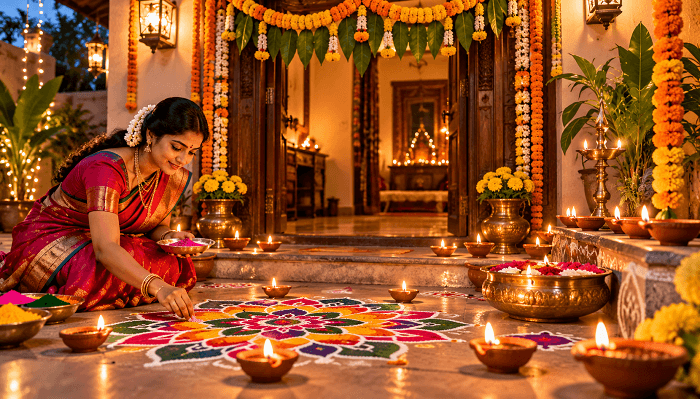
Rangoli, torans, and diyas often form a coordinated welcome.
- At the entrance: A toran decorates the doorway, while rangoli creates an inviting design on the floor.
- In the prayer area: Diyas provide light during prayers and family rituals.
- In the courtyard or balcony: Additional lamps and floral decorations create a festive atmosphere.
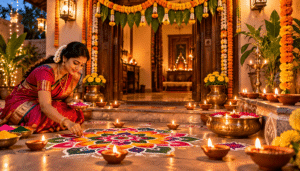
Consider a family preparing for Diwali. One person creates a rangoli near the front door, another hangs a marigold toran, and children help arrange clay lamps under adult supervision. The result is more than a decorated house: it is a shared activity that brings generations together.
These rituals also offer opportunities to teach children about regional art, family customs, and the reasons behind familiar festive practices.
Common Mistakes to Avoid When Decorating for Festivals
Beautiful decorations are most meaningful when they respect the traditions they represent.
- Treating every regional design as the same: Kolam, alpana, and pookalam have distinct cultural contexts.
- Assuming every custom has one universal meaning: Interpretations can differ between regions, religious communities, and families.
- Ignoring fire safety: Keep lamps away from flammable decorations and never leave flames unattended.
- Wasting natural materials: Use flowers and leaves thoughtfully, and dispose of them responsibly.
Choosing appearance over participation: Involve family members in the process rather than treating decorations only as photographs or social media content.
Conclusion: Keeping the Meaning of Indian Festival Decorations Alive
The meaning of Indian festival decorations goes far beyond making a home look beautiful. Rangoli represents artistic expression, hospitality, and auspicious beginnings; torans mark welcoming entrances; and diyas bring light into religious and family celebrations.
Their forms change across India, from Tamil Nadu’s kolam to Kerala’s pookalam and the floral doorways found in many western and northern households. Yet these traditions continue to connect people with their families, communities, and cultural heritage.
The next time you prepare your home for a festival, take a moment to understand the story behind each decoration. Choose designs that reflect your regional traditions, involve younger family members, and celebrate the values these practices carry.
Explore more Indian festivals, cultural traditions, and heritage stories on StoryAccount, and share your family’s favourite festive decoration tradition with others.