Ancient Indian Books and Manuscripts
Ancient Indian Books That Reveal How People Lived Centuries Ago
How did people in ancient India prepare medicines, educate their children, manage kingdoms, trade goods, and understand the natural world? Long before modern textbooks and printed newspapers, writers, scholars, poets, and administrators recorded ideas about everyday life in works that have survived through centuries of copying and preservation.
Some of these texts describe household responsibilities, while others explain farming, taxation, medical treatment, religious ceremonies, and social relationships. Together, ancient Indian books and manuscripts provide valuable clues about how people lived, what they believed, and how their societies functioned.
However, historical texts require careful interpretation. A royal manual does not tell us how every farmer lived, and a religious ideal does not necessarily describe what people actually did. By examining specific surviving works alongside their historical contexts, we can distinguish documented information from assumptions.
1. Arthashastra: Understanding Administration, Trade, and Daily Life
Traditionally associated with Kautilya, also known as Chanakya, the Arthashastra is one of the most important works for understanding ancient Indian political and economic thought. Its surviving text discusses state administration, taxation, agriculture, trade, mining, espionage, law, and the responsibilities of rulers.
The work provides detailed descriptions of how a kingdom could organize its economy. It discusses revenue collection, market supervision, weights and measures, irrigation, and the regulation of commercial activities.
These details help historians investigate the relationship between government and ordinary economic life.
What historians can infer: The text demonstrates that its author or tradition considered economic management, agricultural production, public revenue, and commercial regulation essential subjects of political administration.
What historians cannot conclude: The Arthashastra is primarily a prescriptive manual, not a daily administrative diary. Its rules do not prove that every kingdom implemented them or that all communities experienced the same system.
Its date and composition are also debated, with scholars generally treating the surviving work as a text that developed over time rather than assuming it was written entirely by one person in a single period.
2. Ancient Indian Books and Manuscripts About Medicine
Medical texts reveal another dimension of historical life: how people understood the body, disease, diet, and healthcare.
Charaka Samhita and Sushruta Samhita
The Charaka Samhita is a major Ayurvedic work concerned with internal medicine, diagnosis, treatment, diet, and professional conduct. The Sushruta Samhita is especially associated with surgery, anatomy, surgical instruments, and medical training.
These works discuss the relationship between food, bodily health, seasonal changes, and daily habits. They also show that medical knowledge was organized into specialized traditions and transmitted through teaching and textual study.
For example, their discussions of diet and seasonal routines offer evidence of how some medical authorities connected health with lifestyle and the environment.
What historians can infer: These texts document sophisticated medical theories, therapeutic practices, and ideals of physician training within Indian intellectual traditions.
What historians cannot conclude: A treatment described in a medical text was not necessarily used by everyone, nor does its appearance establish modern clinical effectiveness. The texts also contain layers of material from different periods.
They are historical evidence of medical knowledge, not substitutes for modern medical advice.
3. Manusmriti: Social Rules and Expectations
The Manusmriti, also known as the Laws of Manu, is an influential Sanskrit text addressing social duties, legal principles, inheritance, marriage, ritual obligations, and the organization of society.
It helps researchers understand how certain ancient and early historical authors imagined social order. Its discussions of family responsibilities and property can reveal the values that influential legal and religious traditions attempted to promote.
Yet this text requires particular caution.
Its prescriptions reflect normative ideals, including hierarchical social distinctions. They cannot automatically be treated as a complete description of how every household behaved or how all communities understood social relationships.
Historical lesson: The difference between a rule and actual practice matters. To understand historical society, researchers compare prescriptive literature with inscriptions, legal records where available, archaeological evidence, and other texts.
The Manusmriti is therefore useful not only for studying social expectations but also for investigating the gap between idealized rules and lived experience.
4. Sangam Literature: Ordinary People, Love, War, and Landscapes
Sangam literature offers a different perspective on life in ancient southern India. These Tamil poems describe love, separation, warfare, generosity, kingship, farming, cattle, trade, and landscapes.
Unlike administrative manuals, many poems focus on human emotions and relationships. They portray warriors, rulers, poets, farmers, herders, and communities whose lives were shaped by their surroundings.
The literary tradition also connects different landscapes with particular occupations and ways of life. Coastal settings, for instance, are associated with maritime activity and fishing, while agricultural regions feature cultivation and settled communities.
What historians can infer: Sangam poems preserve valuable evidence about cultural ideals, regional identities, economic activities, political relationships, and the ways poets represented human experience.
What historians cannot conclude: Poetry is shaped by genre, symbolism, patronage, and artistic conventions. A poem about a generous king does not independently establish the exact scale of his wealth or the prosperity of his entire kingdom.
When combined with inscriptions and archaeological discoveries, these poems become especially useful for reconstructing early Tamil society.
5. Palm Leaf Manuscripts and the History of Indian Knowledge
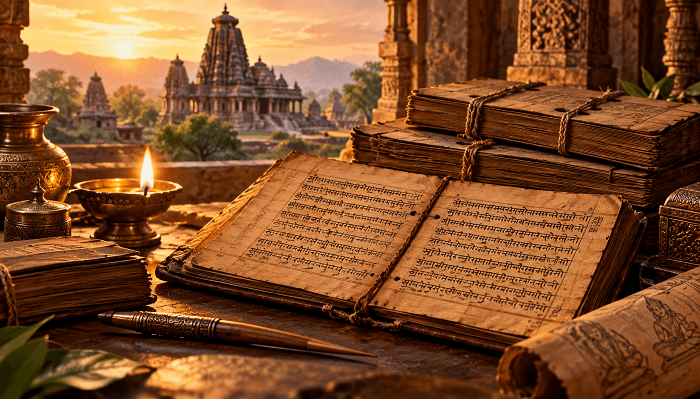
Many Indian intellectual traditions were preserved through handwritten manuscripts, including texts written on palm leaves and birch bark. Palm leaf manuscripts were particularly important in several regions of South and Southeast Asia.
Preparing and preserving such manuscripts required considerable skill. Leaves had to be processed, inscribed or written upon, and stored carefully. Because organic materials deteriorate, manuscripts often needed to be recopied to keep their contents available to later generations.
This creates an important distinction: the age of a text’s composition may differ significantly from the age of its oldest surviving manuscript.
The Aryabhatiya, composed by Aryabhata around 499 CE, is a notable example of early Indian mathematical and astronomical scholarship. It discusses topics including arithmetic, mathematical techniques, and astronomical calculations.
Such works illuminate the history of Indian knowledge by showing how scholars investigated numbers, planetary movements, and mathematical relationships.
However, surviving copies do not necessarily preserve every original detail unchanged. Copyists sometimes introduced errors, revised wording, or transmitted different versions.
For this reason, historians compare manuscript copies, examine linguistic features, and study historical references before making claims about a work’s original form.
6. How to Read Ancient Indian Literature as Historical Evidence
Readers can get more from historical texts by asking a few practical questions.
- Who produced the text? A royal adviser, physician, poet, or religious scholar would have different priorities and perspectives.
- What was its purpose? A handbook offering rules differs from a poem describing emotions or a mathematical treatise explaining calculations.
- Who is represented? Elite writers often provide more information about rulers and learned communities than about laborers, women, or marginalized groups.
- When was it composed and copied? Composition dates, later revisions, and surviving manuscript dates are not always identical.
- What other evidence supports it? Inscriptions, coins, archaeological remains, and material culture can help confirm, qualify, or challenge textual claims.
A common mistake is to treat every ancient text as a factual account of daily life. Another is to assume that an entire society followed the practices described by one author.
A stronger approach is to consider the text’s intended audience, historical setting, literary form, and limitations.
Conclusion: Discover the Past Through Ancient Indian Books and Manuscripts
From the economic principles of the Arthashastra to the medical traditions of the Charaka Samhita, the social ideals of the Manusmriti, and the human experiences represented in Sangam poetry, ancient Indian books and manuscripts preserve remarkable insights into earlier societies.
Their greatest value lies not in providing a complete picture of the past but in revealing how people thought, what they studied, which institutions they valued, and how they represented their world.
At the same time, responsible historical interpretation means recognizing the difference between written ideals and everyday realities. When Indian historical manuscripts are examined alongside archaeological and epigraphic evidence, they help build a richer understanding of the history of Indian knowledge and everyday life.
Want to explore more stories from India’s past? Discover our other history articles to learn about ancient civilizations, forgotten traditions, remarkable historical figures, and the discoveries that continue to reshape our understanding of India.