Dussehra Traditions In Different States of India
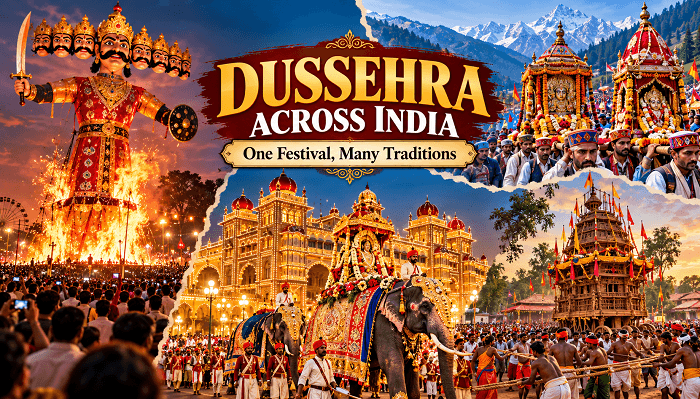
Imagine watching a towering effigy of Ravana burn in North India, witnessing a royal procession in Mysuru, and experiencing a tribal festival in Chhattisgarh that continues for weeks. All three celebrations are connected to the same festive season, yet their rituals, stories, and cultural meanings are remarkably different.
The Dussehra traditions in different states of India reflect the country’s diverse religious beliefs, regional histories, folk traditions, and community identities. Known as Vijayadashami in many parts of the country, Dussehra generally celebrates the victory of good over evil. However, the way people express this message depends on local legends and centuries-old customs.
From the famous Mysore Dasara celebrations to the extraordinary Kullu Dussehra festival and the fascinating Bastar Dussehra history, here are seven traditions that reveal how one festival can take many different forms.
Why Dussehra Is Celebrated Differently Across India
1. Mysore Dasara, Karnataka: A Celebration of Royal Heritage
Mysore Dasara is among India’s best-known Dussehra celebrations. Its historical association with the Wadiyar dynasty and the royal traditions of Mysuru gives the festival a distinctive character.
The festivities centre on the worship of Goddess Chamundeshwari, a form of Durga associated with the Chamundi Hills. According to local religious tradition, the Goddess defeated the buffalo demon Mahishasura, whose legend is closely connected with Mysuru.
What makes Mysore Dasara special?
The festival is famous for its illuminated Mysore Palace, cultural performances, traditional music, and the grand Vijayadashami procession, commonly called the Jamboo Savari.
Decorated elephants, ceremonial displays, musicians, and tableaux form part of the procession, although arrangements can change from year to year. The celebration combines religious devotion with the region’s royal and artistic heritage.
For visitors, Mysore Dasara offers an opportunity to explore Karnataka’s classical music, dance, crafts, and historical architecture alongside the festival itself.
2. Kullu Dussehra, Himachal Pradesh: When the Festival Begins After Vijayadashami
Kullu Dussehra follows a schedule that surprises many first-time visitors. While celebrations in many regions conclude on Vijayadashami, the major festivities in Kullu begin on that day and continue for approximately a week.
The festival is deeply connected to Lord Raghunath, a form of Lord Rama worshipped in the Kullu Valley.
How is Kullu Dussehra different?
Hundreds of local village deities, traditionally carried in decorated palanquins, gather at Dhalpur Maidan. The event brings together communities from across the valley through processions, devotional music, and traditional gatherings.
The presence of local deities is particularly important. Rather than focusing exclusively on Ravana’s defeat, Kullu Dussehra highlights the region’s living traditions of village worship and community relationships.
This makes Kullu Dussehra a valuable example of how local religious customs can shape a major Indian festival.
3. Bastar Dussehra, Chhattisgarh: A Festival Rooted in Tribal Traditions
The Bastar Dussehra history is especially fascinating because the celebration differs significantly from the familiar story of Rama defeating Ravana.
Located in the Bastar region of Chhattisgarh, this festival is closely associated with Goddess Danteshwari, a revered local deity. Its traditions are shaped by Adivasi communities, regional beliefs, and historical practices connected with the former Bastar kingdom.
The festival traditionally extends across many weeks, with ceremonies, processions, and community participation forming its central elements.
One of its most distinctive features is the use of an enormous ceremonial wooden chariot during designated rituals. The festival also includes important ceremonies involving local deities and community representatives.
Bastar Dussehra demonstrates why it is misleading to assume that every Dussehra celebration revolves around Ravan Dahan. Here, devotion to the Goddess and the cultural identity of local communities take centre stage.
Visitors should approach the festival respectfully and follow local guidance, particularly during ceremonies that have religious or community-specific significance.
4. Delhi and Uttar Pradesh: The Tradition of Ravan Dahan
In many parts of North India, Dussehra is closely associated with Ravan Dahan, the burning of effigies representing Ravana, often accompanied by effigies of Meghnath and Kumbhakarna.
The tradition is connected to the Ramayana, in which Lord Rama defeats Ravana to rescue Sita.
Ramlila performances often take place during the days leading up to Vijayadashami. These dramatic presentations bring episodes from the epic to life through dialogue, costumes, music, and staged battles.
Large public gatherings in Delhi and cities across Uttar Pradesh make Ravan Dahan a recognisable part of the festival.
Beyond the spectacle, the ceremony encourages reflection on pride, misuse of power, responsibility, and the consequences of wrongdoing. Different communities interpret these lessons through their own religious and cultural perspectives.
5. West Bengal: Vijayadashami and Durga’s Farewell
In West Bengal, Vijayadashami marks the emotional conclusion of Durga Puja. The festival celebrates Goddess Durga’s victory over Mahishasura and welcomes her symbolic return to her divine abode.
One familiar custom is Sindoor Khela, traditionally observed by married Bengali Hindu women, who apply vermilion to the Goddess and one another. Practices and participation vary between communities.
The day also includes prayers, greetings, and the immersion of Durga idols. For many families, the farewell carries a feeling similar to seeing a beloved daughter return home after a visit.
This tradition highlights a different dimension of Dussehra: the celebration is not only about victory but also about family, belonging, devotion, and farewell.
6. Tamil Nadu: Golu and the Celebration of Knowledge
In Tamil Nadu, the Navaratri season is known for the tradition of Golu, in which dolls and figurines are arranged on stepped platforms inside homes.
The displays may feature Hindu deities, scenes from epics, everyday village life, and miniature representations of cultural activities. Families invite friends and neighbours to see their arrangements and exchange festive offerings.
Saraswati Puja and Ayudha Puja are also important parts of the wider festive period. Saraswati Puja honours learning and knowledge, while Ayudha Puja involves the worship of tools, instruments, books, and equipment used in daily work.
Vijayadashami is considered an auspicious occasion for beginning education or learning a new skill in many communities.
These practices show how the festival season can connect spirituality with education, craftsmanship, and professional life.
7. Gujarat: Garba, Community Dancing and Navaratri
In Gujarat, Navaratri is famous for its energetic Garba and Dandiya Raas celebrations. People gather in traditional clothing to dance in circles or pairs, accompanied by devotional songs and rhythmic music.
Garba is associated with devotion to the Divine Feminine and is performed throughout Navaratri. Dussehra, or Vijayadashami, follows the nine nights of celebration.
Although the burning of Ravana’s effigy is observed in some communities, it is not the defining feature of Gujarat’s Navaratri celebrations.
The region’s emphasis on dance, collective participation, and worship of the Goddess illustrates how the same festive season can produce very different cultural experiences across India.
Practical Tips for Experiencing Dussehra Across India
If you want to witness these traditions firsthand, a little planning will help.
- Check festival dates: Lunar-calendar dates and local schedules can affect travel plans.
- Book accommodation early: Mysuru and Kullu can attract large crowds during major celebrations.
- Choose the right experience: Mysuru suits visitors interested in royal heritage, Kullu offers a distinctive gathering of village deities, and Bastar provides insight into Adivasi cultural traditions.
- Respect local customs: Ask before photographing rituals, religious figures, or community ceremonies.
- Plan for crowds and safety: Follow official instructions around processions, fireworks, and large gatherings.
A common mistake is to assume that every region celebrates Dussehra in exactly the same way. Understanding local context makes the experience far more rewarding.
Why Choose StoryAccount for Indian Cultural Stories?
At StoryAccount, our goal is to help readers discover the stories behind India’s festivals, history, biographies, travel destinations, and regional customs.
Rather than presenting traditions as simple lists of rituals, we explore their historical background, cultural significance, and regional differences. This approach helps readers understand why celebrations matter to the communities that preserve them.
Explore more StoryAccount articles to discover lesser-known Indian traditions, historic places, and the people who keep cultural heritage alive.
Conclusion: One Festival, Many Indian Traditions
The Dussehra traditions in different states of India reveal that a shared festive season does not have to mean identical celebrations. Mysore Dasara honours royal heritage and Goddess Chamundeshwari, Kullu Dussehra brings together village deities, and Bastar Dussehra preserves distinctive Adivasi traditions. Elsewhere, Ravan Dahan, Durga Puja, Golu, and Garba express different regional interpretations of faith and celebration.
Together, these traditions demonstrate the richness of India’s cultural landscape. Each offers a different way to reflect on courage, devotion, knowledge, and the victory of good over evil.
Want to discover more fascinating stories about India? Visit StoryAccount for more articles on Indian festivals, forgotten history, cultural heritage, and remarkable destinations.
Frequently Asked Questions
1. Why is Dussehra celebrated differently across India?
Dussehra traditions differ because regional communities have their own religious beliefs, historical experiences, local deities, and cultural practices. Some focus on Lord Rama’s victory over Ravana, while others celebrate Goddess Durga or regional traditions.
2. What is special about Mysore Dasara?
Mysore Dasara is known for its royal heritage, illuminated Mysore Palace, worship of Goddess Chamundeshwari, cultural programmes, and the grand Vijayadashami procession called Jamboo Savari.
3. Why does Kullu Dussehra begin on Vijayadashami?
Unlike many celebrations that conclude on Vijayadashami, Kullu Dussehra begins on that day. Its distinctive schedule reflects the region’s traditional religious calendar and customs associated with Lord Raghunath and local village deities.
4. Why is Bastar Dussehra different from other Dussehra festivals?
Bastar Dussehra centres on Goddess Danteshwari and the traditions of local Adivasi communities. It extends over several weeks and is not primarily centred on the burning of Ravana’s effigy.
5. Is Ravan Dahan performed throughout India?
No. Ravan Dahan is particularly prominent in many North Indian communities, but it is not universal. Other regions emphasise Goddess Durga, local deities, cultural performances, or different Navaratri traditions.