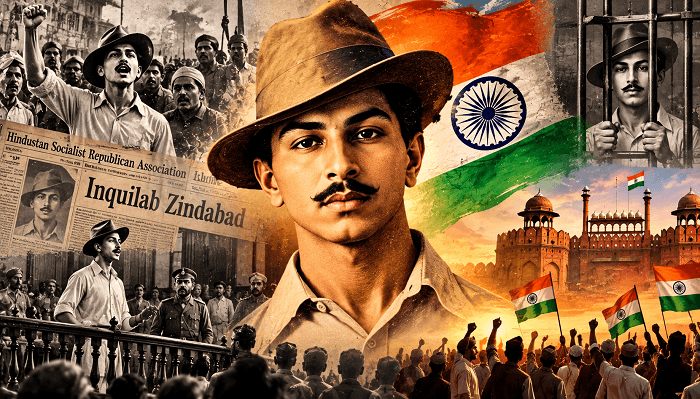
Bhagat Singh is remembered as one of the most influential young revolutionaries of India’s struggle against British colonial rule. Yet a serious Bhagat Singh biography reveals a personality more complex than the familiar image of a fearless freedom fighter. He was an active reader, political thinker, writer and revolutionary who developed strong views about colonialism, social inequality and the future of an independent India..
Executed at just 23 years old, Bhagat Singh had a remarkably short public life. Still, his actions, courtroom statements and writings gave him an enduring place in modern Indian history. Understanding his journey means examining both the dramatic events associated with him and the ideas behind them.
Bhagat Singh Biography: Early Life and Political Awakening
Bhagat Singh was born on 28 September 1907 in Banga, Lyallpur district of Punjab, then part of British India and now in Pakistan. He grew up in a family with strong involvement in anti-colonial politics.
The political atmosphere of Punjab deeply influenced his youth. The Jallianwala Bagh massacre of 1919, in which British troops killed hundreds of people in Amritsar, became one of the defining events for his generation.
As he grew older, Bhagat Singh studied revolutionary movements and political philosophies from India and abroad. His interests extended beyond achieving independence. He increasingly considered questions of economic inequality, workers’ rights, communal divisions and socialism.
He later became associated with organisations including the Naujawan Bharat Sabha and the Hindustan Socialist Republican Association (HSRA).
Bhagat Singh Biography and His Revolutionary Journey
Bhagat Singh believed British colonial rule required organised political resistance. His revolutionary career became closely connected with two major incidents that eventually led to his arrest and execution.
Bhagat Singh Biography: Saunders Case and Its Background
In 1928, the Simon Commission faced widespread opposition in India because it contained no Indian members. During a protest in Lahore, nationalist leader Lala Lajpat Rai was injured in a police lathi charge and died several weeks later.
Bhagat Singh and his associates planned to target police superintendent James A. Scott, whom they held responsible for the assault. However, Assistant Superintendent John Saunders was mistakenly identified and killed in December 1928.
Bhagat Singh subsequently escaped Lahore and continued his revolutionary activities underground.
The Saunders case became a turning point in his life and later formed a major part of the prosecution against him.
Central Legislative Assembly Bombing
On 8 April 1929, Bhagat Singh and Batukeshwar Dutt threw bombs into the Central Legislative Assembly in Delhi while controversial legislation was being considered.
The action was deliberately designed as a political demonstration rather than an attempt at mass killing. The bombs were thrown into a relatively unoccupied area, after which Bhagat Singh and Dutt distributed leaflets, raised revolutionary slogans and allowed themselves to be arrested.
Their decision to remain at the scene was strategic. They intended to use the trial and subsequent publicity to communicate their political message to a much larger audience.
The phrase “Inquilab Zindabad”, or “Long Live the Revolution,” became strongly associated with Bhagat Singh and the revolutionary movement.
Prison Hunger Strike and Political Ideas
Bhagat Singh’s struggle continued after imprisonment. Along with other prisoners, he participated in a prolonged hunger strike demanding better treatment and equal status for Indian political prisoners.
The strike attracted widespread public attention. Revolutionary Jatin Das died after a 63-day hunger strike, intensifying public anger and bringing greater visibility to the prisoners’ demands.
Bhagat Singh also continued reading and writing in prison. His essays and letters show that his understanding of revolution extended beyond armed action. He engaged seriously with socialism, rationalism, religion, imperialism and social justice.
His famous essay “Why I Am an Atheist” provides important insight into his intellectual development and willingness to question established beliefs.
Trial, Execution and Sacrifice
Bhagat Singh, Shivaram Rajguru and Sukhdev Thapar were ultimately sentenced to death in connection with the Lahore Conspiracy Case.
They were executed in Lahore Central Jail on 23 March 1931.
Their deaths caused widespread grief and anger across India. Bhagat Singh became known as Shaheed Bhagat Singh, with “Shaheed” meaning martyr.
His execution at such a young age also ensured that his ideas and sacrifice became deeply embedded in the public memory of India’s independence movement.
What Can We Learn From Bhagat Singh’s Life?
Bhagat Singh’s story provides lessons that go beyond memorising historical dates:
Read before forming opinions: His political thinking developed through extensive study.
Question established assumptions: His writings demonstrate intellectual independence.
Understand the purpose behind actions: His Assembly protest was designed to attract political attention.
Think beyond individual goals: His writings frequently addressed wider social and economic issues.
Study primary sources: Letters, essays and court statements reveal a more complete person than popular slogans alone.
For students, comparing his own writings with historical scholarship is one of the best ways to understand his political evolution.
Common Mistakes When Reading a Bhagat Singh Biography
A common mistake is portraying Bhagat Singh only as an armed revolutionary. Doing so overlooks his extensive reading, writing and developing socialist thought.
Another error is assuming that every quote circulating online under his name is authentic. Readers should verify quotations through reputable historical works or documented writings.
It is equally important to study his actions within the broader political environment of British India rather than separating them from their historical context.
Conclusion: Why the Bhagat Singh Biography Still Inspires
A thoughtful Bhagat Singh biography reveals a revolutionary whose influence came from both action and ideas. From his political awakening and involvement with the HSRA to the Assembly bombing, prison hunger strike and eventual execution, his short life was shaped by an intense commitment to political change.
Bhagat Singh’s legacy continues because his writings encourage readers to think about freedom, equality, rational inquiry and social responsibility—not merely personal courage.