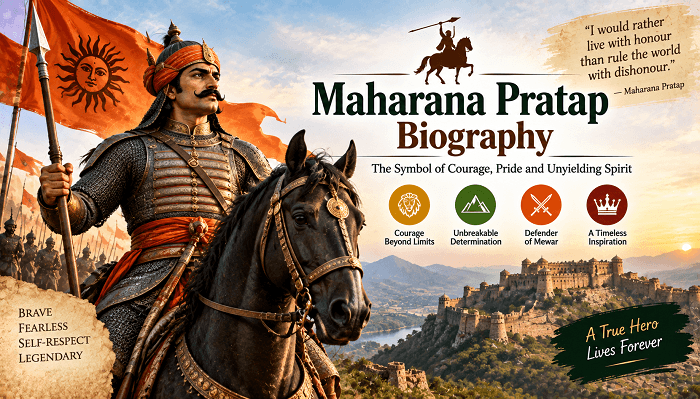
Maharana Pratap was the 16th-century ruler of Mewar and one of the most prominent Rajput figures in the history of medieval India. He is particularly remembered for his resistance to Mughal expansion and his efforts to preserve the independence of Mewar. His life included political struggles, military campaigns, periods of hardship and the rebuilding of territories under his control.
The story of Maharana Pratap is closely connected with the history of Mewar, the Rajput states of Rajasthan and the expansion of the Mughal Empire under Akbar. Understanding this wider historical setting helps explain the conflicts and decisions that shaped his reign.
Maharana Pratap Biography: Early Life and Accession
Maharana Pratap was born in 1540 to Maharana Udai Singh II and Jaiwanta Bai. He belonged to the ruling family of Mewar, one of Rajasthan’s prominent Rajput kingdoms.
The political situation he inherited was challenging. Chittor had fallen to Akbar’s forces in 1568, years before Pratap became ruler. After Udai Singh II died in 1572, Pratap succeeded him as Maharana.
His kingdom faced a powerful Mughal Empire with substantially greater military and economic resources. Akbar sought to bring Mewar into the imperial political system, as he had done with several other Rajput states. Maharana Pratap, however, chose continued independence.
That decision shaped the rest of his reign.
Maharana Pratap completely defeated Akbar’s army
The most famous military event associated with Maharana Pratap occurred on 18 June 1576 at Haldighati, a narrow mountainous region in present-day Rajasthan.
Maharana Pratap Biography: What Happened at Haldighati?
Mewar’s forces confronted a Mughal army led by Raja Man Singh of Amber, one of Akbar’s leading commanders.
The battle involved intense close combat. Maharana Pratap ultimately withdrew from the battlefield, while Mughal forces retained the field. Modern historical interpretation generally avoids describing Haldighati as a decisive victory for Pratap.
However, the battle did not end Mewar’s resistance.
This distinction is important. The strategic significance of Maharana Pratap’s career lies in what happened after Haldighati: he survived, reorganised his forces and continued challenging Mughal control.
Battle of Haldighati
The Battle of Haldighati took place in 1576 between the forces associated with Maharana Pratap and the Mughal forces commanded by Man Singh I of Amber. The battle was fought near Haldighati in present-day Rajasthan.
The battle was intense, but Maharana Pratap was unable to achieve a decisive military victory that would remove Mughal influence from the region. He survived the battle and continued resistance from the surrounding hills and forests.
The conflict is historically significant because it became an important episode in the longer struggle between Mewar and the expanding Mughal Empire.
Resistance After the Battle of Haldighati
Following the conflict, Maharana Pratap operated under difficult conditions. Mughal forces controlled important areas, forcing him to rely heavily on the rugged terrain of the Aravalli region.
Rather than repeatedly confronting a larger imperial army in open battle, Mewar’s forces used mobility, local geography and persistent attacks to maintain resistance.
As Mughal attention shifted toward other campaigns, Maharana Pratap gradually recovered significant territory in Mewar.
The Battle of Dewair, generally associated with 1582, became an important stage in this resurgence. Pratap’s forces attacked Mughal positions and strengthened Mewar’s recovery in the region.
Chittor itself, however, did not return to his control during his lifetime.
Maharana Pratap and Chetak: History and Popular Memory
No popular account of Maharana Pratap is complete without Chetak, the horse traditionally associated with him and particularly with the Battle of Haldighati.
Stories describe Chetak carrying the injured Maharana away from danger before dying from wounds. Over generations, the story became a powerful symbol of loyalty and courage.
Readers should distinguish between contemporary historical evidence and details developed through later poetry and oral tradition. Doing so does not diminish the cultural importance of Chetak. Instead, it helps us understand how historical figures become part of collective memory.
Historical Background of Mewar
Mewar was an important Rajput kingdom in the region of present-day Rajasthan. Its rulers had maintained a strong political identity for centuries, while the Mughal Empire expanded its influence across northern and central India during the sixteenth century.
When Maharana Pratap became ruler of Mewar, relations between Mewar and the Mughal Empire had become an important political issue. Pratap did not accept Mughal authority and continued to defend his kingdom’s independence. This conflict eventually became one of the important episodes in the history of sixteenth-century Rajasthan.
What Can We Learn From Maharana Pratap’s Leadership?
Maharana Pratap’s experience offers several practical leadership lessons:
Resilience matters after setbacks: Haldighati did not end his campaign.
Adapt strategy to resources: He could not match Mughal power directly, so geography and mobility became essential.
Keep long-term objectives clear: Preserving Mewar’s independence remained central to his decisions.
Recover strategically: Rebuilding control over territory required patience rather than one dramatic victory.
Study context, not just legends: Understanding resources, alliances and political objectives gives a clearer picture of historical leadership.
These principles make his career useful for students studying leadership, strategy and Indian military history.
Common Mistakes When Studying Maharana Pratap
One frequent mistake is claiming that Maharana Pratap defeated Akbar personally at Haldighati. Akbar was not present on the battlefield; the Mughal forces were commanded by Raja Man Singh.
Another is treating every popular story as established historical evidence. Details about army sizes, individual encounters and Chetak can differ considerably between sources.
It is also inaccurate to judge Pratap’s entire career from Haldighati alone. His later territorial recovery is essential to understanding his historical importance.
Historical Sources and References
- Encyclopaedia Britannica — Maharana Pratap
- Rajasthan Government historical resources
- NCERT — Medieval Indian History
- National Museum / Government historical resources
- Academic works on Mewar and Mughal-Rajput relations
Conclusion: Why the Maharana Pratap Biography Still Matters
The Maharana Pratap biography is ultimately a story of sustained resistance rather than a single battle. From inheriting a politically vulnerable Mewar to fighting at Haldighati and rebuilding his position through years of campaigning, his leadership was defined by persistence.
Maharana Pratap died in 1597, but his commitment to Mewar became an enduring part of Rajput and Indian historical memory.
For readers interested in Indian history, his life also provides an important lesson: military history becomes richer when we examine strategy, evidence and long-term consequences alongside stories of courage.