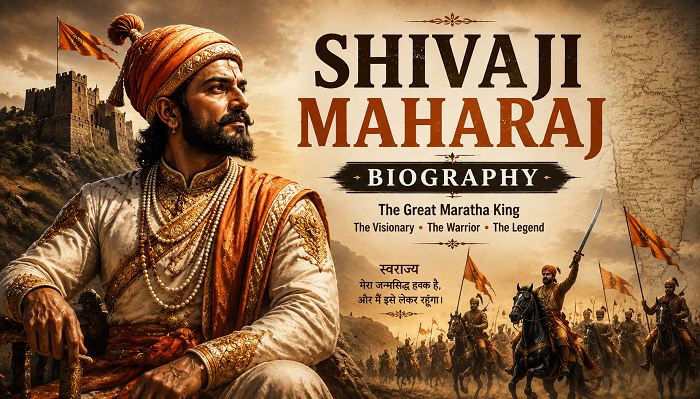
Few figures in Indian history combine military skill, political vision, administration, and popular memory as powerfully as Chhatrapati Shivaji Maharaj. A careful Shivaji Maharaj biography reveals much more than stories of famous battles. His rise involved strategic fort-building, diplomacy, intelligence, naval development, administration, and an ability to operate effectively against stronger regional powers.
Born in 1630 at Shivneri Fort, Shivaji emerged during a politically complex period in the Deccan. He gradually established an independent Maratha state and was formally crowned at Raigad in 1674. His achievements later became foundational to the expansion of Maratha power.
Shivaji Maharaj Biography: Early Life and Rise to Power
Shivaji was born to Shahaji Bhonsle and Jijabai. His father was an influential military commander whose career was connected with the Deccan sultanates, while Jijabai is traditionally credited with having a strong influence on Shivaji’s upbringing.
Historical Sources and References
This article has been prepared using information from established educational, government and historical resources.
Historical Sources and References
This article has been prepared using information from established educational,
government and historical resources.
Encyclopaedia Britannica – Shivaji
National Council of Educational Research and Training (NCERT) – Textbooks
and Educational Resources
Government of Maharashtra – Rajgad: The King of Forts
Government of Maharashtra – Heritage Forts: The Gems of Maratha Empire
NCERT – Maharashtra: Cultural and Historical Background
The hill forts and rugged landscapes of the Western Ghats played an important role in his early political and military development. Rather than relying only on large conventional armies, Shivaji understood the strategic value of controlling forts, mountain routes, and local supply networks.
In the 1640s, he began establishing control over important territories and forts. Torna Fort was among his early acquisitions and became associated with the beginning of his territorial expansion.
Shivaji Maharaj Biography and His Most Famous Battles
Shivaji’s military career included direct battles, sieges, surprise attacks, strategic withdrawals, and diplomatic negotiations. His success came partly from knowing when a conventional confrontation was useful—and when it was better avoided.
Shivaji Maharaj Biography: Battle of Pratapgad
One of the defining events of his career occurred at Pratapgad in 1659. Afzal Khan, a powerful general of the Bijapur Sultanate, was sent against Shivaji.
The personal meeting between Shivaji and Afzal Khan ended violently, after which their forces fought near Pratapgad. Shivaji’s troops gained a major victory.
The episode strengthened his political standing and demonstrates a recurring feature of Maratha strategy: careful preparation combined with effective use of difficult terrain.
The Attack on Shaista Khan
In 1663, Shivaji carried out a daring attack against Mughal commander Shaista Khan in Pune. Shivaji and his men entered the city and attacked Khan’s residence at night.
Shaista Khan survived but was injured, and the raid became famous for its bold execution. Militarily, it demonstrated the value of intelligence, surprise, speed, and precise objectives rather than simply relying on numerical strength.
Military Strategy That Defined Shivaji Maharaj
Shivaji is strongly associated with highly mobile warfare adapted to the geography of the Deccan. His forces could move quickly, attack vulnerable positions, disrupt opponents, and avoid unnecessary confrontations.
Forts formed another pillar of his strategy. Raigad, Pratapgad, Rajgad, Sindhudurg and numerous other forts supported defence, administration, communication, and territorial control.
He also recognised the strategic importance of India’s western coastline. Naval bases and coastal forts helped strengthen Maratha maritime defence at a time when European and regional powers competed for influence along the coast.
This combination of land and maritime strategy distinguishes his career within seventeenth-century Indian military history.
Coronation and Administration of the Maratha State
Shivaji Maharaj was formally crowned Chhatrapati at Raigad in 1674. The coronation represented more than a ceremonial achievement; it reinforced his position as an independent sovereign.
His government included an organised administrative structure traditionally associated with the Ashta Pradhan, or council of eight ministers. Revenue administration, military organisation, fort management, justice, and diplomacy were important parts of governance.
Historians therefore study Shivaji not merely as a battlefield commander but also as a state-builder who developed institutions capable of supporting an expanding kingdom.
What Leadership Lessons Can We Learn From Shivaji Maharaj?
His career offers several practical lessons even outside military history:
Know your environment: His strategies frequently reflected a deep understanding of terrain.
Choose battles carefully: Not every challenge required direct confrontation.
Invest in infrastructure: Forts provided long-term strategic advantages.
Build reliable intelligence: Information could be as important as military strength.
Adapt quickly: Strategy changed according to the opponent and circumstances.
Think beyond immediate victories: Administration was necessary to convert military success into durable political power.
For students, studying these decisions is more useful than simply memorising dates and battle names.
Common Mistakes When Reading a Shivaji Maharaj Biography
One mistake is relying entirely on popular stories without distinguishing tradition from documented history. Accounts written by different Maratha, Mughal, European, and later historians can vary in detail and interpretation.
Another is describing Shivaji only as a warrior. His military achievements were significant, but ignoring administration, diplomacy, forts, maritime policy, and institution-building gives an incomplete picture of his historical importance.
Historical Context
Shivaji Maharaj emerged in the seventeenth-century Deccan, a region shaped by competing political powers, fortified hill territories and changing alliances. The Deccan Sultanates, Mughal expansion and local political networks created a complex environment in which control of forts, territory and trade routes was strategically important. Understanding this background helps explain the political and military challenges Shivaji faced while building an independent Maratha state.
Conclusion: Understanding the Shivaji Maharaj Biography
A detailed Shivaji Maharaj biography shows why Chhatrapati Shivaji Maharaj remains one of the most influential figures in Indian history. From Pratapgad and daring operations against Mughal forces to his coronation at Raigad, fort network, naval initiatives, and administrative system, his career combined military strategy with state-building.
Shivaji Maharaj died in 1680, but the political foundations he established survived him and contributed to the later rise of Maratha power across India.