India’s Most Mysterious Historical Places and the Real Stories Behind Them
India’s ancient forts, abandoned villages, and forgotten palaces hold stories that are far more fascinating than ghost tales alone. Some were once thriving kingdoms, while others became deserted for reasons that historians still examine. These mysterious historical places in India attract travellers because they combine architectural beauty, documented history, and legends passed down through generations.
But how much of their mystery comes from historical events, and how much comes from folklore? From the infamous Bhangarh Fort in Rajasthan to the deserted village of Kuldhara, let’s explore the real stories behind some of India’s most intriguing destinations.
1. Bhangarh Fort, Rajasthan: History Behind the Haunted Legend
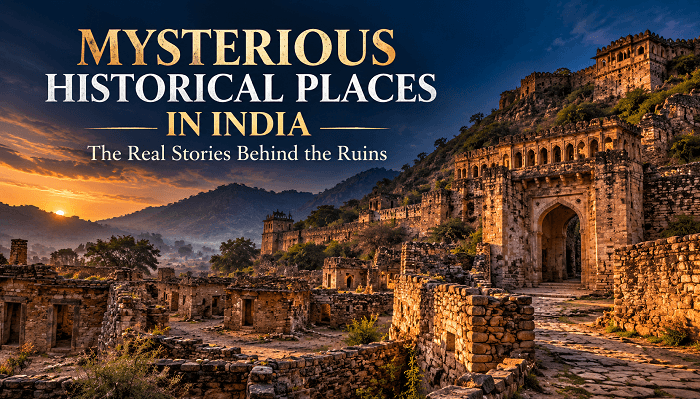
Located in Rajasthan’s Alwar district, Bhangarh Fort is among India’s best-known destinations associated with supernatural legends. Built during the 16th century, the fortified settlement contains palace ruins, temples, gateways, and remains of an old marketplace.
According to a popular local legend, a tantric named Singhia fell in love with Princess Ratnavati and attempted to use magic to win her affection. When his plan failed, he supposedly cursed the settlement before dying. Another version connects the fort’s misfortune to a sage whose conditions were allegedly violated during construction.
However, these accounts are folklore, not established historical facts. The fort’s decline and abandonment should be considered separately from its supernatural reputation.
What makes Bhangarh genuinely fascinating is its surviving architecture. Visitors can explore its temples, ruined homes, and palace structures during permitted hours.
Travel tip: Visit during daylight, wear comfortable footwear, and respect official entry restrictions. The Rajasthan Tourism Department identifies the site as a protected historical attraction with a strong haunted reputation.
2. Kuldhara Village, Rajasthan: The Settlement That Disappeared
About 17 kilometres west of Jaisalmer, Kuldhara Village presents a different kind of mystery. Its roofless houses, deserted lanes, and ruined structures offer a glimpse into a settlement that once supported a prosperous community.
The village was associated with the Paliwal Brahmins, who developed agricultural communities in Rajasthan’s challenging desert environment. Local legend says that the villagers abandoned Kuldhara and neighbouring settlements in 1825 to escape the demands of a powerful minister who wanted to marry a village leader’s daughter.
According to the story, the departing residents placed a curse on the settlement to prevent anyone from living there again.
Although Rajasthan Tourism recounts this traditional narrative, the precise circumstances surrounding the abandonment are not fully established. It is therefore more accurate to distinguish the village’s documented existence from the details of its legendary departure.
Why visit? Kuldhara offers an opportunity to examine traditional desert settlement patterns, old building techniques, and the challenges of sustaining communities in an arid landscape.
3. Shaniwar Wada, Pune: A Palace With a Tragic Past
Shaniwar Wada was constructed in 1732 as a residence and political centre of the Peshwas, important leaders of the Maratha Empire. Today, its remaining walls and gateways recall a period of considerable political influence.
The palace is also associated with the tragic story of young Peshwa Narayanrao, who was murdered in 1773 during a struggle for power. A popular legend claims that his spirit calls for help within the palace grounds.
Although this haunting story remains part of local folklore, there is no conclusive evidence that supernatural activity occurs there.
The historical events themselves are compelling enough. Shaniwar Wada reflects the political rivalries, ambitions, and conflicts that shaped 18th-century Indian history.
For visitors, the site is especially interesting because it connects a familiar ghost story with a documented episode of royal intrigue.
4. Dumas Beach, Gujarat: Mystery Along the Arabian Sea
Dumas Beach, near Surat, is widely discussed in stories about supposedly haunted places in western India. Its dark sand, coastal winds, and relatively quiet stretches have contributed to its mysterious image.
Local tales associate the beach with spirits and unexplained sounds, while some stories link its reputation to its use as a cremation ground.
However, such claims should not be treated as verified paranormal evidence. Dark sand can result from the mineral composition of coastal sediments, and unusual sounds may have ordinary environmental explanations.
Dumas Beach is also a coastal destination where visitors can experience the Arabian Sea, enjoy the scenery, and explore nearby Surat.
For travellers interested in haunted forts in India stories and related legends, it provides an example of how geography and oral traditions can shape a destination’s reputation.
How to Explore Mysterious Historical Places in India Responsibly
Exploring these destinations becomes more rewarding when curiosity is balanced with historical awareness.
Check reliable sources: Consult government tourism websites, archaeological records, and museum information before accepting popular legends.
Respect protected monuments: Avoid climbing fragile walls, damaging structures, or entering restricted areas.
Choose suitable visiting hours: Check current opening times and local safety guidance before travelling.
Separate legends from evidence: Ask whether a story is supported by historical records or survives primarily through oral tradition.
Support local communities: Use authorised guides and local businesses to understand regional culture and heritage.
A common mistake is assuming that every abandoned building has a supernatural explanation. Wars, political instability, economic decline, environmental pressures, and changing trade routes can all contribute to the abandonment of historic settlements.
Conclusion: Discover the Real Stories Behind Mysterious Historical Places in India
The appeal of mysterious historical places in India lies in the relationship between historical evidence, architecture, and enduring folklore. Bhangarh Fort’s haunting reputation, Kuldhara’s abandoned streets, Shaniwar Wada’s tragic past, and Dumas Beach’s coastal legends each reveal a different side of India’s cultural landscape.
While ghost stories make these destinations intriguing, their historical significance deserves equal attention. Understanding what is documented, what remains uncertain, and what belongs to folklore makes every visit more meaningful.
Planning your next heritage trip? Choose one of these destinations, research its history before you go, and experience the stories behind the ruins for yourself. Explore more historical destinations and fascinating Indian stories on StoryAccount.com.