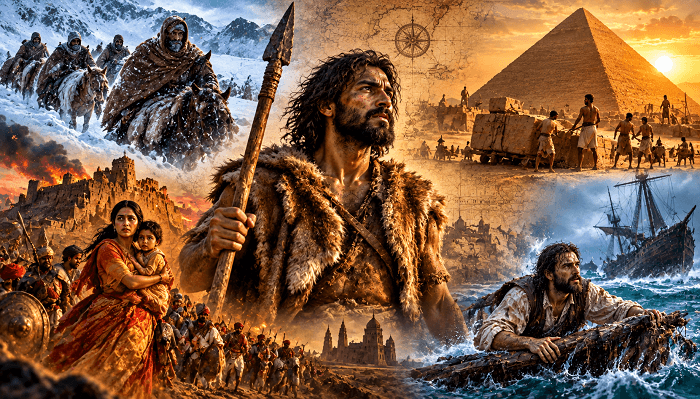
History contains accounts of people surviving circumstances that appear almost impossible: months adrift at sea, isolation in frozen landscapes, devastating accidents and days without reliable food or shelter. What makes these survival stories from history fascinating is not simply that people lived. It is how they reacted when ordinary routines, resources and expectations disappeared.
Well-documented survival accounts also provide valuable lessons. Researchers who study disasters and human behaviour frequently emphasize preparation, decision-making, adaptability and cooperation. The following historical cases demonstrate these qualities under extraordinary pressure.
1. Ernest Shackleton’s Endurance Expedition
In 1914, explorer Ernest Shackleton departed with his crew aboard Endurance, hoping to cross Antarctica.
The ship became trapped in pack ice in the Weddell Sea and was eventually crushed. The crew had to survive on drifting ice before reaching Elephant Island. Shackleton and several companions then undertook an extraordinary open-boat journey of roughly 800 miles to South Georgia.
After crossing the mountainous island to reach a whaling station, Shackleton organized the rescue of the remaining men. Remarkably, all members of the Endurance party survived.
Why It Remains One of the Greatest Survival Stories From History
Shackleton’s achievement was not the result of one heroic moment. Survival required ration management, teamwork, navigation, morale and repeated adjustments when plans failed.
For modern readers, the practical lesson is straightforward: when the original objective becomes impossible, changing the objective can be essential. Shackleton shifted his priority from exploration to bringing his crew home alive.
2. Juliane Koepcke: Alone in the Amazon Rainforest
On Christmas Eve 1971, 17-year-old Juliane Koepcke was aboard LANSA Flight 508 when the aircraft broke apart during a storm over Peru.
She survived a fall from thousands of feet while still strapped into a row of seats and found herself alone in the Amazon rainforest.
Koepcke had an important advantage: knowledge. Her parents were scientists, and she had learned about the rainforest environment. She followed flowing water, knowing that streams could eventually lead toward human settlements.
After around 11 days, she encountered local workers and was rescued.
Her experience demonstrates that survival knowledge can become far more valuable than physical strength alone.
3. The Andes Flight Disaster of 1972
Uruguayan Air Force Flight 571 crashed in the Andes Mountains in October 1972 while carrying a rugby team and other passengers.
Those who survived the initial crash faced freezing temperatures, injuries, limited supplies and extreme isolation. Rescue operations were eventually suspended because authorities believed nobody could still be alive.
The survivors had to make agonizing decisions to stay alive, including consuming the bodies of those who had died.
Eventually, Nando Parrado and Roberto Canessa crossed the mountains seeking help. After 72 days, the remaining survivors were rescued.
The case remains one of history’s most studied examples of endurance, group cooperation and decision-making under extreme conditions.
4. Poon Lim: 133 Days Alone at Sea
Chinese sailor Poon Lim was working aboard the British merchant ship Benlomond when it was torpedoed by a German U-boat in 1942.
He found a life raft containing limited emergency supplies and survived alone in the Atlantic for 133 days.
As supplies disappeared, Lim collected rainwater and improvised ways to catch fish and birds. He also maintained physical activity to preserve his strength.
Brazilian fishermen eventually rescued him near the coast of South America.
His survival demonstrates the importance of improvisation when prepared resources are exhausted.
5. Ada Blackjack: Survival in the Arctic
In 1921, Ada Blackjack joined an expedition to Wrangel Island in the Arctic, primarily working as a seamstress and cook.
The expedition deteriorated as supplies became scarce and attempts to obtain assistance failed. Eventually, Blackjack was left caring for a sick expedition member, who later died.
She had to learn survival skills beyond those for which she had originally been hired, including trapping animals and maintaining camp equipment. She survived until a rescue vessel arrived in 1923.
Her experience is an important reminder that expertise can be developed under pressure when circumstances demand adaptation.
6. Vesna Vulović and an Extraordinary Aviation Survival
In 1972, flight attendant Vesna Vulović survived after JAT Flight 367 broke apart over Czechoslovakia.
She was discovered seriously injured in wreckage after falling an extraordinary distance. Vulović suffered major injuries and underwent extensive medical treatment and rehabilitation.
Her survival became one of aviation history’s most remarkable documented cases.
Unlike stories involving prolonged wilderness survival, Vulović’s case highlights another reality: sometimes survival depends on an unusual combination of physical circumstances, rapid assistance and medical care rather than conscious survival decisions.
What Survival Stories From History Actually Teach Us
The most useful lesson from survival stories from history is not that determination makes people invincible. Chance often plays an enormous role.
However, once someone survives the initial event, behaviour matters. Staying calm enough to assess available resources, finding water and shelter, maintaining communication, cooperating with others and adapting plans can improve survival prospects.
A common mistake is romanticizing these experiences. Survivors frequently endured severe injuries, psychological trauma and long recoveries. Their accounts deserve to be understood as real human experiences rather than adventure entertainment.
Practical Lessons From Historical Survival Accounts
Several principles appear repeatedly: conserve essential resources, understand your environment, avoid unnecessary risks and reassess plans as conditions change.
Modern travellers can apply these lessons without facing an extreme disaster. Carry appropriate emergency supplies, tell someone your planned route, understand local weather and terrain, and learn basic first aid before entering remote areas.
Technology helps, but preparation should not depend entirely on a phone or GPS device.
Conclusion
The greatest survival stories from history combine preparation, adaptability, cooperation, courage and sometimes extraordinary luck. Shackleton’s crew survived Antarctic isolation, Juliane Koepcke navigated the Amazon, Poon Lim endured months at sea, and the Andes survivors faced conditions almost impossible to imagine.
These stories do more than amaze us. They reveal how people make decisions when familiar systems disappear and survival becomes the only priority.