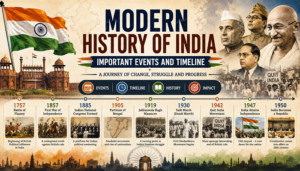
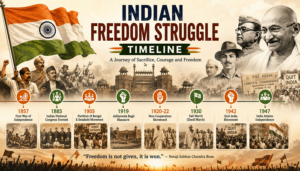
From Early Political Consciousness to the Struggle for Independence
Why Did Indian Nationalism Grow?
Indian nationalism did not emerge from a single event or from the work of one leader. It developed gradually as people across different regions began responding to colonial economic policies, political exclusion, social reforms, education, newspapers and new forms of political organization. Over time, these different developments helped transform political awareness into a broader movement for self-government and independence.
Introduction
The rise of Indian nationalism was a response to British colonial rule and its exploitative economic, social, and political policies. Nationalism in India was a complex and evolving movement that emerged in stages, shaped by regional, cultural, and class-based differences, yet united by the goal of ending colonial domination.
This chapter examines the origins, ideological foundations, early organizations, mass movements, and leadership that contributed to the emergence of Indian nationalism. It traces the evolution from the moderate early phase of the Indian National Congress (INC) to the radical, mass-based movements of the 20th century, culminating in India’s independence in 1947.
1. Causes of Indian Nationalism
Economic Exploitation
-
Drain of wealth to Britain (Dadabhai Naoroji’s “Drain Theory”)
-
Deindustrialization and collapse of traditional crafts
-
Heavy land taxes and rural indebtedness
Political Exclusion
-
Indians excluded from governance
-
Administrative and legislative reforms were minimal
-
Limited franchise for Indians under the Indian Councils Act 1861 and 1892
Social and Cultural Causes
-
Introduction of Western education created a new intelligentsia
-
Spread of liberal and reformist ideas
-
Awareness of inequality and the need for self-governance
Influence of Global Movements
-
Revolutions in Europe and America inspired Indian intellectuals
-
Anti-colonial movements in Asia provided models of resistance
2. Early Organizations and the Birth of the Indian National Congress (1885)
Formation of the INC
-
Founded in 1885 by A.O. Hume, a retired British civil servant
-
Initially a moderate forum for political dialogue
-
Early members were largely educated middle-class elites
Objectives of Early INC
-
Administrative reforms and greater Indian representation
-
Civil liberties and legal equality
-
Economic reforms to protect Indian interests
Moderates vs Radicals
-
Moderates: Leaders like Dadabhai Naoroji, Gopal Krishna Gokhale
-
Advocated petitions, dialogue, and gradual reforms
-
-
Radicals: Leaders like Bal Gangadhar Tilak, Bipin Chandra Pal, Lala Lajpat Rai
-
Demanded swaraj (self-rule)
-
Advocated assertive methods including agitation and boycott
-
3. Ideological Foundations of Nationalism
Economic Nationalism
-
Emphasis on protecting Indian industries
-
Promotion of Swadeshi goods and boycotts of British goods
Cultural Nationalism
-
Revival of Indian languages, literature, and religion
-
Promotion of Indian history and heritage
Political Nationalism
-
Demand for representative government
-
Assertion of Indian sovereignty
-
Advocacy for constitutional reforms
4. Swadeshi and Boycott Movements (1905–1911)
Partition of Bengal (1905)
-
Initiated by Lord Curzon to divide Bengal for administrative purposes
-
Seen as an attempt to divide and rule
Reaction
-
Boycott of British goods and promotion of indigenous industries
-
Mass mobilization, public meetings, and protests
-
Rise of revolutionary nationalist organizations
5. Revolutionary Movements
Revolutionary Societies
-
Anushilan Samiti and Jugantar in Bengal
-
Ghadar Party abroad
Methods
-
Assassination of British officials
-
Armed rebellion and secret societies
Impact
-
Created fear among British rulers
-
Inspired younger generations
-
Forced British authorities to consider reforms
6. Role of World War I
Indian Contribution
-
Indian soldiers fought for Britain in Europe, Africa, and the Middle East
-
Financial and material support provided
Post-War Expectations
-
Indians expected political concessions and self-government
-
Disappointment with British policies led to widespread unrest
7. Rise of Mass Politics: Gandhian Era (1919–1947)
Mahatma Gandhi
-
Leader of mass movements
-
Advocated non-violent resistance (Satyagraha)
-
Emphasized moral and ethical approach to politics
Key Movements under Gandhi
Non-Cooperation Movement (1920–22)
-
Response to Jallianwala Bagh Massacre and Rowlatt Act
-
Boycott of British institutions, schools, and goods
-
Mass mobilization of peasants, workers, and students
Civil Disobedience Movement (1930–34)
-
Salt March (1930) as a symbolic act of defiance
-
Nationwide participation, including women and rural masses
Quit India Movement (1942)
-
Demanded immediate British withdrawal
-
Repressed violently but galvanized nationalist sentiment
8. Role of Regional and Community Leaders
Bengal and Eastern India
-
Subhas Chandra Bose: Advocated radical and armed struggle
-
Netaji formed the Indian National Army (INA)
South India
-
C. Rajagopalachari, Annie Besant: Advocated constitutional reforms and Home Rule
Punjab and North-West Frontier
-
Lala Lajpat Rai: Active in Swadeshi and revolutionary movements
-
Sikh organizations contributed to national defense and political consciousness
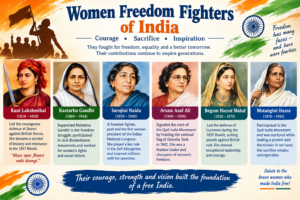
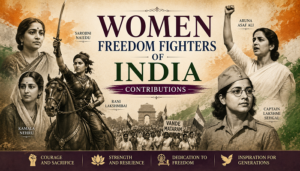
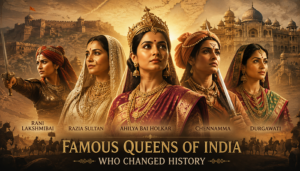
9. Women in the Nationalist Movement
Women played a crucial role in the nationalist struggle:
-
Participation in protests and marches
-
Formation of women’s organizations (e.g., All India Women’s Conference)
-
Figures like Sarojini Naidu, Kasturba Gandhi, and Annie Besant
-
Mobilization in both urban and rural areas
Women’s participation challenged traditional social norms and contributed to a broader democratization of political action.
10. Peasant and Tribal Movements
Peasant Movements
-
Champaran Satyagraha (1917): Against indigo plantations
-
Kheda Satyagraha (1918): Against high taxes and crop failures
Tribal Movements
-
Revolts against exploitation and forest laws
-
Santhal, Munda, and Gond revolts inspired by nationalist ideals
These movements integrated social and economic grievances with the national freedom struggle.
11. Political Reforms under British Rule
Government of India Acts
-
1909 (Morley-Minto Reforms): Separate electorates for Muslims
-
1919 (Montagu-Chelmsford Reforms): Dyarchy introduced
-
1935 Act: Provincial autonomy expanded
While intended to co-opt Indian elites, reforms also provided constitutional platforms for nationalist mobilization.
12. Role of Press and Literature
Press
-
Vernacular newspapers spread nationalist ideas
-
Criticism of British policies and advocacy for reform
Literature
-
Historical novels, poetry, and essays reinforced national identity
-
Figures like Bankim Chandra Chatterjee and Rabindranath Tagore shaped cultural nationalism
13. Communalism and Nationalism
While Indian nationalism sought unity, the British policy of divide and rule created communal tensions:
-
Formation of All India Muslim League (1906)
-
Separate electorates for Muslims
-
Early seeds of religious-based politics emerged
These divisions complicated nationalist strategy and unity.
14. Towards Independence (1940s)
Quit India and Mass Mobilization
-
Congress-led campaigns during World War II
-
Civil disobedience, strikes, and protests
Indian National Army
-
Subhas Chandra Bose sought armed liberation with Axis support
-
Boosted morale and challenged British claims of invincibility
Transition to Sovereignty
-
Post-war Britain weakened economically and politically
-
Indian political consensus and mass pressure forced negotiations
-
Partition of India (1947) and independence achieved
Conclusion
The rise of Indian nationalism was multi-faceted, evolving from elite, moderate beginnings to a mass movement spanning regions, religions, and social classes. Economic exploitation, social reforms, and political exclusion created the conditions for organized resistance, while leaders like Gandhi, Tilak, Bose, and others provided ideological and strategic direction.
Nationalism in India was not a single, monolithic movement but a complex interplay of political, cultural, and social forces. The struggle integrated:
-
Constitutional and moderate efforts
-
Revolutionary and radical campaigns
-
Mass mobilization of peasants, workers, and women
Ultimately, Indian nationalism succeeded in uniting diverse communities to challenge imperial rule, culminating in independence in 1947, while also laying the foundations of a modern, democratic India.