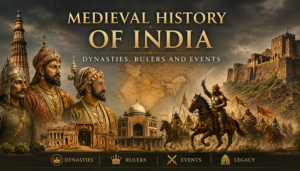
(Political Power, Cultural Synthesis, and Regional Flourishing in India, c. 600–1700 CE)
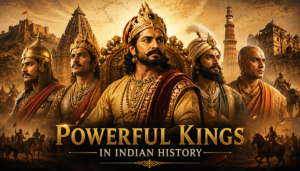
The medieval period of Indian history, stretching roughly from the seventh to the seventeenth century CE, was marked by profound political transformations, cultural synthesis, religious evolution, and regional diversification. Unlike the large centralized empires of the Mauryas and Guptas, medieval India witnessed the rise of multiple regional kingdoms, each contributing uniquely to the subcontinent’s political traditions, economic structures, artistic expressions, and religious life. This era laid the foundations of many social and cultural patterns that continue to shape India today.
Medieval Indian history is often divided into two broad phases: the Early Medieval Period (c. 600–1200 CE) and the Late Medieval Period (c. 1200–1700 CE). While political power shifted repeatedly, the period as a whole was characterized by resilience, adaptability, and remarkable cultural creativity.
Early Medieval India: Regional Powers and Political Fragmentation
After the decline of the Gupta Empire, India entered an era of political decentralization. No single power controlled the entire subcontinent, but strong regional kingdoms emerged across different regions.
Harsha and the Revival of North India
One of the most notable early medieval rulers was Harshavardhana (c. 606–647 CE). Ruling from Thanesar and Kannauj, Harsha reunited much of northern India after a period of fragmentation.
Harsha was:
-
A capable administrator
-
A patron of learning and the arts
-
A supporter of Buddhism and Hinduism
The Chinese pilgrim Xuanzang visited his court and left detailed accounts of Harsha’s administration and generosity. After Harsha’s death, however, his empire quickly disintegrated, underscoring the fragile nature of political unity during this era.
The Rise of Rajput Kingdoms
From the eighth century onward, Rajput clans emerged as dominant political forces in northwestern and central India. Kingdoms such as:
-
The Chauhans
-
The Pratiharas
-
The Chandelas
-
The Paramaras
These rulers emphasized martial values, honor, and lineage. Rajput architecture flourished in the form of forts and temples, such as Khajuraho, which combined political authority with artistic excellence.
Southern Kingdoms: Stability and Cultural Grandeur
While northern India experienced frequent invasions and political instability, southern India enjoyed longer periods of stable rule under powerful dynasties.
The Chalukyas and Rashtrakutas
The Chalukyas of Badami (6th–8th centuries) and later the Rashtrakutas (8th–10th centuries) dominated the Deccan region.
Their contributions included:
-
Rock-cut cave architecture (Ajanta, Ellora)
-
Promotion of Sanskrit and regional languages
-
Religious tolerance among Hinduism, Buddhism, and Jainism
The Chola Empire: Maritime Power and Administration
One of the most remarkable medieval Indian dynasties was the Chola Empire (c. 9th–13th centuries CE). Centered in Tamil Nadu, the Cholas built a powerful empire extending across southern India and overseas into Southeast Asia.
Key features of Chola rule:
-
Highly organized administration
-
Village self-government through sabhas
-
Strong navy and overseas trade
-
Monumental temple architecture
The Brihadeeswara Temple at Thanjavur stands as a masterpiece of Chola engineering and devotion.
Cultural and Religious Developments
Bhakti Movement
One of the most transformative developments of medieval India was the Bhakti movement, which emphasized personal devotion to a chosen deity over ritual and caste hierarchy.
Saints such as:
-
Ramanuja
-
Basava
-
Kabir
-
Mirabai
-
Tulsidas
Used regional languages to spread spiritual messages, making religion accessible to the common people and fostering social unity.
Growth of Regional Languages and Literature
Medieval India witnessed the rise of:
-
Tamil, Telugu, Kannada, Marathi, Bengali, and Hindi literature
-
Court poetry and devotional songs
-
Translation of Sanskrit texts into regional languages
This linguistic flowering strengthened regional identities while preserving cultural continuity.
Late Medieval Period: Islamic Kingdoms and Cultural Synthesis
Delhi Sultanate (1206–1526 CE)
The establishment of the Delhi Sultanate marked a new phase in Indian history. Rulers such as:
-
Qutbuddin Aibak
-
Alauddin Khalji
-
Muhammad bin Tughlaq
Introduced centralized administration, land revenue reforms, and new architectural styles.
Despite political challenges, the Sultanate facilitated:
-
Indo-Islamic cultural synthesis
-
Urban growth
-
Expansion of trade networks
The Vijayanagara Empire
In southern India, the Vijayanagara Empire (1336–1646 CE) emerged as a powerful Hindu kingdom resisting northern invasions.
Its capital, Hampi, became one of the world’s largest cities, renowned for:
-
Monumental architecture
-
Economic prosperity
-
Cultural patronage
The Mughal Empire
The medieval period reached its political zenith with the rise of the Mughal Empire (1526–1707 CE). Rulers such as Akbar, Jahangir, Shah Jahan, and Aurangzeb created a centralized state with a sophisticated administrative system.
Key achievements:
-
Land revenue system (mansabdari)
-
Promotion of art, miniature painting, and architecture
-
Construction of monuments like the Taj Mahal
Akbar’s policy of religious tolerance and cultural integration remains one of the most celebrated aspects of Mughal rule.
Economic Life and Trade
Medieval India was deeply integrated into global trade networks:
-
Indian textiles dominated world markets
-
Spices, gemstones, and agricultural goods were exported
-
Ports like Calicut, Surat, and Masulipatnam flourished
Guilds and merchant communities played vital roles in economic growth.
Art and Architecture
Medieval Indian art reflected religious diversity and regional styles:
-
Temple architecture (Nagara, Dravida, Vesara)
-
Indo-Islamic structures (mosques, forts, tombs)
-
Miniature paintings under the Mughals
This period produced some of India’s most iconic cultural landmarks.
Decline and Transition
By the late seventeenth century, internal conflicts, administrative strain, and European intervention weakened traditional kingdoms. The decline of the Mughal Empire paved the way for colonial rule, marking the end of the medieval period.
Historical Significance of Medieval Indian Kingdoms
Medieval Indian kingdoms:
-
Preserved and transformed ancient traditions
-
Encouraged cultural and religious synthesis
-
Developed regional identities
-
Advanced art, architecture, and literature
Conclusion
The medieval period of Indian history was not an age of decline but one of dynamic transformation and cultural resilience. Through the rise and fall of kingdoms, India remained a vibrant center of civilization, creativity, and spiritual exploration. The legacy of medieval Indian kingdoms continues to influence the nation’s cultural and historical identity, standing as a testament to India’s enduring capacity for renewal and synthesis.