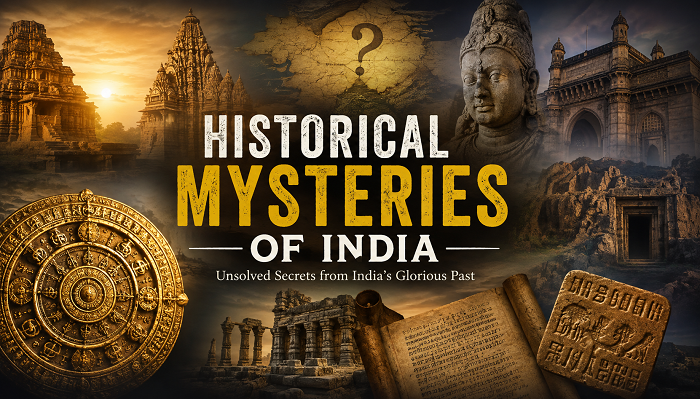
India’s past is documented through inscriptions, monuments, manuscripts, archaeological remains, oral traditions, and accounts written by travellers. Yet some parts of that past remain surprisingly difficult to explain. The most fascinating historical mysteries of India are not simply supernatural stories; many involve genuine gaps in archaeological or historical evidence.
Researchers have solved parts of several mysteries through archaeology, genetics, linguistics, and modern scientific techniques. Others remain open to interpretation. Here are some famous examples where the evidence still leaves important questions unanswered.
1. The Undeciphered Indus Valley Script
The Indus Valley Civilization produced one of the ancient world’s most sophisticated urban cultures. Excavations at Harappa, Mohenjo-daro, Dholavira and other sites have revealed planned streets, drainage systems, standardized weights, seals and impressive architecture.
One problem remains: the symbols appearing on thousands of seals and objects have not been conclusively deciphered.
Most inscriptions are extremely short, which makes linguistic analysis difficult. Researchers also lack a bilingual inscription comparable to the Rosetta Stone. Until the script is reliably understood, questions about the civilization’s administration, beliefs, languages and social organization may remain unanswered.
Why This Is One of the Greatest Historical Mysteries of India
Deciphering the script could transform our understanding of ancient South Asia. Numerous interpretations have been proposed, but no reading has achieved broad scholarly acceptance. This is an important distinction: an attractive theory is not the same as a decipherment supported by reproducible evidence.
2. Son Bhandar Caves and the Legendary Hidden Treasure
Located at Rajgir in Bihar, the Son Bhandar caves are associated with a popular story about a hidden royal treasure.
The caves themselves are historically significant rock-cut structures. Local legends claim that enormous wealth is concealed behind a stone wall and that an inscription provides clues for opening it.
The treasure story has attracted considerable attention, but compelling archaeological evidence confirming a secret treasure chamber has not emerged. The contrast between the physical monument and the folklore surrounding it makes Son Bhandar particularly interesting.
3. What Really Happened at Roopkund Lake?
High in the Himalayas of Uttarakhand lies Roopkund, commonly called Skeleton Lake because human remains have been discovered around the area.
For years, explanations ranged from an ancient military disaster to pilgrims being killed during an extreme hailstorm. Scientific research, including genetic analysis, complicated the story further by indicating that the remains were not necessarily from one population or a single event.
This makes Roopkund one of the most unusual historical mysteries of India. Instead of providing one simple answer, modern research has shown that people may have died there during different periods.
4. The Engineering Questions Around Ancient Indian Temples
India’s historic temples demonstrate remarkable achievements in stone carving, architecture and structural engineering. Sites such as the Kailasa Temple at Ellora are especially impressive.
Kailasa was carved from rock rather than assembled from individual stone blocks. The scale of excavation, planning and sculptural detail continues to inspire questions about how ancient builders organized labour and executed such ambitious designs with the technology available to them.
There is no need to invoke lost supernatural technology. The more useful historical question is how skilled craftspeople, architects and labour forces coordinated such extraordinary projects.
Separating Engineering Achievement From Internet Myths
Online discussions often exaggerate genuine historical mysteries. Claims that a monument was created overnight or could not possibly have been built using ancient tools should be treated carefully.
Archaeology works by comparing physical evidence, inscriptions, construction techniques and historical context. Recognizing the capabilities of ancient engineers often provides a more compelling story than sensational speculation.
5. The Disappearance of Nana Sahib
Nana Sahib became one of the prominent figures associated with the uprising of 1857. After British forces regained control of key territories, his later movements became difficult to establish with certainty.
Different accounts suggested that he escaped toward Nepal or survived elsewhere under another identity. Reports of sightings appeared over the years, but his final fate was never conclusively established.
Unlike mysteries rooted in ancient archaeology, this case demonstrates how even relatively recent history can contain significant gaps when records are incomplete, politically influenced or contradictory.
How to Explore Historical Mysteries Responsibly
Anyone researching Indian historical mysteries should distinguish among archaeological evidence, established historical interpretation and folklore. Start with reports from archaeological institutions, museum collections, peer-reviewed research and recognized historians.
Check when a claim first appeared. A story repeated across hundreds of websites may still originate from one unsupported source. Also remember that “unexplained” does not automatically mean supernatural; it may simply mean that the surviving evidence is insufficient for a definite conclusion.
Visiting museums and heritage sites can also add valuable context. Seeing inscriptions, architecture and archaeological remains firsthand often makes it easier to understand why historians reach certain conclusions.
Conclusion
The enduring appeal of the historical mysteries of India comes from the questions they raise about civilizations, people and events separated from us by centuries or millennia. The undeciphered Indus script, Roopkund remains, Son Bhandar legends, extraordinary temple engineering and the uncertain fate of Nana Sahib all show that history is not always a completed story.
New archaeological discoveries and advances in genetics, dating techniques and linguistic analysis may eventually answer some of these questions. Until then, these mysteries offer a compelling reason to explore India’s history with curiosity—and with respect for evidence.