Political Transformation, Social Change, and Cultural Continuity
Introduction
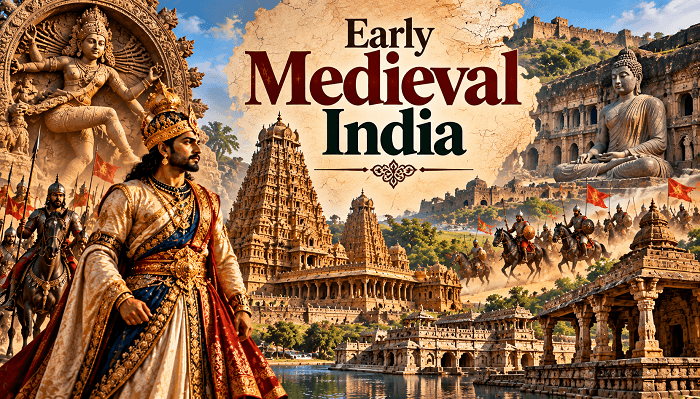
The period between 600 CE and 1200 CE marks a crucial transitional phase in Indian history, commonly referred to as Early Medieval India. This era stands between the classical age of the Guptas and the advent of Islamic rule in North India. Far from being a “dark age,” as once believed by colonial historians, this period was characterized by political decentralization, regional state formation, agrarian expansion, cultural synthesis, and religious transformation.
Early Medieval India witnessed the decline of large imperial structures and the rise of regional kingdoms, each with its own administrative systems, cultural expressions, and economic patterns. Simultaneously, Indian society underwent profound changes in land relations, caste structure, religious practices, and artistic traditions. This chapter explores the political, economic, social, religious, and cultural developments that shaped this important phase of Indian history.
1. Political Landscape: From Empire to Regions
Decline of Imperial Authority
With the collapse of the Gupta Empire in the late 6th century, India entered a phase of political fragmentation. The absence of a centralized imperial power led to the emergence of numerous regional kingdoms, particularly in North, South, and Eastern India. Unlike the Guptas or Mauryas, these kingdoms rarely controlled vast territories for long durations.
The weakening of central authority resulted in:
-
Frequent wars between neighboring states
-
Shifting boundaries
-
Short-lived dynasties
-
Increased autonomy of local rulers and feudatories
Major Regional Kingdoms
North India
-
Harsha of Kannauj (606–647 CE) emerged as a notable ruler who temporarily restored political unity in North India.
-
After Harsha’s death, North India again fragmented into multiple Rajput states.
Prominent Rajput dynasties included:
-
Pratiharas (Rajasthan and Kannauj)
-
Palas (Bengal and Bihar)
-
Rashtrakutas (Deccan, often competing in North Indian politics)
This tripartite struggle between Palas, Pratiharas, and Rashtrakutas dominated North Indian politics for nearly two centuries.
South India
South India experienced relative political stability and strong state formation:
-
Pallavas of Kanchipuram
-
Chalukyas of Badami
-
Rashtrakutas (later dominant in Deccan)
-
Cholas (rose to power after 850 CE)
The Chola Empire deserves special mention for its:
-
Strong centralized administration
-
Efficient revenue system
-
Naval power and overseas trade
2. Administrative Structure and Feudal Trends
Rise of Feudalism
One of the defining features of Early Medieval India was the growth of feudal relations, often referred to as Indian feudalism.
Key characteristics included:
-
Land grants to Brahmins, temples, and officials
-
Emergence of samantas (feudal lords)
-
Decentralization of political authority
-
Hereditary offices and privileges
Land grants were often tax-free and transferred revenue rights from the state to private individuals, weakening royal control over resources.
Samanta System
Samantas were local chiefs or feudatories who:
-
Collected revenue
-
Maintained troops
-
Owed military service to kings
-
Gradually became autonomous
Over time, many samantas turned into independent rulers, contributing to political instability.
3. Agrarian Expansion and Economy
Expansion of Agriculture
Despite political instability, this period saw significant agrarian expansion:
-
Forest lands were cleared for cultivation
-
New villages were established
-
Irrigation systems improved, especially in South India
The Cholas developed extensive irrigation networks using:
-
Tanks
-
Canals
-
River embankments
Village Economy
The village became the basic unit of administration and economy:
-
Self-sufficient production
-
Artisans, peasants, and traders coexisted
-
Village assemblies (sabhas) played an important role
In South India, sabhas and ur (village assemblies) managed:
-
Local disputes
-
Land distribution
-
Temple administration
Trade and Commerce
Trade did not decline but became more localized:
-
Inland trade routes flourished
-
Overseas trade continued with Southeast Asia, China, and Arabia
-
South Indian ports like Nagapattinam and Kaveripattinam thrived
Guilds of merchants and artisans remained influential, especially in urban centers.
4. Social Structure and Caste System
Intensification of Caste Hierarchy
The caste system became more rigid during this period:
-
Brahmins gained increased privileges through land grants
-
Shudras were increasingly tied to agricultural labor
-
Untouchability became more pronounced
Social mobility declined, and birth increasingly determined social status.
Position of Women
The status of women deteriorated in many regions:
-
Child marriage became common
-
Restrictions on widow remarriage increased
-
Practices like sati gained social approval among elite groups
However, women in royal families and religious spheres sometimes enjoyed education and influence.
5. Religious Developments
Decline of Buddhism and Jainism
Buddhism declined significantly due to:
-
Loss of royal patronage
-
Absorption of Buddhist ideas into Hinduism
-
Rise of Brahmanical institutions
Jainism survived mainly in Western and Southern India.
Revival of Brahmanism
Brahmanism evolved into Puranic Hinduism, emphasizing:
-
Bhakti (devotion)
-
Temple worship
-
Personal gods like Vishnu, Shiva, and Devi
This transformation made Hinduism accessible to the masses.
Rise of the Bhakti Movement
The early Bhakti movement began in South India:
-
Alvars (devotees of Vishnu)
-
Nayanars (devotees of Shiva)
Bhakti emphasized:
-
Personal devotion
-
Equality before God
-
Rejection of ritualism
This movement laid the foundation for later medieval religious reform.
6. Temple-Centered Culture
Temples as Economic Centers
Temples were not merely religious spaces but:
-
Centers of education
-
Employers of artisans
-
Storehouses of wealth
-
Landowners and administrators
Large temples controlled vast resources and influenced local politics.
Architecture and Art
Early Medieval India produced remarkable architectural achievements:
-
Rock-cut temples (Ellora, Elephanta)
-
Structural temples (Brihadeshwara Temple, Thanjavur)
-
Development of Nagara (North Indian) and Dravida (South Indian) styles
Sculpture, bronze casting, and mural painting flourished.
7. Literature and Education
Sanskrit and Regional Languages
Sanskrit remained the language of elite learning, administration, and religion.
However, regional languages like:
-
Tamil
-
Kannada
-
Telugu
-
Bengali
began to develop literary traditions.
Educational Institutions
-
Temples and monasteries functioned as learning centers
-
Subjects included philosophy, astronomy, medicine, grammar, and logic
Universities like Nalanda continued to function until the early second millennium.
8. Foreign Contacts and Cultural Exchange
India maintained extensive contacts with:
-
Southeast Asia (Cambodia, Java, Srivijaya)
-
China
-
Arab world
Indian culture influenced:
-
Architecture
-
Religion (Hinduism and Buddhism)
-
Administrative ideas
Indian traders and missionaries played a major role in spreading Indian civilization abroad.
Conclusion
Early Medieval India was not a period of decline but one of transformation and transition. While political fragmentation replaced imperial unity, it also encouraged regional cultural growth, local governance, and religious creativity. The foundations laid during this period—agrarian expansion, temple-centered society, bhakti traditions, and regional identities—shaped the course of Indian history for centuries to come.
Understanding Early Medieval India is essential to comprehending the later developments of the Delhi Sultanate, Mughal Empire, and even modern Indian society. It was an age that quietly but decisively reshaped the Indian subcontinent.