Subhas Chandra Bose Biography: His Life, INA and India’s Freedom Struggle
Subhas Chandra Bose, widely remembered as Netaji, occupies a distinctive place in the history of India’s struggle for independence. He was a nationalist leader whose political ideas and methods differed in important ways from those of leaders who relied primarily on non-violent mass movements.
Bose believed that India needed to achieve independence through determined political action and, particularly during the Second World War, he sought international assistance to challenge British rule. His journey took him from Bengal’s political circles to Europe and Southeast Asia, where he became associated with the Indian National Army (INA) and the Provisional Government of Free India.
His life was marked by political disagreements, imprisonment, an extraordinary escape from British surveillance, military organization and continuing historical debate.
Early Life of Subhas Chandra Bose
Subhas Chandra Bose was born on 23 January 1897 in Cuttack, then part of the Bengal Presidency under British rule.
His father, Janakinath Bose, was a respected lawyer, while his mother, Prabhavati Devi, came from a traditional Bengali family. Bose grew up in a large family in an environment where education, discipline and cultural values were highly regarded.
During his childhood and teenage years, he developed a strong interest in philosophy, spirituality and the condition of India under colonial rule. The political atmosphere of Bengal also influenced his understanding of nationalism.
Education and Early Political Thinking
Bose received his early education at Ravenshaw Collegiate School in Cuttack. He later studied in Calcutta, including at Presidency College and Scottish Church College.
His academic ability was strong, but his student years were also influenced by political events and his growing opposition to colonial discrimination.
In 1919, Bose travelled to England to prepare for the Indian Civil Service examination. He successfully passed the examination and achieved a high position among the candidates.
However, a career serving the colonial administration did not fit with his political convictions. In 1921, he resigned from the Indian Civil Service and decided to dedicate himself to India’s independence movement.
This decision became an important turning point in his life.
Association with Chittaranjan Das
After returning to India, Bose became associated with Chittaranjan Das, popularly known as Deshbandhu.
Das became an important political mentor for Bose. Under his influence, Bose developed experience in political organization, public administration and nationalist activities.
Bose gradually became an influential figure among younger nationalists in Bengal. His organizational abilities and willingness to challenge British authority brought him into conflict with the colonial government on several occasions.
Imprisonment by the British Government
Bose was arrested several times during his political career.
His imprisonment affected his health, but it did not end his political activities. His repeated arrests also increased his visibility among supporters of the independence movement.
During the 1920s and 1930s, Bose became increasingly convinced that India needed a more forceful and organized approach toward independence.
At the same time, he continued to work within the Indian National Congress, where different leaders held different views about the methods and timing of the independence struggle.
Bose and the Indian National Congress
Bose rose rapidly within Congress politics.
In 1938, he was elected president of the Indian National Congress at the Haripura Session.
During his presidency, he emphasized:
- Industrial development
- Scientific research
- Economic planning
- National defence
- Social and economic modernization
He believed that an independent India would need strong institutions and rapid economic development.
In 1939, Bose was again elected Congress president at Tripuri. However, disagreements between Bose and sections of the Congress leadership became increasingly serious.
These disagreements involved questions of political strategy, organization and India’s approach to the British government.
Bose eventually resigned from the Congress presidency.
Formation of the Forward Bloc
After leaving the Congress presidency, Bose established the Forward Bloc in 1939.
The organization sought to bring together nationalist and left-wing forces and push for a stronger struggle against British rule.
The British authorities considered Bose a significant political threat. He was eventually placed under house arrest.
However, his political activities did not stop.
The Escape from British House Arrest
One of the most remarkable episodes of Bose’s life occurred in January 1941.
While under house arrest in Calcutta, Bose secretly escaped. He travelled under an assumed identity and eventually made his way through Afghanistan and onward to Europe.
His escape required careful planning and assistance from several people.
He eventually reached Germany, where he attempted to gain international support for India’s independence.
The episode became an important part of the popular story surrounding his life and contributed to his reputation as a determined and resourceful nationalist leader.
Subhas Chandra Bose in Germany
During his time in Germany, Bose established the Free India Centre and worked to build support for India’s independence.
He also became associated with the Indian Legion, which was formed from Indian prisoners of war captured by Axis forces in Europe.
Bose hoped that Britain’s involvement in the Second World War would create an opportunity for India’s independence movement.
His relationship with Germany was part of his broader strategy of seeking assistance from countries that were fighting Britain’s wartime alliance.
This part of his political career remains historically significant because it demonstrates the international dimension of his independence strategy.
Journey to Southeast Asia
Bose later travelled from Europe to Southeast Asia during the Second World War.
There he found an established network of Indian nationalists and soldiers associated with the Indian National Army.
The INA had initially been organized under the leadership of Captain Mohan Singh and others. Bose subsequently took leadership of the organization and reorganized it on a larger scale.
He became its most prominent political and military figure.
Indian National Army and Netaji
Under Bose’s leadership, the Indian National Army (INA) became closely associated with the slogan of armed struggle for India’s independence.
Bose addressed soldiers and supporters with the call:
“Delhi Chalo”
Another famous phrase associated with him was:
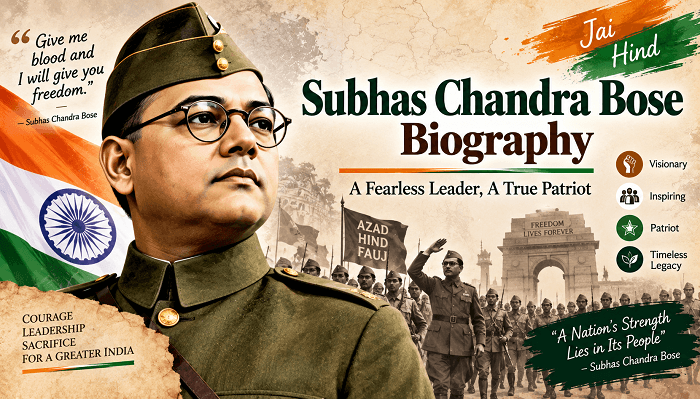
“Give me blood, and I will give you freedom.”
The INA included Indian soldiers and volunteers from Southeast Asia.
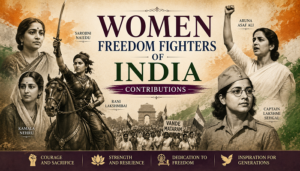
Bose also supported the participation of women in the independence struggle. The Rani of Jhansi Regiment, commanded by Captain Lakshmi Sahgal, became an important example of women’s participation in the INA.
Azad Hind Government
In 1943, Bose announced the establishment of the Provisional Government of Free India, commonly known as the Azad Hind Government, in Singapore.
The government claimed to represent an independent India and received recognition from several Axis-aligned countries.
Bose became its head and continued to organize political and military activities from Southeast Asia.
The government had symbols associated with statehood, including its own currency and stamps.
INA Campaign in Northeast India
The INA, supported by Japanese forces, participated in military operations against British and Allied forces in the northeastern region of the Indian subcontinent.
The Imphal and Kohima campaigns of 1944 became important episodes in the military history of the Second World War in South Asia.
The campaign eventually failed because of military, logistical and supply difficulties.
The INA could not achieve its objective of advancing into India and overthrowing British rule.
Nevertheless, the INA became a powerful symbol within the wider history of India’s independence movement.
INA Trials and Their Public Impact
After the Second World War, several INA officers were put on trial at the Red Fort in Delhi.
The trials attracted considerable attention throughout India.
Public demonstrations and political campaigns developed around the defence of the INA officers. The events became part of the political atmosphere surrounding the final years of British rule.
Historians continue to discuss the precise role played by the INA and the trials in Britain’s eventual decision to leave India. The subject should therefore be understood as part of a larger combination of political, economic, military and international developments that shaped India’s independence in 1947.
What Happened to Subhas Chandra Bose?
Subhas Chandra Bose is widely reported to have died following an aircraft crash on 18 August 1945 in Taihoku, then under Japanese control and now known as Taipei, Taiwan.
However, questions surrounding his disappearance and reported death continued for decades.
The Government of India subsequently established committees and commissions to investigate different aspects of the case.
As a result, Bose’s death remains an important subject of historical discussion and public interest.
Subhas Chandra Bose’s Legacy
Subhas Chandra Bose left behind a complex political and historical legacy.
He is remembered for:
- His commitment to India’s independence
- His organizational abilities
- His leadership of the INA
- His international efforts during the Second World War
- His emphasis on industrial and scientific development
- His support for women’s participation in the INA
- His determination to challenge British rule
His political methods, especially his decision to seek assistance from Axis powers during the Second World War, have also been subjects of historical debate.
Studying Bose therefore requires understanding both his contribution to India’s independence movement and the difficult international circumstances in which he operated.
10 Important Facts About Subhas Chandra Bose
- Born: 23 January 1897
- Birthplace: Cuttack, Odisha
- Popular name: Netaji
- Education: Ravenshaw Collegiate School and institutions in Calcutta and England
- ICS: Passed the Indian Civil Service examination and resigned in 1921
- Congress President: 1938 and 1939
- Forward Bloc: Founded in 1939
- INA: Became its leading figure during the Second World War
- Azad Hind Government: Established in 1943
- Reported death: 18 August 1945
Frequently Asked Questions
Who was Subhas Chandra Bose?
Subhas Chandra Bose was an Indian nationalist leader who played a prominent role in India’s independence movement and later led the Indian National Army.
Why is Subhas Chandra Bose called Netaji?
The title Netaji, meaning “Respected Leader,” became associated with Bose during his activities in Southeast Asia.
What was the Indian National Army?
The Indian National Army was an armed organization formed during the Second World War with the objective of fighting British rule in India. Bose later became its most prominent leader.
When was the Azad Hind Government established?
Bose announced the Provisional Government of Free India, commonly called the Azad Hind Government, in 1943.
When did Subhas Chandra Bose die?
He is widely reported to have died following an aircraft crash on 18 August 1945, although circumstances surrounding his death have remained the subject of historical controversy.
Historical Sources and References
For transparency, article ke end mein actual sources do. Generic “scholarly books” likhne ke bajay specific sources use karo:
- Ministry of Culture, Government of India — Netaji Subhas Chandra Bose
- National Archives of India — Netaji Papers
- Press Information Bureau, Government of India — Netaji Subhas Chandra Bose
- NCERT — Modern Indian History educational resources
- Government of India’s historical records relating to the Indian National Army and INA trials
Ministry of Culture — Netaji Subhas Chandra Bose