(The Foundations of Indian Civilization and Thought)
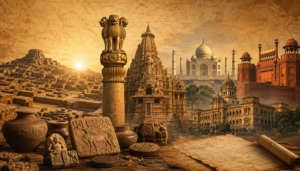
The Vedic Age marks one of the most formative periods in Indian history, laying the intellectual, social, religious, and cultural foundations of what later evolved into classical Indian civilization. Spanning roughly from c. 1500 BCE to 600 BCE, this era is named after the Vedas, the oldest surviving sacred texts of India and among the most ancient religious scriptures in the world. The Vedic Age represents a transition from the urban culture of the Indus Valley to a predominantly rural, pastoral, and later agrarian society shaped by ritual, philosophy, and evolving social institutions.
Historians usually divide the Vedic Age into two broad phases: the Early (Rigvedic) Period and the Later Vedic Period. Together, these phases reflect a gradual transformation in political organization, economy, religion, and social structure, ultimately giving rise to early states, new philosophical ideas, and the foundations of Hinduism.
Origins and Historical Background
The beginning of the Vedic Age is closely associated with the arrival and settlement of Indo-Aryan-speaking groups in northwestern India after the decline of the Indus Valley Civilization. These groups migrated into the Indian subcontinent through mountain passes such as the Khyber Pass, gradually spreading across the Sapta Sindhu region (the land of the seven rivers), including the Indus and its tributaries.
Unlike the Harappans, the early Vedic people lived mostly in small tribal settlements rather than large cities. Their culture was preserved orally, with hymns and rituals passed down from generation to generation through meticulous memorization, a tradition that ensured remarkable textual accuracy over centuries.
The Vedas: Core of Vedic Culture
At the heart of the Vedic Age lie the four Vedas:
-
Rigveda – A collection of hymns dedicated to natural forces and deities
-
Samaveda – Chants and melodies used in rituals
-
Yajurveda – Ritual formulas and sacrificial procedures
-
Atharvaveda – Hymns dealing with daily life, healing, magic, and social concerns
The Rigveda, the earliest of the four, provides invaluable insight into early Vedic society, beliefs, and values. It portrays a world centered on nature, ritual sacrifice, and the quest for divine favor.
Early Vedic (Rigvedic) Society
Political Organization
Early Vedic society was tribal and pastoral in nature. The basic political unit was the jana (tribe), which later evolved into the janapada (territorial settlement). The head of the tribe was known as the rajan (king), who was not an absolute monarch but a tribal leader supported by assemblies such as:
-
Sabha – Council of elders
-
Samiti – Popular assembly of tribal members
These institutions suggest that early Vedic governance had participatory and consultative elements.
Economic Life
The Rigvedic economy was primarily pastoral, with cattle being the principal measure of wealth. Words for war often revolved around cattle raids, emphasizing their importance. Agriculture existed but was secondary during the early phase.
Other economic activities included:
-
Craft production (pottery, carpentry)
-
Barter-based trade
-
Limited use of metals, mainly copper and bronze
Social Structure
Early Vedic society was relatively egalitarian. Although social divisions existed, they were flexible. The concept of varna (social classification) was in an embryonic stage and based more on occupation than birth.
Women enjoyed a comparatively high status:
-
Participation in religious rituals
-
Access to education
-
Composition of hymns by women sages such as Gargi and Lopamudra
Religion and Beliefs in the Early Vedic Period
Religion during the early Vedic period was simple and nature-oriented. The Vedic people worshipped forces of nature personified as gods, including:
-
Indra – God of thunder and war
-
Agni – God of fire and mediator between gods and humans
-
Varuna – Guardian of cosmic order (ṛta)
-
Surya – Sun god
Sacrifices (yajnas) formed the core of religious practice. These rituals were performed to ensure prosperity, victory, and protection. There were no temples or idols; worship was conducted in open spaces.
Later Vedic Period: Transformation and Change
Around 1000 BCE, Vedic society began to undergo profound changes as Indo-Aryan groups moved eastward into the fertile Ganga-Yamuna plains. The adoption of iron technology (krishna ayas) revolutionized agriculture, leading to surplus production and population growth.
Political Developments
Tribal units evolved into territorial kingdoms. The rajan became more powerful and hereditary, supported by officials, priests, and standing armies. Large kingdoms known as mahajanapadas began to emerge toward the end of the Vedic Age.
Royal rituals such as:
-
Rajasuya
-
Ashvamedha
-
Vajapeya
were performed to assert political authority and divine legitimacy.
Economic Expansion
The Later Vedic economy was predominantly agrarian. Improved farming techniques and iron tools led to:
-
Increased agricultural output
-
Growth of villages and towns
-
Emergence of private land ownership
-
Expansion of trade and exchange
Craft specialization increased, and early forms of taxation appeared, strengthening state structures.
Social Stratification and the Varna System
One of the most significant developments of the Later Vedic period was the rigidification of the varna system into four hereditary classes:
-
Brahmins – Priests and scholars
-
Kshatriyas – Warriors and rulers
-
Vaishyas – Farmers, traders, artisans
-
Shudras – Service providers
Social mobility declined, and birth increasingly determined social status. Patriarchal norms strengthened, and women’s position gradually deteriorated compared to the early Vedic period.
Religion in the Later Vedic Period
Religion became more complex and ritualistic. Sacrifices grew elaborate, costly, and exclusive, dominated by Brahmin priests. At the same time, philosophical inquiry deepened, leading to the composition of:
-
Brahmanas – Ritual explanations
-
Aranyakas – Forest texts
-
Upanishads – Philosophical treatises
The Upanishads introduced revolutionary ideas such as:
-
Brahman (ultimate reality)
-
Atman (soul)
-
Karma
-
Samsara
-
Moksha
These concepts shifted focus from ritual action to knowledge and self-realization, profoundly influencing Indian philosophy.
Education and Learning
Education was conducted through the gurukul system, where students lived with their teachers and received instruction in:
-
Vedic literature
-
Grammar and phonetics
-
Astronomy and mathematics
-
Ethics and philosophy
Oral transmission remained central, emphasizing discipline, memory, and moral conduct.
Art, Culture, and Daily Life
Vedic culture valued music, poetry, and oral performance. Hymns were composed in refined Sanskrit, contributing to the development of classical Indian language and literature.
Daily life revolved around:
-
Agricultural cycles
-
Domestic rituals
-
Seasonal festivals
-
Family and kinship ties
Hospitality, truthfulness, and respect for elders were emphasized as moral ideals.
End of the Vedic Age and Its Legacy
By around 600 BCE, the Vedic Age gradually gave way to a new historical phase marked by:
-
Urbanization
-
Rise of powerful kingdoms
-
Emergence of heterodox philosophies such as Buddhism and Jainism
However, the legacy of the Vedic Age endured and continues to shape Indian civilization.
Historical Significance of the Vedic Age
The Vedic Age contributed enduring elements to Indian culture:
-
Sanskrit as a classical language
-
Core religious and philosophical concepts
-
Social institutions and rituals
-
Foundations of Hinduism
-
Early political and economic systems
Conclusion
The Vedic Age was not merely a historical period but a civilizational turning point. It witnessed the transformation of nomadic tribes into settled communities, the evolution of religious ritual into philosophical inquiry, and the emergence of social and political institutions that shaped India’s future. Through the Vedas and associated texts, the voices of this ancient age continue to resonate, offering insight into humanity’s timeless search for order, meaning, and truth.