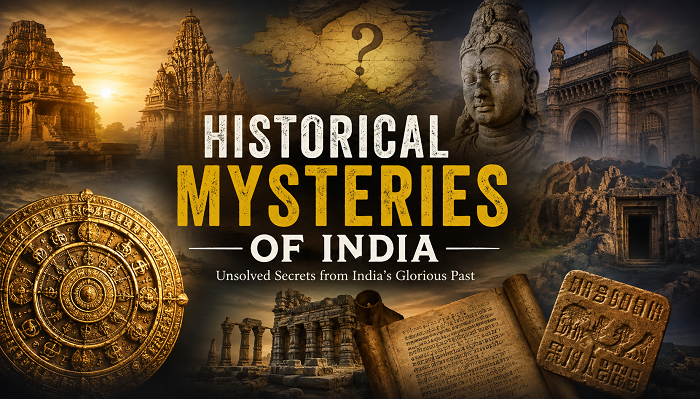
Ancient India was home to sophisticated settlements, trading centres, ports and royal capitals long before many modern cities existed. Some flourished for centuries before environmental change, shifting trade routes, political upheaval or other forces altered their fortunes. Today, their ruins provide remarkable windows into the past.
The lost cities of ancient India are particularly fascinating because archaeology allows us to move beyond legends. Streets, reservoirs, inscriptions, workshops, temples and everyday objects reveal how people actually lived. From the carefully engineered settlement of Dholavira to the monumental ruins of Hampi, these places show the diversity and ingenuity of India’s urban past.
Why the Lost Cities of Ancient India Still Matter
Archaeologists do more than uncover spectacular monuments. They study pottery, construction techniques, plant remains, coins, inscriptions, water systems and settlement patterns to reconstruct everyday life.
These findings can reveal how ancient communities responded to drought, conducted long-distance trade or organized crowded urban spaces. Such evidence also challenges a common mistake: assuming ancient societies were technologically simple.
Several Indian archaeological sites demonstrate advanced approaches to water conservation, city planning, craftsmanship and commerce that remain impressive today.
Dholavira: A Harappan City Built Around Water
Located on Khadir Island in Gujarat’s Kutch region, Dholavira was an important settlement of the Harappan, or Indus Valley, Civilization.
What makes Dholavira exceptional is its sophisticated water-management system. The city incorporated reservoirs, channels and carefully planned structures designed to collect and conserve water in an environment where freshwater could be scarce.
Its urban layout also reveals distinct sections and substantial stone architecture. Archaeologists have uncovered evidence of craft activity, trade and a large inscription consisting of Indus symbols.
What Dholavira Reveals About the Lost Cities of Ancient India
Dholavira demonstrates that ancient urban success depended on adapting to local geography rather than following one universal model. Its inhabitants developed infrastructure suited to a challenging landscape.
UNESCO inscribed Dholavira as a World Heritage Site in 2021, recognizing its importance as one of the best-preserved urban settlements associated with the Harappan Civilization.
Lothal: An Ancient Centre of Trade and Craftsmanship
Another important Harappan site, Lothal, lies in present-day Gujarat.
The settlement is well known for its association with maritime trade and a large brick-built basin traditionally interpreted as a dockyard, although aspects of its exact function have been debated by researchers.
Archaeological discoveries also point to specialized industries. Bead-making, metallurgy, shell working and standardized weights suggest a community deeply involved in production and exchange.
Lothal is especially valuable for understanding how ancient Indian settlements may have participated in wider commercial networks connecting regions of South Asia with communities farther west.
Hampi: The Magnificent Capital That Became Ruins
Hampi offers a very different chapter of Indian urban history. Located in Karnataka, it was part of Vijayanagara, the capital of the powerful Vijayanagara Empire.
Travellers who visited the city described its markets, temples and prosperity. Its surviving landscape includes monumental temple complexes, bazaars, gateways, royal structures and sophisticated waterworks.
Following the Battle of Talikota in 1565, Vijayanagara experienced extensive destruction and political decline. The ruins that remain today demonstrate the extraordinary scale of the former capital.
Rather than a mysterious city that simply vanished, Hampi illustrates how warfare and changing political power can transform a thriving metropolis.
Kalibangan: Evidence of Early Urban Planning
Kalibangan in Rajasthan is another major archaeological site associated with the Harappan world.
Excavations revealed planned streets, houses and evidence interpreted as an ancient ploughed field. Archaeologists also identified both pre-Harappan and Harappan phases at the site, making it particularly useful for understanding how settlements changed over time.
Its location near the Ghaggar river system has also contributed to research into ancient environments and settlement patterns in northwestern India.
Common Mistakes When Reading About Ancient Lost Cities
The biggest mistake is treating every dramatic online claim as established history. Archaeological sites often attract stories about supernatural destruction, impossible technologies or civilizations disappearing overnight.
Reliable historical interpretation works differently. Experts compare excavation reports, dating evidence, environmental data, inscriptions and material remains before drawing conclusions.
Another mistake is assuming that “lost” means completely unknown. Many ancient sites were known locally long before systematic archaeological excavation brought their historical significance to wider attention.
How to Explore These Ancient Cities Responsibly
If you plan to visit archaeological sites in India, read information published by the Archaeological Survey of India, UNESCO, museums and established academic sources beforehand. Knowing the basic chronology makes ruins far easier to understand.
At the site, look beyond the largest monument. Drainage channels, wells, streets, workshops and water reservoirs often reveal more about everyday life than a single impressive structure.
Most importantly, avoid touching carvings, removing fragments or entering restricted archaeological areas. Preservation allows future generations—and future researchers—to continue learning from these places.
Conclusion
The lost cities of ancient India reveal that the subcontinent’s urban history was remarkably varied. Dholavira demonstrates sophisticated water management, Lothal provides evidence of craft production and trade, Kalibangan preserves clues to early settlement planning, while Hampi illustrates the scale and eventual decline of a great imperial capital.
Archaeology continues to refine what we know about these places, and future discoveries may change existing interpretations.