Important Documents in India
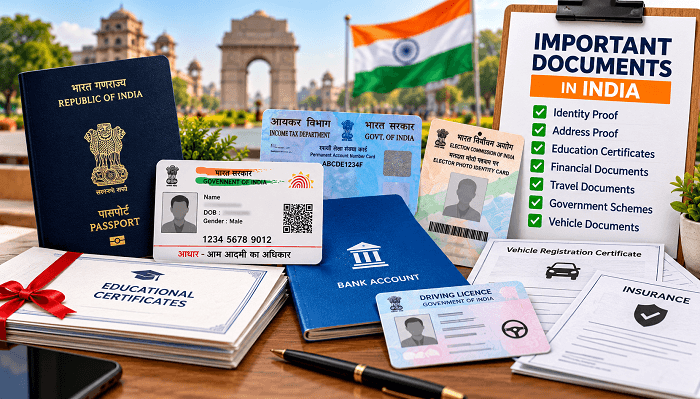
Essential Documents Every Indian Citizen Should Keep Updated
Imagine applying for a job, opening a bank account, receiving a government benefit, or booking an international trip, only to discover that your name differs across two documents. A small spelling mistake or an outdated address can lead to delays, extra paperwork, and unnecessary stress.
Keeping the important documents in India updated is a practical step that can make everyday life easier. Identity proof, address proof, educational certificates, financial records, and other official documents may be required at different stages of life. However, not every document serves the same purpose, and some updates are mandatory only under specific circumstances.
This guide explains which documents Indian citizens should review, what to check, and how to maintain their records safely.
Why Keeping Important Documents in India Updated Matters
Official documents help establish your identity, address, qualifications, financial details, and eligibility for particular services. Banks, employers, educational institutions, government departments, and travel authorities may request different records depending on the situation.
For example, a person applying for a job may need educational certificates and identity proof, while someone purchasing property may need identity documents, financial records, and transaction-related paperwork.
Keeping your documents organised can help you:
- Complete applications with fewer delays.
- Correct inconsistencies before they become bigger problems.
- Access eligible government services and benefits.
- Maintain accurate financial and employment records.
- Respond more easily to emergencies or important life events.
The key is to review documents regularly rather than waiting until an application deadline.
10 Important Documents in India Every Citizen Should Review
The following checklist covers commonly used documents. Your individual requirements will depend on your age, occupation, financial situation, and eligibility for particular services.
1. Aadhaar Card
Aadhaar is widely used for identity verification and, where permitted, authentication for various services. Review your name, date of birth, photograph, and registered mobile number for accuracy.
Update your address when necessary and check the current UIDAI rules for demographic or biometric updates. Aadhaar is not proof of citizenship, and it should not automatically be assumed to replace every other identity document.
2. PAN Card
A Permanent Account Number (PAN) is important for tax-related activities and many financial transactions. Check that your name and other particulars match your supporting records.
If your name changes after marriage or another legal event, check the prescribed correction process. Eligible individuals should also review applicable PAN–Aadhaar linking requirements and deadlines through official channels.
3. Voter ID Card
The Voter Photo Identity Card (EPIC) helps identify an elector, but voter registration and eligibility depend on electoral rules.
Review your name, address, and other details in the electoral roll. If you move, follow the prescribed process to update your registration rather than assuming your old address will automatically change.
4. Passport
A passport is essential for international travel and can also serve as an identity and address document where accepted.
Check its expiry date well before planning a trip. If your personal particulars change, determine whether a reissue is required. Visa and destination-country rules may impose additional requirements, so verify these before travelling.
5. Bank Account Records
Keep your bank account details, registered mobile number, email address, nominee information, and KYC records current.
If you change your address or contact details, inform your bank through its authorised channels. Review statements periodically and report suspicious transactions promptly.
6. Birth Certificate
A birth certificate records important details such as a person’s name, date of birth, and place of birth. It can be useful for school admissions, passport applications, and other official processes.
Check the information carefully. Corrections or delayed registration must follow the relevant state or local civil registration procedure.
7. Educational Certificates and Mark Sheets
School certificates, university degrees, mark sheets, and other qualifications may be required for employment, higher education, and professional applications.
Keep the original documents safe and maintain readable digital copies. If your name differs between certificates and identity documents, ask the relevant educational institution about the appropriate correction or supporting-document process.
8. Driving Licence and Vehicle Documents
If you drive, review your driving licence and the relevant vehicle records, including the registration certificate, insurance, and pollution-under-control certificate where applicable.
Check validity and renewal dates. Requirements vary by document and vehicle, so confirm the applicable rules before driving or completing a transfer.
9. Income Tax and Financial Documents
Maintain your Permanent Account Number details, filed income tax returns, Form 16 where applicable, tax-related certificates, and relevant financial statements.
These records can help with tax compliance, loan applications, and financial planning. Keep them for an appropriate period based on applicable legal and financial requirements.
10. Ration Card and Other Government Benefit Records
If you are eligible for a ration card, pension, scholarship, or another public benefit, check the details recorded in the relevant scheme.
Ensure that household information, address, and other required particulars are accurate. Eligibility and documentation requirements differ across schemes and states, so verify changes with the responsible department.
How to Keep Important Documents in India Updated
A simple document-management routine can prevent many common problems.
Create a Personal Document Checklist
Prepare a list of your documents and record their important details, such as expiry dates, correction requirements, and the department responsible for updates.
For example, passport renewal planning is different from correcting a birth certificate or updating bank KYC. Treat each requirement separately.
Follow Official Correction Procedures
Use the authorised government portal, bank, educational institution, or relevant service centre for updates. Check the required application form, supporting documents, fees, and processing time before applying.
Never assume that correcting one document will automatically update every other record.
Store Digital and Physical Copies Securely
Keep original documents in a safe, dry place. Store scanned copies in an access-controlled digital location, and maintain a secure backup.
DigiLocker can help users access and manage supported digital documents. Where applicable, use documents issued or made available through authorised systems rather than relying solely on ordinary photographs or scans.
Common Mistakes to Avoid
Even organised people can overlook small details that cause problems later.
- Ignoring expiry dates: Review passports, driving licences, insurance, and other time-limited documents in advance.
- Using inconsistent personal details: Check spelling, dates of birth, and addresses across records.
- Sharing sensitive information carelessly: Avoid sending identity documents to unknown people or unverified websites.
- Trusting unofficial agents blindly: Verify service providers and never share OTPs, passwords, or unnecessary authentication details.
- Keeping only physical copies: Secure digital backups can help if originals are lost or damaged.
- Assuming every document is compulsory: Requirements depend on the service, scheme, institution, and applicable law.
For legal, tax, or complex identity corrections, seek guidance from the relevant authority or a qualified professional.
Conclusion: Review Your Important Documents in India Today
Keeping the important documents in India accurate and accessible can make job applications, financial transactions, government services, and travel planning much smoother. Aadhaar, PAN, voter ID, passport, bank records, educational certificates, and other relevant documents each serve different purposes.
Start by checking the documents you use most often. Correct errors through authorised channels, note expiry dates, and store your records securely. You do not need to update everything at once; a short, regular review can help you stay organised.
Take action today: make your personal document checklist, identify any outdated details, and begin with the most urgent correction. A little preparation now can save time and trouble later.
Digital Skills for Rural Youth

Digital Skills That Can Help Rural Youth Find New Opportunities
A young person living in a village today can learn graphic design, manage a business’s social media accounts, build websites, or apply for remote jobs without moving to a big city. A smartphone, an internet connection, and a willingness to learn can open doors that were difficult to access just a few years ago.
However, having access to technology is only the first step. Rural youth also need practical skills that help them solve problems, serve customers, and earn an income. Developing digital skills for rural youth can create opportunities in employment, self-employment, online education, and local entrepreneurship.
Whether you are a student, job seeker, farmer’s family member, or aspiring entrepreneur, learning the right digital skills can help you prepare for a changing job market.
Why Digital Skills for Rural Youth Matter
Many young people in rural areas face challenges such as limited local employment, long travel distances to training centres, and fewer opportunities to connect with employers. Digital technology can help reduce some of these barriers.
For example, a student can complete an online course from home, a local shopkeeper can promote products through social media, and a trained freelancer can work with clients in different cities.
Digital skills are also useful beyond online jobs. Understanding digital payments, spreadsheets, online applications, and cybersecurity can make everyday tasks easier and improve workplace productivity.
The goal is not simply to use technology. It is to use it confidently, responsibly, and productively.
7 Digital Skills for Rural Youth to Learn
Not every career requires advanced coding or expensive equipment. Beginners can start with basic computer knowledge and gradually develop specialised skills based on their interests.
1. Basic Computer and Internet Skills
Basic digital literacy is the foundation for almost every technology-related career. Young people should learn to use word processors, spreadsheets, email, web browsers, online forms, and cloud storage.
These skills are valuable for office assistant positions, data entry work, customer support, and administrative jobs.
Practical example: A candidate who can create a professional resume, organise information in Excel, send formal emails, and upload documents correctly is better prepared for many entry-level roles.
Start by practising everyday tasks rather than memorising software features.
2. Digital Marketing and Social Media Management
Small businesses increasingly use digital channels to reach customers. Local clothing shops, coaching centres, restaurants, travel operators, and agricultural businesses may need help promoting their products online.
Useful skills include social media management, search engine optimisation (SEO), content writing, keyword research, and basic advertising analytics.
Practical example: A young person could help a nearby shop create product posts, update its business information, respond to customer enquiries, and measure which posts generate interest.
Build a small portfolio with sample posts and a simple content calendar before approaching potential clients.
3. Graphic Design and Video Editing
Visual content is widely used in advertising, education, entertainment, and online business. Beginners can learn to create posters, thumbnails, promotional banners, short videos, and product catalogues.
Tools such as Canva and beginner-friendly video editors can help learners practise without immediately investing in expensive software.
Practical example: A student who can design attractive YouTube thumbnails or edit short promotional videos may offer services to local businesses, creators, or community organisations.
Focus on readable text, clean layouts, good storytelling, and consistent quality rather than complicated effects.
4. Website Development and Coding
For learners who enjoy logical thinking and problem-solving, web development can offer a path towards technical employment and freelance projects.
Start with HTML, CSS, and JavaScript. Once comfortable with these fundamentals, learners can explore website development frameworks, databases, and backend programming.
Practical example: Build a simple website for a local tuition teacher, showing course details, contact information, class timings, and an enquiry form.
A working project provides stronger evidence of practical ability than a list of completed tutorials alone.
5. Content Writing and SEO
People who enjoy writing can develop skills in blog writing, product descriptions, website content, social media captions, and search-friendly articles.
Good content writing requires more than using keywords. Writers must understand the audience, verify information, organise ideas, and explain topics clearly.
AI writing tools can support brainstorming and editing, but the writer remains responsible for accuracy, originality, and useful insights.
Create three to five sample articles on topics you understand well. These samples can form the foundation of a writing portfolio.
6. Data Entry, Excel, and Data Analysis
Spreadsheets are useful in offices, shops, schools, warehouses, and many other workplaces. Learning Excel or Google Sheets can help young people organise records, calculate totals, prepare reports, and identify patterns.
After mastering formulas, sorting, filtering, and charts, interested learners can progress to data analysis tools and basic SQL.
Accuracy and confidentiality are especially important when working with customer or business information.
7. Online Business and E-Commerce Skills
Digital skills can also help rural youth build their own businesses. Instead of relying only on walk-in customers, entrepreneurs can use online channels to showcase products and receive enquiries.
Useful skills include product photography, digital payments, customer communication, online catalogues, inventory tracking, and order management.
For example, a small business selling handmade crafts, clothing, or locally produced goods can use digital catalogues and social media to reach customers beyond its immediate neighbourhood.
Before investing money, test demand on a small scale and calculate packaging, delivery, platform, and marketing costs.
How to Start Learning Digital Skills in Rural Areas
You do not need to learn everything at once. A focused learning plan is often more effective than collecting certificates from multiple courses.
Follow these steps:
- Choose one skill: Select an area that matches your interests and available resources.
- Use accessible learning resources: Explore free tutorials, online learning materials, and practical exercises.
- Practise regularly: Set aside 30–60 minutes daily, depending on your schedule and internet access.
- Build real projects: Create sample designs, websites, articles, spreadsheets, or marketing campaigns.
- Prepare a portfolio: Save your best work in an organised folder or online portfolio.
- Look for opportunities: Approach local businesses, apply for entry-level jobs, or explore reputable freelance platforms.
- Improve through feedback: Review mistakes, ask for constructive feedback, and update your projects.
Learners with limited internet access can download learning materials when connected and practise offline where possible. Shared community facilities and local training centres may also provide access to computers.
Common Mistakes Rural Youth Should Avoid
Learning digital skills becomes more productive when you avoid a few common mistakes.
- Trying to learn everything together: Master one useful skill before adding another.
- Expecting instant income: Finding clients or securing employment takes time and consistent effort.
- Paying for unrealistic promises: Be cautious of courses or recruiters guaranteeing high income without credible evidence.
- Ignoring practical experience: Build projects that demonstrate what you can actually do.
- Neglecting online safety: Never share OTPs, passwords, or sensitive financial information with unknown people.
- Using AI without checking facts: Verify important claims and review AI-generated content before publishing or submitting it.
Remember that a certificate may support your application, but demonstrated skills, communication, reliability, and problem-solving are also important.
Where Can Rural Youth Find Learning and Career Opportunities?
Young learners can explore government-supported digital literacy initiatives, vocational training centres, community computer centres, online learning platforms, and apprenticeship opportunities.
In India, the Skill India Digital Hub and the National Career Service portal are useful starting points for exploring skill development and employment-related resources. Check current course availability, eligibility, fees, and registration requirements before enrolling.
Local businesses can also be valuable learning partners. Offering to create a sample poster, organise a spreadsheet, or improve a basic website can help you gain practical experience and understand what customers need.
Choose opportunities carefully. Verify employers, check payment terms, and avoid jobs that require upfront fees merely to secure employment.
Conclusion: Build Your Future with Digital Skills
The right digital skills for rural youth can create new pathways into employment, freelancing, entrepreneurship, and lifelong learning. From basic computer operations to coding, digital marketing, and online business management, there are options for different interests and experience levels.
Start with one skill, practise consistently, and create work that demonstrates your ability. You do not need to wait until you have expensive equipment or advanced qualifications to begin learning.
Take your first step today: choose a digital skill, complete a practical beginner project, and use that experience to prepare for your next opportunity. Your progress will come from applying what you learn, improving your work, and staying open to new possibilities.
Free AI Tools for Students and Job Seekers
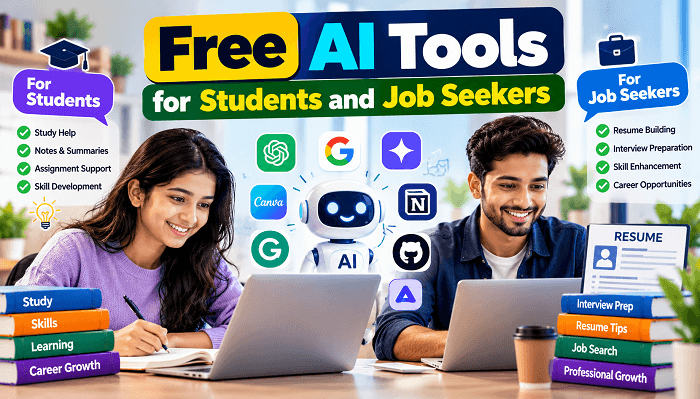
Artificial intelligence is changing how people learn, develop skills, and prepare for employment. Students can use AI to understand difficult subjects, organize assignments, and practise new skills. Job seekers can use it to improve their resumes, prepare for interviews, and discover ways to present their experience more effectively.
The good news is that you do not always need an expensive subscription to get started. Many platforms offer free plans, limited free access, or useful tools that can help with everyday tasks. Choosing the right free AI tools for students can save time while helping learners become more independent.
However, AI is not a replacement for studying, practical experience, or professional judgment. The best results come from using it as a learning assistant rather than accepting every answer without checking it.
This guide explores useful AI tools for students and job seekers, explains how to use them, and shares practical tips for getting better results without overspending.
Why Free AI Tools for Students and Job Seekers Matter
Students and job seekers often face similar challenges: limited time, a need to learn new skills, and pressure to produce quality work.
AI tools can help break large tasks into manageable steps. For example, a college student preparing for an examination can request a topic-wise revision plan. A fresher applying for a software development role can practise technical interview questions and identify gaps in their knowledge.
These tools can support:
- Understanding difficult topics through simpler explanations
- Creating revision notes, quizzes, and study schedules
- Improving grammar, writing clarity, and communication
- Preparing resumes and cover letters
- Practising interview questions and answers
- Learning coding, data analysis, and other job-related skills
The key is to select tools according to your goal instead of signing up for every AI platform you encounter.
Best Free AI Tools for Students
Different tools work best for different tasks. The following options have free access or free-tier features, although usage limits and availability may change.
1. ChatGPT — Learning and Study Assistance
ChatGPT can explain concepts, generate practice questions, summarize material you provide, and help you plan your studies.
For example, a student learning PHP can ask for a beginner-friendly explanation of Laravel routing, followed by a practical coding exercise. You can also request examples in simple English or ask for an explanation in Hindi.
Best for: Study planning, concept explanations, brainstorming, coding practice, and revision.
2. Google Gemini — Research and Idea Development
Google Gemini can help brainstorm project ideas, explain concepts, organize information, and assist with writing tasks. Depending on the available features, it may also help you work with supported Google services.
A student preparing a presentation could use it to develop an outline, suggest discussion questions, and identify areas that need further research.
Best for: Brainstorming, learning support, outlining, and organizing ideas.
3. NotebookLM — Understanding Study Materials
NotebookLM is useful when you have several documents to study. You can provide supported source materials and ask questions about their contents, helping you focus on specific topics rather than searching through every page manually.
For example, a student preparing for a competitive examination could use their notes to generate revision questions and identify important concepts.
Best for: Document-based learning, revision, and understanding supplied materials.
4. Grammarly — Writing Improvement
Grammarly can help identify grammar issues, improve clarity, and make professional writing easier to read. Its free features can be useful for assignments, emails, and job applications.
Use its suggestions to learn from your mistakes rather than accepting every change automatically.
Best for: Grammar, proofreading, and professional communication.
Free AI Tools for Job Seekers
Finding a job requires more than submitting applications. You need to communicate your skills clearly, prepare for interviews, and understand what employers expect.
AI can make this process more structured, particularly for freshers and people changing careers.
1. Canva — Resume and Portfolio Design
Canva offers design tools and templates that can help you create a resume, portfolio, or professional presentation. Some AI-powered features are available subject to plan limits.
Choose a clean, readable resume format and prioritize relevant skills and achievements over decorative graphics.
Best for: Resume layout, portfolios, and job application presentations.
2. Microsoft Copilot — Writing and Preparation
Microsoft Copilot can assist with brainstorming, drafting professional messages, explaining concepts, and practising interview questions. Available features depend on your account, region, and plan.
For example, you can ask it to generate interview questions for a customer support role and then practise answering them one at a time.
Best for: Interview preparation, communication, and workplace learning.
3. GitHub Copilot — Coding Practice
For students and job seekers pursuing software development, GitHub Copilot can provide AI-assisted coding suggestions in supported development environments. Its free access is subject to eligibility and usage limits.
Use coding assistants to understand suggested solutions, test your code, and learn why a particular approach works. Do not rely on generated code without reviewing it.
Best for: Programming practice, code completion, and learning software development workflows.
How to Use Free AI Tools for Students Effectively
Access to an AI tool is only the beginning. Your instructions determine how useful its response will be.
Create Better Prompts
Instead of typing, “Teach me JavaScript,” provide a clear goal and your current skill level.
For example:
“Act as a JavaScript tutor. I am a beginner. Explain arrays using three simple examples, give me five practice questions, and provide the answers separately.”
For job preparation, try:
“Act as an interviewer for an entry-level Laravel developer role. Ask one question at a time, wait for my answer, and explain how I can improve it.”
These prompts establish the context, expected format, and level of difficulty. You can use the same approach with most general-purpose AI assistants.
Common Mistakes to Avoid When Using AI
AI can be helpful, but careless use can create problems.
Submitting AI-generated assignments without understanding them: Read, verify, and rewrite material in your own words. Follow your institution’s rules on AI assistance.
Trusting every answer: AI may produce inaccurate facts, outdated information, fabricated references, or incorrect code. Verify important claims using reliable sources and test technical solutions.
Using the same resume for every job: Tailor your resume to the role, emphasizing relevant skills and genuine achievements. Never invent qualifications or experience.
Sharing personal information: Avoid uploading passwords, identity documents, confidential employer information, or sensitive personal data.
Ignoring free-plan limits: Some tools restrict messages, file uploads, advanced features, or monthly usage. Check the current terms before building an important workflow around a particular feature.
A Simple Daily AI Learning Routine
You can begin with a practical routine without paying for multiple subscriptions.
- 30 minutes: Learn one new concept using an AI tutor.
- 20 minutes: Complete exercises without copying the suggested answers.
- 20 minutes: Improve a resume, portfolio, or professional communication skill.
- 20 minutes: Practise interview questions or work on a small project.
- 10 minutes: Review what you learned and note any mistakes.
Adjust the schedule according to your classes, job search, and available time. Consistent practice and real projects are more valuable than simply collecting AI-generated notes.
Conclusion
The right free AI tools for students can make learning more manageable, improve communication, and help job seekers prepare for employment with greater confidence. Tools such as ChatGPT, Gemini, NotebookLM, Grammarly, Canva, Microsoft Copilot, and GitHub Copilot can support different tasks, depending on their current free features and usage limits.
Start with one tool that solves your biggest problem. Use it to learn, practise, and improve your work, but verify important information and develop your own skills along the way.
Ready to get started? Choose a tool from this guide today, set one clear learning or career goal, and spend the next seven days using it consistently. Your progress will depend less on the number of tools you use and more on what you learn to do with them.
Free Online Courses for Students
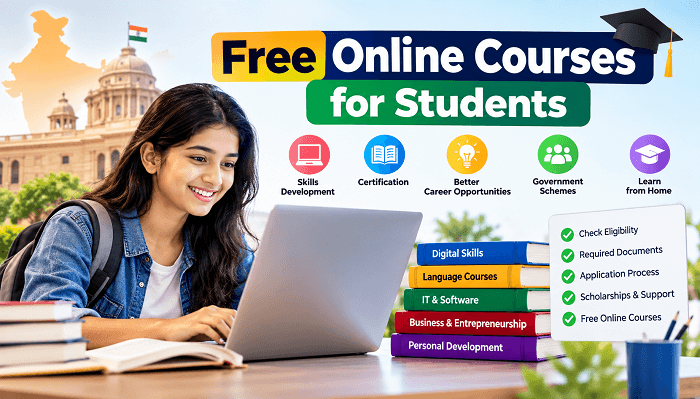
How to Check Eligibility for Government Schemes in India
India offers numerous government schemes designed to support students, farmers, women, job seekers, senior citizens, small business owners, and low-income households. However, finding the right scheme is only the first step. You also need to understand its eligibility conditions, required documents, application process, and deadlines.
For example, a student looking for financial assistance may qualify for a scholarship, a skill-development programme, or free online courses for students offered through an eligible educational initiative. Similarly, a rural household may qualify for housing, healthcare, or livelihood assistance depending on its circumstances.
The challenge is knowing which benefits apply to you without wasting time on unsuitable applications. This guide explains how to check government scheme eligibility in India, verify important details, and avoid common mistakes before applying.
Why Checking Government Scheme Eligibility Matters
Government schemes have different objectives and eligibility rules. Some are intended for specific income groups, while others focus on education, employment, agriculture, healthcare, or entrepreneurship.
Eligibility may depend on several factors:
- Age and residential status
- Annual family income
- Educational qualifications or current course
- Occupation and employment status
- Caste or category, where applicable
- Rural or urban residence
- Land ownership, household details, or other scheme-specific conditions
Meeting one condition does not automatically mean you qualify. You must satisfy all mandatory requirements applicable to the scheme.
For students, checking eligibility early can help identify scholarships, vocational training programmes, digital learning resources, and free online courses for students before application deadlines pass.
Check Eligibility for Government Schemes
You do not always need to visit a government office to begin your search. Many schemes publish eligibility information and application instructions online.
Step 1: Identify the Right Scheme
Start by defining what you need. Are you searching for educational support, a scholarship, employment training, healthcare coverage, housing assistance, or financial support for a business?
For example, a college student may investigate central or state scholarships, while an unemployed young person may explore skill-development programmes. A farmer should look for agricultural schemes relevant to their landholding, occupation, and state.
Make a short list of schemes that match your situation instead of applying randomly.
Step 2: Check the Official Eligibility Criteria
Read the scheme’s eligibility requirements carefully. Look for minimum and maximum age limits, income ceilings, education requirements, residency rules, exclusions, and application dates.
Pay attention to the difference between mandatory conditions and preferences. If a scheme requires a particular qualification or income certificate, meeting its other conditions may not be sufficient.
Also check whether the scheme is currently accepting applications. An old article or social media post may describe a programme that has changed or closed.
Step 3: Use Government Portals to Verify Information
Government portals can help you discover schemes and understand their requirements. Depending on the scheme, useful starting points include:
- National Portal of India: General information about government services and initiatives.
- myScheme: A government platform designed to help users discover schemes based on their details.
- National Scholarship Portal: Information and application facilities for participating scholarship programmes.
- Skill India Digital Hub: Information about eligible skill-development and learning opportunities.
These platforms serve different purposes, so choose the one relevant to your needs. Always review the individual scheme’s current guidelines and the responsible department’s instructions before applying.
Free Online Courses for Students and Government Benefits
Education-related benefits can extend beyond scholarships. Students may also find online learning opportunities, vocational training, certification programmes, and digital skills courses.
Free online courses for students can be particularly useful for learners who want to improve their employability without paying substantial training fees. However, course availability, eligibility, certification charges, and assessment requirements vary by provider.
How to Find Free Online Courses for Students
Start by checking government-supported learning and skill-development platforms. Review each course’s entry requirements, language, duration, learning format, and certificate policy.
Before enrolling, ask these questions:
- Is the course genuinely free, including its assessment and certificate?
- Is it open to school students, college students, graduates, or working learners?
- Does it require an institutional email address or identity verification?
- Is the certificate recognized by the relevant employer, institution, or programme?
- Does completing the course qualify you for any additional benefit, or is it only a learning opportunity?
Remember that a free course does not automatically make you eligible for a scholarship or financial assistance scheme. Check the rules of each programme separately.
Documents You May Need Before Applying
Once you identify a suitable scheme, prepare the documents listed in its official guidelines. Common requirements may include:
- Aadhaar or another accepted identity document
- Proof of residence
- Income certificate, where required
- Educational certificates and mark sheets
- Bank account details or accepted proof of account ownership
- Caste or category certificate, if applicable
- Passport-size photograph and a working mobile number
Not every scheme requires all these documents. Some may ask for additional records, while others may use online verification.
Check that your name, date of birth, bank details, and other information match across your documents. Correct discrepancies before submitting an application whenever possible.
Common Mistakes to Avoid When Checking Eligibility
A few simple mistakes can delay an otherwise valid application.
Relying on outdated information: Scheme rules, funding, and application windows can change. Verify the current notification.
Assuming everyone qualifies: Benefits may be restricted by income, age, course, occupation, or location.
Ignoring state-specific schemes: A central programme may not be the only option. Your state government may offer additional assistance.
Submitting incomplete documents: Missing certificates or inconsistent personal details can cause delays or rejection.
Paying unofficial agents: Be cautious of people promising guaranteed approval for a fee. Use official application channels and never share OTPs or banking passwords.
Confusing registration with approval: Submitting an application does not guarantee that you will receive the benefit. Wait for the official status or decision.
Practical Tips for a Successful Application
Create a checklist before applying. Record the scheme name, eligibility conditions, required documents, application deadline, official application portal, and status-checking method.
If you are unsure about a condition, contact the department responsible for the scheme or use its official helpdesk. Keep your application reference number and copies of submitted documents.
Students can follow the same process when comparing scholarships, free online courses for students, and vocational training opportunities. Prioritize programmes that match your educational background, career goals, and financial circumstances.
Conclusion
Checking eligibility for government schemes in India becomes easier when you understand your needs, review the official conditions, prepare the correct documents, and apply through the appropriate portal. Students should explore scholarships, skill-development opportunities, and free online courses for students, while other applicants can investigate benefits relevant to their household, occupation, or location.
Do not rely solely on forwarded messages or promises of guaranteed benefits. Verify current rules before sharing personal information or submitting an application.
Take the next step: Visit a relevant government portal, shortlist schemes that match your circumstances, and check their latest eligibility requirements. A few minutes of careful verification can save time and help you identify opportunities that genuinely fit your needs.
Government Schemes Eligibility
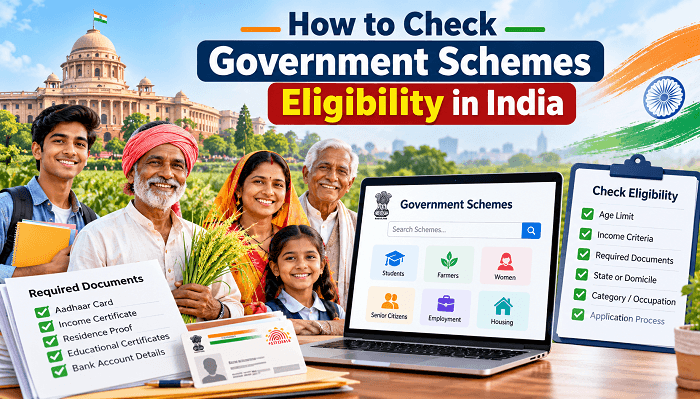
How to Check Eligibility for Government Schemes in India
India offers numerous government schemes designed to support students, farmers, women, senior citizens, workers, entrepreneurs, and families with limited incomes. These programmes may provide scholarships, pensions, financial assistance, insurance, housing support, or help with self-employment. However, not everyone qualifies for every benefit.
Understanding government schemes eligibility before applying can save time, prevent unnecessary paperwork, and help you identify the benefits relevant to your circumstances. The important thing is to look beyond a scheme’s name and understand its actual eligibility rules, required documents, and application process.
In this guide, you will learn how to check eligibility, identify suitable schemes, prepare documents, and avoid common application mistakes.
Why Checking Government Schemes Eligibility Matters
Every government scheme has a specific purpose and target group. Some programmes are designed for households below a defined income threshold, while others focus on education, farming, disability support, employment, or entrepreneurship.
For example, a student seeking financial assistance may need to check educational qualifications, family income, academic performance, and institution requirements. A farmer may need to verify land records, farming status, and other scheme-specific conditions.
Checking eligibility first helps you:
- Identify schemes relevant to your personal and financial circumstances.
- Understand income limits, age requirements, and category-based conditions.
- Prepare the correct documents before submitting an application.
- Avoid applications that do not meet mandatory requirements.
- Reduce the risk of rejection caused by incomplete or incorrect information.
Remember that eligibility for one scheme does not automatically make you eligible for another, even if both programmes serve similar groups.
How to Check Government Schemes Eligibility Online
The easiest starting point is an official government portal. Depending on the scheme, you may find information through central government websites, state government portals, or dedicated department websites.
Step 1: Identify Your Category and Needs
Start by identifying the type of support you need. Consider whether you are looking for:
- Student scholarships and education assistance
- Farmer support and agricultural benefits
- Women-focused welfare programmes
- Pension and senior citizen assistance
- Housing and household support
- Employment, skill development, or self-employment assistance
- Benefits for persons with disabilities or eligible low-income households
This simple step narrows your search and makes it easier to find suitable programmes.
Step 2: Use Official Government Portals
Visit the National Portal of India at india.gov.in or the government’s MyScheme platform at myscheme.gov.in to explore relevant schemes and their eligibility criteria.
You can also check the official website of the ministry or state department responsible for a particular programme.
Read the scheme’s guidelines carefully. Look for the intended beneficiaries, eligibility conditions, benefits offered, required documents, application procedure, and any deadlines.
Do not rely solely on social media posts, forwarded messages, or unofficial websites. Scheme rules and application windows can change, so verify important details through the responsible government department.
Step 3: Check Every Eligibility Condition
Before applying, compare your circumstances with the scheme’s requirements.
Common eligibility conditions include:
- Age: Some schemes have minimum or maximum age limits.
- Income: Benefits may depend on annual family income or a specified economic category.
- Residence: Certain programmes require residence in a particular state or region.
- Occupation: Some benefits are available only to farmers, registered workers, students, or specific professional groups.
- Education: Scholarships may require particular qualifications, marks, or enrolment status.
- Category or disability status: Some schemes include conditions related to officially recognised categories or disability certification.
Meeting one condition is not enough if the scheme has several mandatory requirements. Check every applicable rule before proceeding.
Documents Required for Government Schemes Eligibility
Document requirements differ from one programme to another. Preparing the relevant records in advance can make the application process smoother.
Commonly requested documents include:
- Aadhaar card or another accepted identity document
- Proof of residence or domicile certificate
- Income certificate or other accepted income evidence
- Bank passbook or account details
- Caste certificate, where applicable
- Educational certificates and mark sheets for scholarships
- Land records for relevant agricultural schemes
- Disability certificate, where applicable
- Passport-size photographs and a registered mobile number, if required
Important: This is a general checklist, not a mandatory list for every scheme. Always follow the official scheme guidelines. Ensure that your name, date of birth, address, and other details are consistent across documents wherever required.
How to Confirm Government Schemes Eligibility Before Applying
Finding a scheme is only the first step. You should also confirm whether its conditions match your situation and whether applications are currently being accepted.
Use the myScheme Eligibility Checker
Visit myScheme.gov.in and explore the scheme discovery feature. Enter the requested personal details, such as age, state, income range, occupation, and other relevant information.
The platform can help identify schemes that may suit your profile. Open the individual scheme details to review the eligibility rules, benefits, documents, and application instructions. You may then be directed to the responsible department’s application portal.
Treat the results as a starting point rather than a guarantee of approval. The concerned authority makes the final decision after checking the applicable rules and submitted information.
Verify Application Dates and Local Rules
Some schemes accept applications throughout the year, while others have specific application windows or annual deadlines. State-level programmes may also have different requirements from similar central government schemes.
Check the latest official notification before submitting your application. If any condition is unclear, contact the relevant department, authorised service centre, or designated scheme office.
Common Mistakes to Avoid When Checking Eligibility
Even applicants who appear to qualify can encounter problems because of avoidable mistakes.
1. Trusting unofficial information: Old articles and forwarded messages may contain outdated income limits or application dates. Verify details with the responsible authority.
2. Ignoring state-specific conditions: A central scheme and a state scheme may have different rules. Confirm your state of residence and any domicile requirements.
3. Submitting incomplete documents: Missing certificates, unclear scans, or incorrect bank details can delay processing.
4. Assuming eligibility means guaranteed benefits: Meeting the basic conditions does not always guarantee approval. Verification, available funds, selection criteria, or other scheme-specific rules may apply.
5. Paying unverified agents: Be cautious of anyone promising guaranteed approval for an advance fee. Use official portals and authorised assistance channels, and never share your OTP, PIN, or banking password.
Practical Example: Finding a Suitable Scheme
Suppose a college student from a rural household wants financial assistance for education. Instead of searching only for general government benefits, the student can explore scholarship programmes and filter the options according to state, course, academic performance, family income, and other relevant conditions.
After identifying a potentially suitable scholarship, the student should check whether the institution is eligible, confirm the application deadline, gather the required certificates, and submit the application through the designated official portal.
The same approach works for farmers, job seekers, women, senior citizens, and small business owners: identify the need, check the conditions, verify the documents, and follow the official application process.
Conclusion: Check Government Schemes Eligibility the Right Way
Checking government schemes eligibility is an important step towards finding financial assistance, educational support, pensions, employment opportunities, and other public benefits. Start by identifying your needs, use official government portals to discover suitable programmes, and carefully review every eligibility condition before applying.
Visit myScheme.gov.in to explore schemes relevant to your circumstances. Verify the latest requirements with the responsible department, prepare your documents, and apply through the authorised channel.