A common lesson from beginner yoga sessions is that progress comes from control, not from stretching as far as possible. People often arrive expecting complicated postures, but the most useful early practices involve breathing steadily, moving with awareness, and learning how the body responds.
Yoga for beginners can improve flexibility, balance, posture, and body awareness without requiring advanced fitness. It may also provide a quiet break from a busy routine. You need only comfortable clothing, a nonslip mat, and enough room to extend your arms.
The following poses offer a practical starting point, whether you exercise regularly or have been inactive for some time.
Benefits of Yoga for Beginners
Yoga combines physical movement, controlled breathing, and focused attention. Unlike a workout built entirely around speed or repetition, it encourages you to notice alignment and muscular tension.
Regular practice may help improve strength, mobility, balance, and general well-being. According to the National Center for Complementary and Integrative Health, research suggests that yoga may support stress management, sleep, balance, and certain types of pain. However, it should complement—not replace—appropriate medical care.
Consistency matters more than session length. Ten or fifteen minutes practised several times a week can be more manageable than an exhausting class followed by a long break.
Six Simple Yoga Poses for Beginners
How Should Yoga for Beginners Feel?
A pose may create mild muscular effort or a comfortable stretch, but it should not cause sharp, pinching, or electric pain. Keep breathing normally. If you find yourself holding your breath or forcing a position, reduce the stretch or stop.
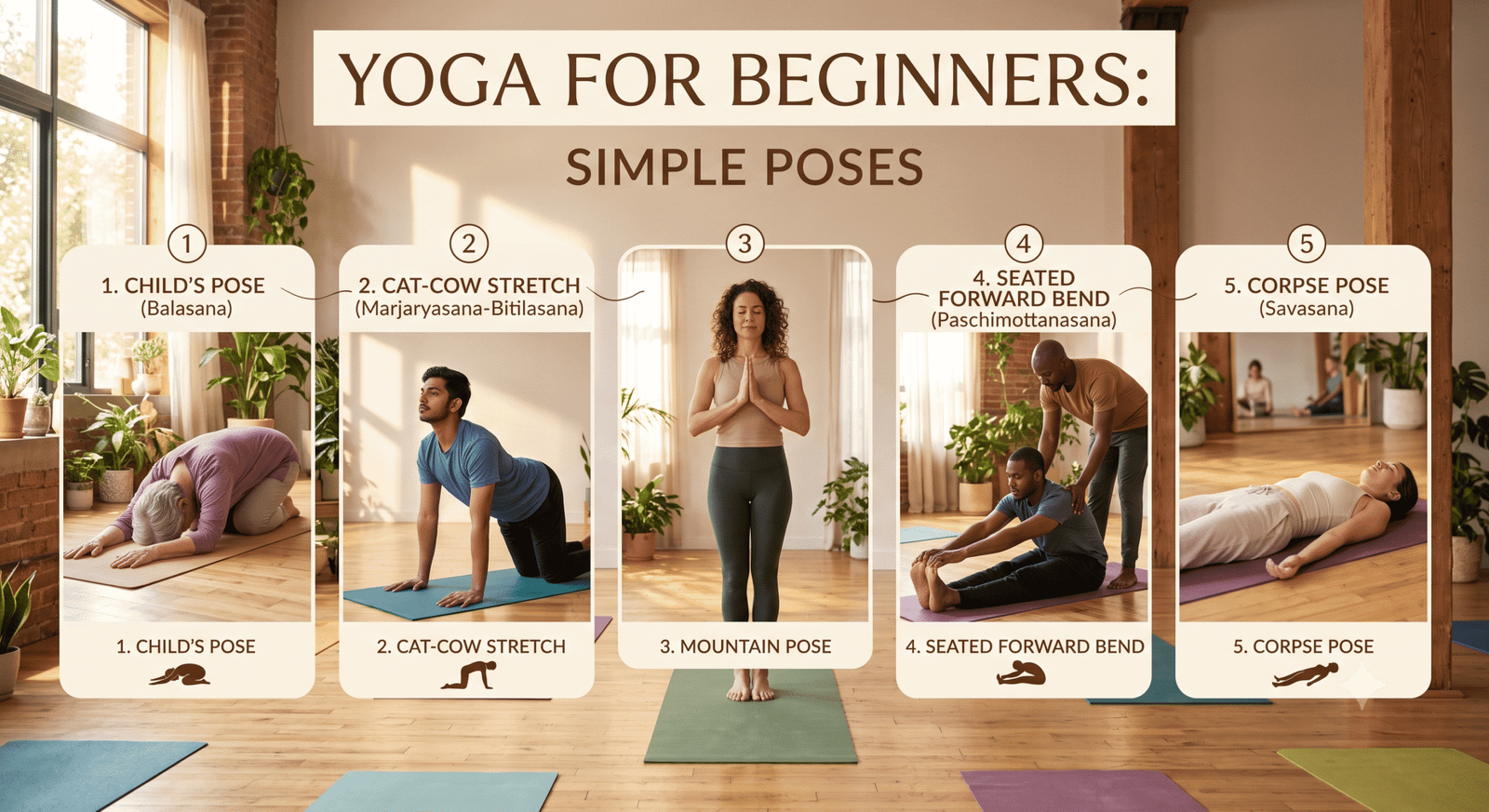
1. Mountain Pose
Stand with your feet hip-width apart and distribute your weight evenly. Relax your shoulders, lengthen your spine, and allow your arms to rest beside you. Look straight ahead and take five slow breaths.
Mountain Pose may appear simple, but it teaches posture and balance. Use it to notice whether you lean more heavily onto one foot.
2. Cat–Cow Stretch
Begin on your hands and knees, placing your wrists under your shoulders and knees under your hips. As you inhale, gently lift your chest and tailbone. As you exhale, round your back and let your head lower naturally.
Repeat six to eight times. This controlled movement can reduce stiffness after prolonged sitting and gently mobilise the spine.
3. Child’s Pose
From your hands and knees, move your hips towards your heels and stretch your arms forward. Rest your forehead on the mat or a folded towel.
Keep your knees wider if that feels more comfortable. Hold the position for five breaths. Child’s Pose works well as a resting posture between more active beginner yoga poses.
4. Low Lunge
Step your right foot between your hands and lower your left knee onto the mat. Keep the front knee roughly above the ankle. Place your hands on your front thigh and gradually lift your torso.
You may feel a stretch across the front of the left hip. Hold for three to five breaths before changing sides. Place a folded towel beneath the back knee if necessary.
5. Cobra Pose
Lie on your stomach with your hands beside your lower ribs. Keep your elbows close to your body. Press lightly through your palms and lift your chest a small distance while keeping your pelvis grounded.
Avoid throwing your head backwards or forcing your arms straight. A low, controlled lift is sufficient to engage the back muscles and open the chest.
6. Supported Downward-Facing Dog
Place your hands on a sturdy chair or wall and step backwards until your torso is almost parallel to the floor. Keep your knees slightly bent and lengthen your spine.
This supported variation provides the benefits of a traditional downward-facing position without placing as much weight on the wrists and shoulders.
A 10-Minute Yoga for Beginners Routine
Start with one minute of slow breathing in Mountain Pose. Continue with Cat–Cow for two minutes, Child’s Pose for one minute, and Low Lunge for one minute on each side. Practise supported Downward-Facing Dog for one minute, followed by gentle Cobra repetitions.
Finish by lying on your back for two minutes with your arms relaxed. Allow your breathing to return to its natural rhythm. Practise this routine three or four times weekly, increasing the duration gradually.
Common Beginner Mistakes to Avoid
Do not compare your flexibility with an instructor or another student. Bone structure, previous injuries, and mobility differ from person to person.
Other common mistakes include locking the knees, holding the breath, moving too quickly, and practising on a slippery surface. Blocks, cushions, straps, and chairs are useful tools—not signs of poor ability.
Choose a qualified instructor when possible, particularly if you are pregnant or have joint problems, balance difficulties, glaucoma, uncontrolled high blood pressure, or a recent injury. Ask a healthcare professional whether particular postures need modification.
Conclusion: Begin Yoga for Beginners Safely
Yoga for beginners should feel steady, comfortable, and sustainable. Start with basic poses, focus on smooth breathing, and give your body time to develop mobility and strength. Improvement may appear as easier movement or better balance rather than dramatic flexibility.
Choose three poses from this guide and practise them today for ten minutes. Keep a short record of how your body feels so you can build a safe routine around genuine progress.