Survival Stories
Juliane Koepcke: The Girl Who Survived the Fall
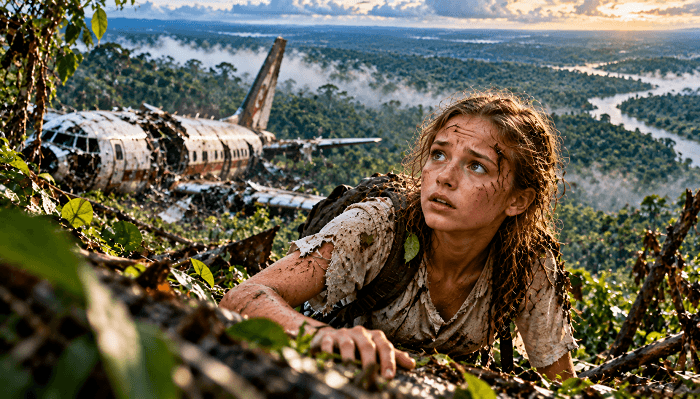
Juliane Koepcke had two incredible stories of survival by the end of her terrifying ordeal. On Christmas Eve in 1971, Koepcke was traveling on LANSA Flight 508 when the plane was struck by lightning. The aircraft began to break apart midair, and Koepcke found herself still strapped to her seat, falling from nearly two miles above the Peruvian rainforest.
She was badly injured. Her body was bruised, and her collarbone was broken. But she was alive—the sole survivor of the crash. Now, she found herself completely alone in the vast jungle. With only a few candies as food, she managed to find a small stream. She followed it downstream, which helped her stay hydrated as she moved forward.
The jungle insects did not kill her, but maggots infested a wound on her arm. After nine days, she managed to find shelter. She gave herself first aid, which included pouring gasoline on the wound to remove the maggots. A few hours later, local lumber workers found her, gave her immediate help, and took her to a more populated area. From there, she was airlifted by helicopter to a hospital.
Her extraordinary story was later told in the 2000 documentary film Wings of Hope, directed by Werner Herzog, who had nearly boarded the same flight before canceling his seat at the last moment.
Related: How to survive a fall from 35,000 feet.
Survival Stories
Wild Boars (Thai football team)
In June 2018, after football practice, 12 members of a Thai football team and their coach decided to explore the nearby Tham Luang Cave, one of the longest cave systems in Thailand.
The boys, aged between 11 and 16, along with their 25-year-old coach, entered the cave and began exploring. Suddenly, flooding pushed them deeper inside, and eventually they reached a high ledge nearly four kilometers into the cave system. Floodwaters filled the winding cave passages, trapping the boys for 17 days. For the first nine days, they had no food and depended on dripping stalactites for water. But they did not sit idle.
When the boys realized they were trapped, they took turns digging a 16-foot-long hole into the cave wall, hoping to find a way out. To conserve energy and avoid thinking about food, they practiced meditation. Meanwhile, British divers, who had entered the cave three hours earlier from the entrance, finally discovered the boys.
Surviving for so long was only half the battle. Members of the Thai Navy SEAL rescue team entered the cave to support the boys and stay with them while a plan was made to bring them out safely. Over the course of a three-day operation, divers successfully rescued each player and their coach.
During the difficult journey to the surface, each boy had to wear a full-face diving mask, remain tied between two divers, and swim for hours through twisting passages and extremely narrow spaces. Thanks to the efforts of the Thai Navy SEALs and the international diving community, all were saved and soon returned to normal, healthy lives after the rescue.
Sadly, during the rescue mission, a former Thai Navy SEAL lost his life.
Also: the true story of the “Miracle Pilot” and his water landing at a speed of 120 miles per hour.