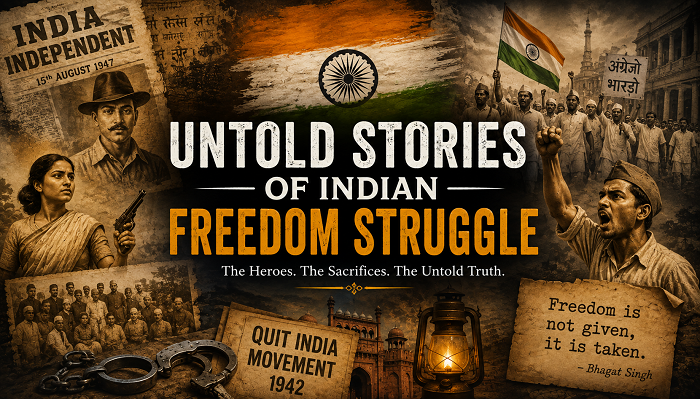
India’s independence movement is often remembered through landmark events such as the Non-Cooperation Movement, Salt March, Quit India Movement and the revolutionary activities of prominent national leaders. Yet this familiar narrative represents only part of a much larger story.
The untold stories of Indian freedom struggle reveal farmers, tribal leaders, women, students, underground revolutionaries and local communities who challenged colonial authority in different ways. Some organized armed resistance; others carried secret messages, mobilized villages, published nationalist literature or endured imprisonment.
Looking beyond the best-known names gives us a richer understanding of how widespread India’s struggle for independence really was.
Why the Untold Stories of Indian Freedom Struggle Matter
The independence movement was not one single campaign conducted from a few major cities. Resistance emerged across different regions and social groups over many decades.
Historians studying colonial records, regional archives, newspapers, memoirs and oral histories have demonstrated the importance of local movements in understanding Indian nationalism. These sources also show why historical context matters: different communities resisted British rule for different economic, political and social reasons.
Learning about lesser-known participants does not diminish famous national leaders. Instead, it shows how their movements were supported by thousands of people whose names rarely appear in popular accounts.
Birsa Munda and the Tribal Challenge to Colonial Rule
Birsa Munda occupies an important place in the history of tribal resistance in India.
Born in the Chotanagpur region in the nineteenth century, Birsa became associated with a movement among the Munda people against exploitation, restrictions on traditional land systems and colonial authority.
The uprising connected with him, commonly known as the Ulgulan or “Great Tumult,” intensified during 1899–1900. British authorities arrested Birsa, and he died in Ranchi jail in June 1900 at only about 25 years of age.
His story is particularly important because it demonstrates that resistance to colonial rule was also closely connected with land rights and indigenous communities.
Birsa Munda Among the Untold Stories of Indian Freedom Struggle
Birsa Munda’s movement took place decades before the major nationwide campaigns of the twentieth century. It reminds readers that opposition to colonial policies developed through numerous regional struggles.
His legacy continues to be remembered as part of India’s tribal history and the wider story of resistance to British rule.
Matangini Hazra: Courage During the Quit India Movement
Women participated in India’s independence movement as organizers, protesters, couriers and revolutionaries. Matangini Hazra of Bengal provides a powerful example.
She became involved in the Gandhian movement and participated in civil disobedience activities. During the Quit India Movement in 1942, Hazra joined a procession in Tamluk that attempted to take control of government institutions.
She was shot by the police while participating in the demonstration and became a lasting symbol of women’s involvement in the freedom struggle.
Her life challenges the misconception that women occupied only supporting roles during the independence movement.
Kanaklata Barua and the Freedom Movement in Assam
India’s northeastern regions also produced remarkable stories of resistance.
Kanaklata Barua was a young participant in the Quit India Movement in Assam. In September 1942, she joined a procession attempting to hoist the Indian national flag at the Gohpur police station.
She was shot during the demonstration while still a teenager.
Kanaklata’s story highlights the geographical reach of the movement. Calls for independence were not limited to Delhi, Bombay, Calcutta or other major political centres; they inspired young people in towns and villages across the country.
Alluri Sitarama Raju and the Rampa Rebellion
In the forest regions of the Madras Presidency, Alluri Sitarama Raju became associated with the Rampa Rebellion of 1922–1924.
The uprising involved tribal communities affected by colonial restrictions and administrative policies. Raju and his followers used guerrilla tactics and attacked police stations to obtain weapons.
British authorities eventually captured and executed him in 1924.
His methods differed considerably from Gandhi’s philosophy of non-violence, illustrating an important historical point: the Indian independence movement contained multiple approaches to resisting colonial power.
The Underground Networks Behind Independence
Not every contribution occurred during a public march or armed rebellion.
Secret networks transported messages, sheltered activists and circulated nationalist publications. During periods of intense repression, underground communication allowed resistance movements to continue when prominent leaders had been arrested.
One notable example was Usha Mehta’s involvement with the underground Congress Radio during the Quit India Movement. The clandestine broadcasts helped communicate nationalist messages while British authorities attempted to suppress information about the movement.
Such activities required planning, secrecy and considerable personal risk.
Common Mistakes When Exploring India’s Freedom Struggle
A common mistake is viewing independence as the achievement of only a small number of famous personalities. Leadership was crucial, but mass participation gave political movements their reach.
Another problem is relying on viral social-media claims without checking historical evidence. Stories about freedom fighters can become exaggerated or inaccurately attributed over time.
For reliable research, readers should compare material from institutions such as the National Archives of India, government museums, university publications, biographies based on primary sources and established historians. Comparing several credible sources is particularly useful when historical accounts disagree.
Conclusion
The untold stories of Indian freedom struggle demonstrate that independence emerged from decades of resistance involving people from remarkably different backgrounds. Birsa Munda fought against colonial policies affecting tribal communities, Matangini Hazra and Kanaklata Barua showed extraordinary courage during the Quit India Movement, while Alluri Sitarama Raju represented another form of anti-colonial resistance.
Behind them were countless organizers, villagers, students, writers and ordinary citizens whose contributions are harder to document but remain part of the broader historical picture.