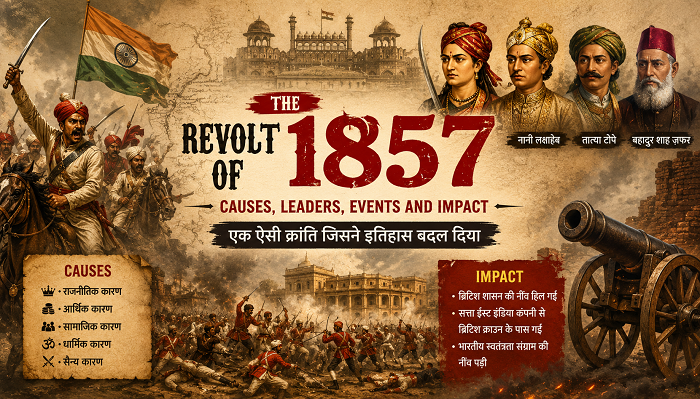
The Revolt of 1857 was one of the most significant uprisings against British rule in nineteenth-century India. It began as a rebellion among sections of the Bengal Army but soon developed into a wider uprising involving rulers, soldiers, landlords, peasants and other groups in several parts of northern and central India.
The revolt had many causes, including military grievances, political annexations, economic pressures and social and religious concerns. Although the uprising was eventually suppressed, it led to major changes in the administration of British India and became an important chapter in the history of India’s later independence movement.
Major Causes of the Revolt of 1857
No single issue caused the uprising. Several long-term grievances created an environment in which military unrest could develop into a much larger rebellion.
Political Causes of the Revolt of 1857
East India Company expansion had weakened or removed numerous Indian ruling houses. Under Governor-General Lord Dalhousie, the Doctrine of Lapse allowed the Company to annex certain princely states when a ruler died without a recognized natural male heir.
Satara, Jhansi and Nagpur were among the territories annexed under this policy. The annexation of Awadh in 1856, although carried out on different grounds, generated particularly strong resentment.
Nana Sahib also had grievances after the Company refused to continue the pension associated with his adoptive father, former Peshwa Baji Rao II.
Economic and Social Causes
British revenue arrangements affected peasants, landholders and traditional elites differently across regions. High revenue demands and changes in land rights contributed to rural dissatisfaction in some areas.
Traditional artisans also faced changing economic conditions as India became increasingly integrated into a colonial trading system dominated by British commercial interests and manufactured imports.
At the same time, some Indians feared that colonial authorities intended to interfere with established religious and social practices. Missionary activity and certain social reforms were interpreted by sections of society as signs of unwanted intervention.
These concerns did not affect every community in the same way, but they contributed to an atmosphere of suspicion.
Military Causes and the Immediate Trigger
Indian soldiers, or sepoys, formed a large part of the East India Company’s armies. Differences in pay, promotion opportunities, overseas service expectations and racial discrimination created resentment among sections of the troops.
The immediate controversy involved cartridges issued for the new Enfield rifle. Soldiers believed that the cartridges were greased with cow and pig fat and had to be bitten open. This offended the religious sensibilities of Hindu and Muslim sepoys.
Mangal Pandey’s actions at Barrackpore in March 1857 became an early symbol of military resistance. The decisive outbreak, however, occurred at Meerut in May.
Major Leaders and Events of the Revolt of 1857
After rebelling at Meerut, sepoys marched to Delhi and declared the ageing Mughal emperor Bahadur Shah Zafar their symbolic leader.
Different centers soon developed their own leadership. Nana Sahib became associated with the uprising at Kanpur, while Begum Hazrat Mahal played an important role in resistance at Lucknow and Awadh.
Rani Lakshmibai of Jhansi emerged as one of the rebellion’s most famous military figures. She fought British forces and later joined resistance around Gwalior before being killed in battle in June 1858.
Other important leaders included Tantia Tope, Kunwar Singh in Bihar and Khan Bahadur Khan in Bareilly.
The rebellion was widespread but not nationwide. Large parts of southern and eastern India did not experience comparable uprisings, while several princely rulers and military groups supported the British.
Why Did the Revolt of 1857 Fail?
The rebels lacked unified leadership, a common military command and a single political objective. Different groups joined for different reasons, which made coordinated action difficult.
British forces also had access to stronger logistical networks, reinforcements and military resources. The telegraph and expanding transport infrastructure assisted communication and troop movement.
Furthermore, not all Indian rulers or soldiers supported the uprising. This limited its geographic and military reach.
By 1858, British forces had regained most major rebel strongholds.
Impact of the Revolt of 1857 on India
Although unsuccessful in overthrowing British power, the rebellion fundamentally changed colonial government.
The Government of India Act 1858 ended the East India Company’s political rule. Administration passed directly to the British Crown, and Queen Victoria’s proclamation later that year announced changes in the government’s approach toward Indian princes and religious affairs.
The British also reorganized the army, altered recruitment patterns and became more cautious in dealing with princely states.
Bahadur Shah Zafar was exiled to Rangoon, marking the effective end of the Mughal dynasty.
Practical Tips for Studying the Revolt
Students should organize the topic into five categories: causes, outbreak, centers, leaders and consequences. A map is especially useful for connecting Meerut, Delhi, Kanpur, Lucknow, Jhansi and Gwalior.
Avoid the common mistake of explaining the entire rebellion through the cartridge controversy. The cartridges were an immediate trigger, but political, military and socioeconomic grievances had developed earlier.
It is also useful to compare colonial, nationalist and modern scholarly interpretations instead of assuming that one label completely explains the uprising.
Causes of the Revolt of 1857
Political Causes
The expansion of British control had affected several Indian rulers and states. The annexation of territories and changes in traditional political arrangements created resentment among sections of the ruling classes.
The Doctrine of Lapse, associated with Governor-General Lord Dalhousie, became particularly controversial because it was used to annex certain states where the British did not recognize adopted heirs.
Economic Causes
British policies also affected sections of peasants, landlords, artisans and traditional industries.
Changes in taxation, land revenue arrangements and the decline of some traditional handicraft industries contributed to economic dissatisfaction in different regions.
Military Causes
Indian soldiers, known as sepoys, formed a large part of the East India Company’s army. They had grievances concerning pay, service conditions, promotion and discrimination.
The immediate controversy surrounding the Enfield rifle cartridges became a major trigger for the uprising.
Social and Religious Concerns
Some sections of Indian society feared that British policies and missionary activities could interfere with established social and religious practices.
It is important, however, to recognize that these concerns varied among different communities and regions.
Beginning of the Revolt
The uprising is generally associated with Meerut on 10 May 1857.
Indian soldiers stationed there rebelled against their British officers and moved toward Delhi.
The rebels reached Delhi and declared Bahadur Shah II (Bahadur Shah Zafar) as their symbolic emperor.
The revolt subsequently spread to several areas of northern and central India.
Major Leaders of the Revolt
Mangal Pandey
Mangal Pandey was a sepoy associated with the events at Barrackpore in March 1857. His actions became part of the events that preceded the wider uprising.
Bahadur Shah Zafar
Bahadur Shah Zafar was the last Mughal emperor. Although he had limited political and military power by 1857, the rebels in Delhi used his position as a symbolic source of legitimacy.
Rani Lakshmibai
Rani Lakshmibai of Jhansi became one of the most prominent figures associated with the revolt. She fought against British forces and became an enduring figure in the historical memory of the uprising.
Nana Sahib
Nana Sahib became an important leader of the rebellion in the Kanpur region.
Tantia Tope
Tantia Tope was a military commander who continued resistance against British forces after the initial stages of the revolt.
Begum Hazrat Mahal
Begum Hazrat Mahal played an important role in the uprising in Awadh and supported resistance against British authority.
Major Centres of the Revolt
The revolt did not occur uniformly across India.
Important centres included:
- Delhi
- Meerut
- Kanpur
- Lucknow
- Jhansi
- Gwalior
- Bareilly
- Bihar
The intensity and character of the rebellion differed from region to region.
This point is important because the entire Indian subcontinent did not participate equally in the revolt.
Why Did the Revolt Fail?
Several factors contributed to the defeat of the uprising.
Limited Geographical Spread
The revolt remained concentrated mainly in northern and central India. Many regions and communities did not participate.
Lack of Unified Leadership
The rebels had different political objectives and did not operate under a single centralized command.
British Military Resources
The British had access to organized military resources, communications and reinforcements.
Support from Some Indian Groups
Some Indian rulers, soldiers and political groups did not join the rebellion and in some cases supported the British.
Communication and Organization
The rebels faced difficulties in coordinating military operations across widely separated regions.
What Changed After the Revolt?
The consequences of 1857 were significant.
The British government ended the rule of the East India Company.
Under the Government of India Act 1858, authority over India was transferred directly to the British Crown.
The British government also reorganized the Indian Army and changed several aspects of its administrative and political policies.
The revolt therefore marked a major turning point in the history of British rule in India.
Historical Significance
The Revolt of 1857 has been interpreted in different ways by historians.
It has been described as:
- A sepoy rebellion
- A major anti-British uprising
- A rebellion involving several social and political groups
- An important early episode in India’s struggle against colonial rule
Rather than assigning it only one label, it is useful to examine the different regional participants, causes and political objectives involved.
This gives readers a more complete understanding of the events of 1857.
Frequently Asked Questions
When did the Revolt of 1857 begin?
The major uprising began at Meerut on 10 May 1857.
Who was the leader of the Revolt of 1857?
There was no single leader of the entire revolt. Different regions had different leaders, including Bahadur Shah Zafar, Rani Lakshmibai, Nana Sahib, Tantia Tope and Begum Hazrat Mahal.
Why did the Revolt of 1857 happen?
The uprising resulted from a combination of political, economic, military and social grievances. The cartridge controversy became an immediate trigger.
What was the result of the Revolt of 1857?
The East India Company’s rule ended and India came directly under the British Crown in 1858.
Historical Sources and References
इस article के अंत में real sources लगाना:
- NCERT — Modern Indian History
- National Archives of India
- British Library — India Office Records
- Encyclopaedia Britannica — Indian Rebellion of 1857
- Government of India historical resources
Conclusion
The Revolt of 1857 was a complex rebellion shaped by military grievances, political expansion, economic pressures and regional interests. Leaders including Rani Lakshmibai, Bahadur Shah Zafar, Nana Sahib, Begum Hazrat Mahal, Tantia Tope and Kunwar Singh became central figures in its history.
Although the uprising failed militarily, it ended East India Company rule and transformed the structure of British administration in India. To understand the event more deeply, explore contemporary records, historical maps, biographies and modern scholarly studies alongside the basic timeline.