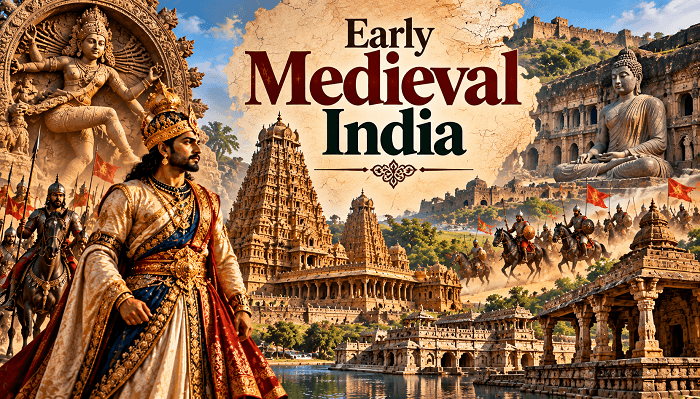
The Chola Empire
Imperial Power, Administration, Maritime Expansion, and Cultural Grandeur
Introduction
Among the regional kingdoms that rose to prominence during the early medieval period, the Chola Empire stands out as one of the most powerful, well-administered, and culturally vibrant states in Indian history. Flourishing primarily in South India between the ninth and thirteenth centuries, the Cholas built an empire that extended far beyond the Tamil heartland, exercising political influence across the Deccan, Sri Lanka, the Maldives, and Southeast Asia.
The Chola state was not merely a military power; it represented a highly evolved system of governance, marked by efficient administration, advanced agrarian management, thriving overseas trade, and extraordinary achievements in art, architecture, and literature. This chapter examines the origins, expansion, administration, economy, society, religion, art, and legacy of the Chola Empire, highlighting its pivotal role in shaping medieval South India and the wider Indian Ocean world.
1. Origins and Early History of the Cholas
Early Cholas (Pre-Imperial Phase)
The Cholas are among the earliest known dynasties in South India, mentioned in:
-
Sangam literature
-
Ashokan inscriptions
-
Greco-Roman accounts
Early Chola rulers such as Karikala Chola (c. 2nd century CE) were known for:
-
Building embankments along the Kaveri River
-
Promoting agriculture
-
Encouraging maritime trade
However, after the Sangam age, the Cholas declined in political importance and were overshadowed by the Pallavas and Pandyas.
Revival of the Cholas
The revival began in the mid-9th century CE, when:
-
Vijayalaya Chola (c. 850 CE) captured Thanjavur from the Pallavas
-
Thanjavur became the new Chola capital
This marked the beginning of the Imperial Chola period, characterized by territorial expansion and centralized authority.
2. Expansion and Consolidation of the Empire
Rajaraja Chola I (985–1014 CE)
Rajaraja Chola I was one of the greatest rulers of the dynasty and the true architect of the Chola Empire.
His achievements included:
-
Defeat of the Pandyas and Cheras
-
Conquest of northern Sri Lanka
-
Expansion into Kerala and Karnataka
-
Establishment of Chola supremacy over South India
Rajaraja reorganized the administration, improved revenue collection, and patronized monumental architecture.
Rajendra Chola I (1014–1044 CE)
Rajendra Chola I expanded the empire to unprecedented heights.
Key achievements:
-
Successful northern expedition up to the Ganga, earning the title Gangaikonda Chola
-
Naval campaigns against Srivijaya (Sumatra, Java)
-
Consolidation of control over Sri Lanka and the Maldives
-
Establishment of a new capital, Gangaikonda Cholapuram
These campaigns transformed the Chola state into a maritime empire and a dominant power in the Indian Ocean.
Later Chola Rulers
Subsequent rulers such as:
-
Rajadhiraja I
-
Kulottunga I
-
Rajaraja II
maintained imperial authority, though the empire gradually weakened due to:
-
Continuous wars
-
Rise of the Hoysalas and Pandyas
-
Administrative overextension
The Chola Empire finally declined in the late 13th century, giving way to Pandya resurgence.
3. Administrative System
Central Administration
The Chola administration was highly organized and centralized, yet allowed significant local autonomy.
The king:
-
Was the supreme authority
-
Issued royal orders (tirumandiram)
-
Maintained a council of ministers
Officials were appointed based on:
-
Merit
-
Loyalty
-
Experience
Departments existed for:
-
Revenue
-
Justice
-
Military
-
Temple management
Provincial Administration
The empire was divided into:
-
Mandalam (province)
-
Valanadu (district)
-
Nadu (sub-district)
-
Village
Governors oversaw mandalams, while local assemblies managed villages.
Village Self-Government
One of the most remarkable features of Chola rule was village self-government, especially through:
-
Sabha (Brahmin villages)
-
Ur (non-Brahmin villages)
-
Nagaram (merchant towns)
The Uttaramerur inscriptions provide detailed rules for:
-
Election of committee members
-
Qualifications and disqualifications
-
Accountability and removal
This system represents one of the earliest examples of democratic local governance in world history.
4. Revenue System and Agrarian Economy
Land Revenue
Agriculture was the backbone of the Chola economy.
Key features:
-
Detailed land surveys
-
Classification of land based on fertility
-
Assessment of taxes in kind and cash
Land was categorized as:
-
Royal land
-
Private land
-
Temple land
Irrigation and Agriculture
The Cholas developed one of the most advanced irrigation systems in pre-modern India:
-
Kaveri River canals
-
Tanks and reservoirs
-
Embankments and sluices
Major crops included:
-
Rice
-
Pulses
-
Sugarcane
-
Cotton
Agricultural surplus supported urbanization, trade, and temple construction.
5. Trade, Commerce, and Maritime Power
Internal Trade
-
Well-maintained road networks
-
Market towns (nagaram)
-
Active merchant guilds such as Manigramam and Ayyavole
Overseas Trade
Chola naval power enabled extensive maritime trade with:
-
Southeast Asia
-
China (Song dynasty)
-
Arabia and East Africa
Exports:
-
Spices
-
Textiles
-
Precious stones
Imports:
-
Gold
-
Horses
-
Luxury goods
The Cholas maintained commercial colonies and diplomatic relations abroad.
6. Military Organization
Army
The Chola military consisted of:
-
Infantry
-
Cavalry
-
Elephants
-
Navy
Standing armies were maintained, and soldiers were paid regularly.
Navy
The Chola navy was among the most powerful in medieval Asia:
-
Enabled overseas conquests
-
Protected trade routes
-
Facilitated cultural exchange
Naval supremacy distinguished the Cholas from most other Indian dynasties.
7. Society Under the Cholas
Caste Structure
Society remained caste-based:
-
Brahmins enjoyed privileges
-
Vellalas dominated agriculture
-
Artisans and traders formed organized guilds
-
Lower castes performed service occupations
Position of Women
Women enjoyed relatively higher status in South India:
-
Participation in temple activities
-
Patronage of arts
-
Some queens wielded political influence
However, patriarchal norms remained dominant.
8. Religion and Temple Culture
Shaivism and Vaishnavism
The Cholas were staunch patrons of Shaivism, though Vaishnavism was also respected.
Kings built and endowed grand temples, including:
-
Brihadeshwara Temple, Thanjavur
-
Temple at Gangaikonda Cholapuram
Temples as Institutions
Temples functioned as:
-
Religious centers
-
Landowners
-
Employers
-
Banks
-
Cultural hubs
They played a central role in social and economic life.
9. Art, Architecture, and Literature
Temple Architecture
Chola architecture reached classical perfection:
-
Towering vimanas
-
Symmetry and proportion
-
Stone construction
The Brihadeshwara Temple remains a UNESCO World Heritage Site.
Sculpture and Bronze Art
Chola bronze sculptures are world-renowned:
-
Nataraja (Dancing Shiva)
-
Graceful proportions
-
Spiritual expression
These bronzes represent the pinnacle of Indian metal art.
Literature
Tamil literature flourished:
-
Kamban’s Ramavataram
-
Shaiva and Vaishnava hymns
-
Inscriptions as historical records
10. Decline of the Chola Empire
Causes of decline:
-
Continuous warfare
-
Administrative strain
-
Rise of Pandya and Hoysala powers
-
Loss of control over trade routes
By the late 13th century, Chola authority had collapsed.
Conclusion
The Chola Empire represents one of the greatest achievements of medieval Indian civilization. Its legacy lies not only in territorial conquests but in administrative innovation, maritime enterprise, cultural excellence, and social organization. The Cholas transformed South India into a center of political power and cultural brilliance, leaving an enduring imprint on Indian history and the broader Indian Ocean world.
Their achievements continue to inspire historians, artists, and political thinkers, making the Chola Empire a cornerstone of India’s medieval past.