Rani Lakshmibai Story Life Courage Legacy
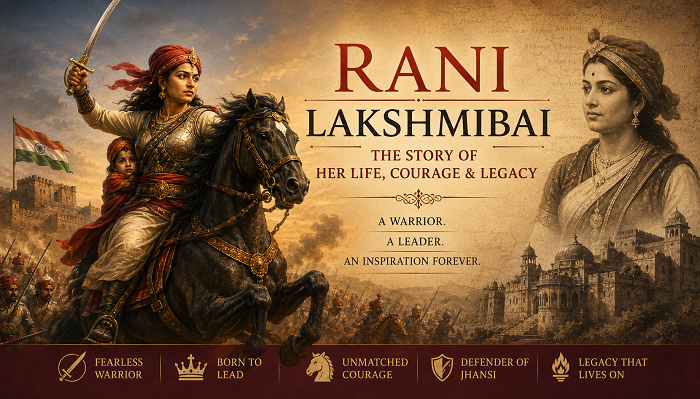
When researching the Revolt of 1857, one figure repeatedly stands out—not simply because she fought the British, but because she became a ruler, military leader, and enduring political symbol during one of the most turbulent periods of nineteenth-century India. The Rani Lakshmibai story is therefore much more than the famous image of a warrior queen riding into battle.
Born as Manikarnika Tambe, she experienced personal loss, a succession dispute, British annexation, rebellion, and eventually war—all before her death at around 29 years of age.
Understanding her real journey helps separate historical evidence from popular legend while revealing why the Queen of Jhansi continues to occupy such an important place in Indian history.
Rani Lakshmibai Story: From Manikarnika to Queen of Jhansi
Rani Lakshmibai was born Manikarnika Tambe, commonly believed to have been born in Varanasi in 1828. She was affectionately known as Manu.
After losing her mother at an early age, she grew up in an environment that exposed her to activities not always associated with conventional female education of that period. Popular accounts describe her learning horse riding, swordsmanship, and other physical skills.
In 1842, Manikarnika married Maharaja Gangadhar Rao Newalkar, ruler of Jhansi, and became Lakshmibai.
The couple had a biological son who died in infancy. Later, shortly before Gangadhar Rao’s death in 1853, they adopted a boy named Anand Rao, who was renamed Damodar Rao.
This succession became central to Lakshmibai’s confrontation with the East India Company.
Rani Lakshmibai Story and the Doctrine of Lapse
Under Governor-General Lord Dalhousie, the East India Company applied a controversial annexation policy known as the Doctrine of Lapse. In territories where the British did not recognize an adopted heir as the legitimate successor, they could annex the princely state.
After Gangadhar Rao died, British authorities refused to recognize Damodar Rao’s claim to the throne and annexed Jhansi in 1854.
Lakshmibai contested the decision and sought recognition of her adopted son’s rights. The dispute demonstrates an important aspect of her life sometimes overshadowed by battlefield stories: before becoming a military resistance leader, she attempted to defend Jhansi through political and legal means.
How the Rani Lakshmibai Story Changed During the Revolt of 1857
The uprising of 1857 transformed the political situation across northern and central India.
In June 1857, sepoys in Jhansi rebelled against British authority. European officers and civilians were subsequently killed. The exact degree of Lakshmibai’s involvement in those killings has long been debated, and historians have examined correspondence and colonial records when assessing the episode.
What is clearer is that, amid the collapse of British administration, Lakshmibai assumed responsibility for governing Jhansi and defending the state.
As conflict intensified, she organized forces and prepared the fortified city against attack.
The Siege of Jhansi and Her Military Leadership
British forces under Sir Hugh Rose reached Jhansi in March 1858. A fierce siege followed.
Lakshmibai participated in the defence of the city while rebel forces commanded by Tatya Tope attempted to relieve Jhansi. The relief effort failed, and British troops eventually breached the city’s defences.
Rather than surrender, Lakshmibai escaped from Jhansi and travelled toward Kalpi, where she joined other resistance leaders.
This stage of the Rani Lakshmibai story is important because it shows that losing Jhansi did not end her campaign. She remained active in the rebellion and continued coordinating with forces opposing British rule.
From Kalpi to Gwalior: The Final Campaign
After the rebels were defeated at Kalpi, Lakshmibai and her allies moved toward Gwalior.
Rebel forces gained control of Gwalior in June 1858, creating a serious challenge for the British. However, Hugh Rose’s troops soon advanced to retake the strategically important city.
Lakshmibai participated in the fighting near Gwalior and was killed on 18 June 1858 near Kotah-ki-Serai.
Accounts of the precise circumstances of her death differ. This is where responsible historical writing matters: later stories sometimes add dramatic details that cannot always be independently verified.
What is beyond dispute is that she died during active resistance to British forces.
Courage Beyond the Battlefield
Lakshmibai’s courage should not be reduced to her ability to use weapons.
She faced political pressure after becoming a widow, challenged the annexation of her kingdom, governed during a period of instability, and made military decisions when Jhansi came under threat.
For a woman operating within the political structures of nineteenth-century India, assuming such public authority was itself remarkable.
British commander Hugh Rose famously acknowledged her courage, describing her in his assessment of the rebellion as one of the most dangerous rebel leaders. Historical interpretations of such colonial descriptions require context, but they demonstrate the impression her leadership made even on her opponents.
Common Myths About Rani Lakshmibai
Popular culture has preserved Lakshmibai’s memory, but it has also blurred the boundary between documented history and legend.
One common mistake is assuming she led an anti-British rebellion from the beginning of 1857. Her position evolved within a complicated political crisis.
Similarly, dramatic descriptions of her escaping Jhansi on horseback with Damodar Rao tied to her back are deeply embedded in popular memory, but individual details vary between historical and later narrative accounts.
Recognizing these distinctions does not diminish her bravery. In fact, the documented events are extraordinary without embellishment.
Why Rani Lakshmibai’s Legacy Still Matters
After her death, Lakshmibai gradually became one of the most powerful symbols of resistance to colonial rule.
Later nationalist movements remembered her as an example of courage and sacrifice. Subhadra Kumari Chauhan’s famous Hindi poem about the Queen of Jhansi further carried her story into popular consciousness.
Her name has since appeared in literature, memorials, educational institutions, military references, films, and public commemorations.
For students researching her life, the best approach is to compare credible historical works, archival evidence, correspondence, and scholarly accounts instead of relying solely on films or social-media summaries.
Conclusion: Why the Rani Lakshmibai Story Must Be Remembered
The Rani Lakshmibai story combines political resistance, personal tragedy, leadership, military struggle, and an extraordinary historical legacy.
She began life as Manikarnika, became the Queen of Jhansi, fought to protect her adopted son’s succession, defended her kingdom during the Revolt of 1857, and continued resisting after Jhansi fell. Her death near Gwalior at a remarkably young age transformed her into an enduring symbol of courage.
Yet remembering Lakshmibai responsibly means looking beyond legend. Her documented decisions and actions reveal a leader navigating an exceptionally complex political crisis.
Explore credible biographies, historical archives, museums, and records of the Revolt of 1857 to discover more about Rani Lakshmibai and the many men and women whose lives shaped India’s struggle against colonial rule.
Forgotten Freedom Fighters of India
India’s independence was not achieved by a handful of famous leaders alone. It emerged from decades of resistance involving revolutionaries, tribal leaders, underground organizers, soldiers, farmers, women activists, and local communities across the country.
Yet when the freedom struggle is discussed, attention often settles on a relatively small group of nationally recognized figures. Looking deeper into regional histories reveals many forgotten freedom fighters of India whose contributions deserve wider recognition.
Some challenged British authority decades before the Revolt of 1857, while others organized armed resistance, mobilized marginalized communities, or worked secretly to support revolutionary movements. Their stories broaden our understanding of what India’s struggle for freedom actually looked like.
Why Should We Remember the Forgotten Freedom Fighters of India?
Remembering lesser-known freedom fighters is not simply about adding more names to a history lesson. It helps us understand that resistance to colonial rule took different forms in different regions.
Tribal uprisings challenged exploitation of land and forests. Revolutionary networks confronted colonial institutions. Women carried messages, raised funds, sheltered activists, and sometimes took up arms themselves.
Studying these individuals also helps students and readers understand independence as a collective achievement rather than the work of a few personalities.
Here are ten remarkable figures worth knowing.
1. Alluri Sitarama Raju
Alluri Sitarama Raju became a prominent leader of the Rampa Rebellion of 1922–1924 in the present-day Andhra Pradesh region.
He worked among tribal communities affected by restrictive colonial forest policies. Raju and his followers used guerrilla tactics and attacked police stations to obtain weapons.
British authorities eventually captured and executed him in 1924. His role remains especially significant in the history of tribal resistance against colonial rule.
2. Matangini Hazra
Matangini Hazra demonstrates why the story of India’s independence movement cannot be told without acknowledging women at the grassroots.
A committed Gandhian from Bengal, she participated in the Civil Disobedience and Quit India movements. In 1942, while leading a procession toward a government establishment in Tamluk, she was shot by British Indian police.
She reportedly continued holding the Indian national flag as she fell, making her a powerful symbol of courage in Bengal’s freedom movement.
3. Kanaklata Barua
Kanaklata Barua was only 17 when she joined the Quit India Movement in Assam.
On 20 September 1942, she led a procession seeking to hoist the national flag at the Gohpur police station. Police opened fire on the demonstrators, killing Kanaklata.
Her story shows how deeply the independence movement had inspired young Indians far beyond major political centres.
Forgotten Freedom Fighters of India Who Led Armed Resistance
Several revolutionaries believed that direct confrontation was necessary to weaken colonial authority. Their methods differed from nonviolent movements, but their objective was the same: ending foreign rule.
4. Surya Sen: A Forgotten Freedom Fighter of India
Known as Masterda Surya Sen, he was a teacher and revolutionary associated with the Chittagong armoury raid of 1930.
Surya Sen and his associates planned to seize British armouries, disrupt communication systems, and isolate Chittagong from colonial administration. Although the uprising could not achieve its long-term military objectives, it became an important episode in revolutionary resistance.
After remaining underground, Surya Sen was arrested, tried, and executed in 1934.
5. Peer Ali Khan
Peer Ali Khan was one of the notable revolutionaries associated with the uprising of 1857 in Bihar.
A bookseller in Patna, he was involved in anti-British revolutionary activity and was arrested by colonial authorities. He refused to reveal information about fellow revolutionaries and was executed in July 1857.
His life is a reminder that ordinary professions and local networks often provided the infrastructure behind resistance movements.
6. Begum Hazrat Mahal
Begum Hazrat Mahal emerged as an important leader during the Revolt of 1857 after the British annexation of Awadh.
She played a major political role in Lucknow and supported resistance against British rule while her young son, Birjis Qadr, was proclaimed ruler.
After British forces regained control, she eventually took refuge in Nepal. Her leadership makes her one of the most significant women associated with the 1857 uprising.
7. Veerapandiya Kattabomman
Resistance to the East India Company existed well before 1857.
Veerapandiya Kattabomman, a Palayakkarar chieftain in present-day Tamil Nadu, opposed the Company’s revenue demands in the late eighteenth century.
Conflict with British forces followed, and Kattabomman was captured and executed in 1799. His resistance remains an important chapter in the history of early anti-colonial struggles in southern India.
8. Rani Gaidinliu
Rani Gaidinliu joined the Heraka movement while still very young and became associated with resistance to British authority among the Zeliangrong Naga communities.
She was arrested in 1932 and received a life sentence. Jawaharlal Nehru later met her in prison and helped bring wider attention to her story.
She was released in 1947 after India became independent.
9. Tirupur Kumaran
Kumaran, popularly remembered as Kodi Kaatha Kumaran, was a young activist from Tamil Nadu.
In 1932, he participated in a protest against British rule while carrying a nationalist flag that had been prohibited by colonial authorities. He died after being injured during police action but continued holding the flag.
His story became associated with determination and devotion to the independence movement.
10. Birsa Munda
Birsa Munda was a tribal leader whose movement challenged exploitation and colonial interference in the Chotanagpur region during the late nineteenth century.
The uprising associated with him, commonly known as Ulgulan, addressed issues including land alienation and the disruption of traditional tribal systems.
Birsa was arrested and died in Ranchi jail in 1900 at just 25 years old. His influence, however, continued far beyond his short life.
What Can We Learn From These Lesser-Known Heroes?
One common mistake when studying Indian independence is treating the movement as a single campaign led only from major cities. Regional and tribal histories tell a much richer story.
Students, teachers, researchers, and travellers can explore local museums, government archives, biographies, memorials, and reputable historical publications to learn how the freedom movement developed in individual regions.
Comparing events is equally useful. For example, examining Kattabomman’s eighteenth-century resistance alongside Birsa Munda’s tribal movement and the Quit India activism of Kanaklata Barua reveals how resistance changed across generations.
Conclusion: Remembering the Forgotten Freedom Fighters of India
The stories of these forgotten freedom fighters of India remind us that independence resulted from sacrifices made across regions, communities, genders, and generations.
Alluri Sitarama Raju, Matangini Hazra, Kanaklata Barua, Surya Sen, Peer Ali Khan, Begum Hazrat Mahal, Veerapandiya Kattabomman, Rani Gaidinliu, Tirupur Kumaran, and Birsa Munda followed different paths, but each contributed to a larger history of resistance.
Their names deserve more than an occasional mention. Explore their biographies, visit historical memorials, and share their stories with younger generations so that these important chapters of India’s freedom struggle remain part of our collective memory.