History
10 Historical Places in India stories
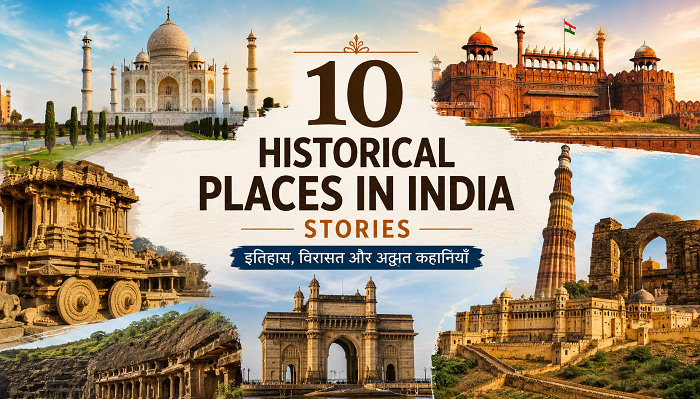
The most memorable historical places in India are more than beautiful structures. Their walls, inscriptions, sculptures, gateways and ruins preserve evidence of changing empires, religious traditions, artistic ideas and everyday life.
A good way to explore Indian history is to look beyond the familiar photograph of a monument and ask three questions: Who built it? Why was it created? What happened there afterward?
From ancient Buddhist monuments to Mughal architecture and colonial-era landmarks, India’s heritage sites represent different periods of a history spanning thousands of years. Here are ten places whose stories make them especially valuable for understanding the country’s past.
10 Historical Places in India Worth Exploring
1. Taj Mahal, Agra
Commissioned by Mughal emperor Shah Jahan in memory of his wife Mumtaz Mahal, the Taj Mahal was constructed in the 17th century. Its white marble, symmetrical gardens, calligraphy and intricate inlay work demonstrate the sophistication of Mughal architecture.
While popularly described as a monument to love, it is fundamentally an imperial mausoleum complex and an outstanding example of Mughal artistic patronage.
2. Red Fort, Delhi
Shah Jahan commissioned Delhi’s Red Fort after moving the Mughal capital from Agra to Shahjahanabad. Completed in the 17th century, it became an important center of Mughal political authority.
Its story extends well beyond the Mughal period. Today, the Prime Minister of India addresses the nation from the Red Fort on Independence Day, connecting the monument with modern Indian history.
3. Qutub Minar, Delhi
The Qutub Minar complex reveals several layers of Delhi’s medieval past. Construction of the minaret was begun under Qutb-ud-din Aibak and continued by his successors.
The complex contains monuments from different periods, making it especially useful for understanding architectural and political transitions associated with the early Delhi Sultanate.
4. Sanchi Stupa, Madhya Pradesh
Sanchi is among India’s most significant Buddhist heritage sites. Its earliest major development is associated with Emperor Ashoka in the 3rd century BCE, although the site was enlarged and modified over subsequent centuries.
The carved gateways depict Buddhist themes through detailed narrative scenes, providing valuable evidence about religion, society and artistic traditions.
5. Ajanta Caves, Maharashtra
The Ajanta caves contain Buddhist monasteries, prayer halls, sculptures and paintings created during different phases between roughly the 2nd century BCE and 6th century CE.
Their murals are particularly important. They depict Buddhist narratives as well as clothing, courtly life and artistic conventions, giving historians insight into the cultural world in which they were produced.
Architectural Historical Places in India with Remarkable Stories
6. Ellora Caves, Maharashtra
Ellora is notable for Buddhist, Hindu and Jain monuments created in close geographic proximity. Its best-known structure is the Kailasa Temple, an extraordinary rock-cut monument carved from a massive body of stone.
Rather than being assembled from blocks, much of the temple was excavated directly from the rock, demonstrating exceptional planning and craftsmanship.
7. Hampi, Karnataka
Walking through Hampi’s ruins reveals the scale of Vijayanagara, once the capital of a major South Indian empire.
Temples, marketplaces, water systems and royal structures illustrate the city’s economic and political importance. The Vijayanagara capital suffered major destruction following the Battle of Talikota in 1565, although its surviving remains continue to reveal the city’s former scale.
8. Konark Sun Temple, Odisha
Built in the 13th century during the reign of Narasimhadeva I of the Eastern Ganga dynasty, the Konark Sun Temple was dedicated to Surya, the Sun God.
Its architectural conception resembles a monumental stone chariot, complete with elaborately carved wheels and horses. The surviving sculpture makes Konark one of India’s most distinctive temple sites.
9. Fatehpur Sikri, Uttar Pradesh
Mughal emperor Akbar developed Fatehpur Sikri as an imperial capital in the 16th century. Its palaces, courtyards, audience halls and religious buildings reflect the architectural experimentation of Akbar’s reign.
The imperial court later shifted away, but describing the city simply as “abandoned because of water shortage” oversimplifies a more complex historical transition involving political and strategic considerations.
10. Cellular Jail, Andaman and Nicobar Islands
Not every important heritage site celebrates royal power. The Cellular Jail in Port Blair preserves a difficult chapter of colonial history.
The British used the prison to incarcerate political prisoners and others sentenced to transportation. Its cellular design was intended to isolate prisoners, making the site a powerful reminder of colonial punishment and India’s struggle against British rule.
Why These Historical Places in India Matter
These monuments provide physical evidence that textbooks alone cannot offer. Sanchi helps explain early Buddhist patronage, Hampi reveals Vijayanagara urbanism, while the Red Fort connects Mughal and modern political history.
Heritage specialists generally encourage visitors to examine monuments in context. Inscriptions, museum collections, archaeological reports and conservation information can reveal details that are easily missed during a quick sightseeing trip.
Practical Tips for Visiting Heritage Sites
Before visiting, learn the site’s approximate period and ruling dynasty. This makes architectural details easier to understand. Check official timings, ticket rules and conservation restrictions because these can change.
Avoid touching carvings, climbing restricted structures or writing on monuments. A common travel mistake is focusing entirely on photographs while ignoring interpretation boards, museums and less-famous sections of a complex.
When possible, use official guides or credible archaeological resources rather than relying on unverified stories circulated online.
Conclusion
The best historical places in India allow us to see history through architecture, art, religion, political power and human experience. From the Buddhist heritage of Sanchi and Ajanta to the imperial landscapes of Hampi, Fatehpur Sikri and Delhi, each destination tells a different part of India’s story.
Choose one of these heritage sites for your next journey, research its history before you arrive, and explore beyond its most photographed landmark. The experience becomes far more meaningful when you understand the story behind what you are seeing.
History
Revolt of 1857: Causes, Leaders, Events and Impact
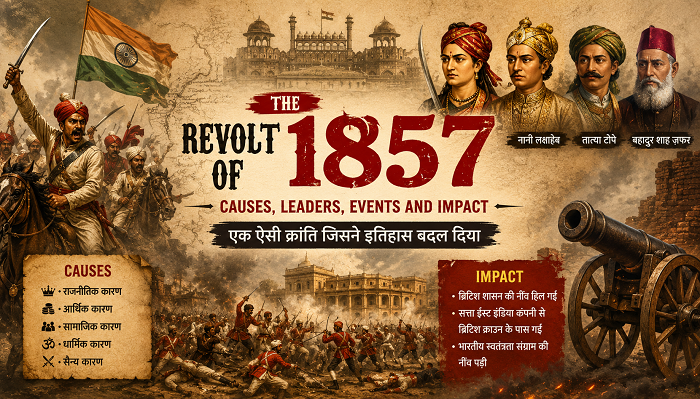
The Revolt of 1857 was one of the most consequential uprisings against East India Company rule in India. Beginning at Meerut on 10 May 1857, the rebellion spread to Delhi, Kanpur, Lucknow, Jhansi and several parts of northern and central India.
It is sometimes reduced to the controversy surrounding rifle cartridges, but historical evidence reveals a much broader crisis. Military dissatisfaction combined with political annexations, economic pressures, land-revenue grievances and fears of social and religious interference.
Historians have interpreted the uprising differently. Some colonial accounts called it a “Sepoy Mutiny,” while nationalist writers emphasized its anti-colonial character. Modern scholarship generally examines its regional variations and the different motivations of soldiers, rulers, landholders and civilians.
Major Causes of the Revolt of 1857
No single issue caused the uprising. Several long-term grievances created an environment in which military unrest could develop into a much larger rebellion.
Political Causes of the Revolt of 1857
East India Company expansion had weakened or removed numerous Indian ruling houses. Under Governor-General Lord Dalhousie, the Doctrine of Lapse allowed the Company to annex certain princely states when a ruler died without a recognized natural male heir.
Satara, Jhansi and Nagpur were among the territories annexed under this policy. The annexation of Awadh in 1856, although carried out on different grounds, generated particularly strong resentment.
Nana Sahib also had grievances after the Company refused to continue the pension associated with his adoptive father, former Peshwa Baji Rao II.
Economic and Social Causes
British revenue arrangements affected peasants, landholders and traditional elites differently across regions. High revenue demands and changes in land rights contributed to rural dissatisfaction in some areas.
Traditional artisans also faced changing economic conditions as India became increasingly integrated into a colonial trading system dominated by British commercial interests and manufactured imports.
At the same time, some Indians feared that colonial authorities intended to interfere with established religious and social practices. Missionary activity and certain social reforms were interpreted by sections of society as signs of unwanted intervention.
These concerns did not affect every community in the same way, but they contributed to an atmosphere of suspicion.
Military Causes and the Immediate Trigger
Indian soldiers, or sepoys, formed a large part of the East India Company’s armies. Differences in pay, promotion opportunities, overseas service expectations and racial discrimination created resentment among sections of the troops.
The immediate controversy involved cartridges issued for the new Enfield rifle. Soldiers believed that the cartridges were greased with cow and pig fat and had to be bitten open. This offended the religious sensibilities of Hindu and Muslim sepoys.
Mangal Pandey’s actions at Barrackpore in March 1857 became an early symbol of military resistance. The decisive outbreak, however, occurred at Meerut in May.
Major Leaders and Events of the Revolt of 1857
After rebelling at Meerut, sepoys marched to Delhi and declared the ageing Mughal emperor Bahadur Shah Zafar their symbolic leader.
Different centers soon developed their own leadership. Nana Sahib became associated with the uprising at Kanpur, while Begum Hazrat Mahal played an important role in resistance at Lucknow and Awadh.
Rani Lakshmibai of Jhansi emerged as one of the rebellion’s most famous military figures. She fought British forces and later joined resistance around Gwalior before being killed in battle in June 1858.
Other important leaders included Tantia Tope, Kunwar Singh in Bihar and Khan Bahadur Khan in Bareilly.
The rebellion was widespread but not nationwide. Large parts of southern and eastern India did not experience comparable uprisings, while several princely rulers and military groups supported the British.
Why Did the Revolt of 1857 Fail?
The rebels lacked unified leadership, a common military command and a single political objective. Different groups joined for different reasons, which made coordinated action difficult.
British forces also had access to stronger logistical networks, reinforcements and military resources. The telegraph and expanding transport infrastructure assisted communication and troop movement.
Furthermore, not all Indian rulers or soldiers supported the uprising. This limited its geographic and military reach.
By 1858, British forces had regained most major rebel strongholds.
Impact of the Revolt of 1857 on India
Although unsuccessful in overthrowing British power, the rebellion fundamentally changed colonial government.
The Government of India Act 1858 ended the East India Company’s political rule. Administration passed directly to the British Crown, and Queen Victoria’s proclamation later that year announced changes in the government’s approach toward Indian princes and religious affairs.
The British also reorganized the army, altered recruitment patterns and became more cautious in dealing with princely states.
Bahadur Shah Zafar was exiled to Rangoon, marking the effective end of the Mughal dynasty.
Practical Tips for Studying the Revolt
Students should organize the topic into five categories: causes, outbreak, centers, leaders and consequences. A map is especially useful for connecting Meerut, Delhi, Kanpur, Lucknow, Jhansi and Gwalior.
Avoid the common mistake of explaining the entire rebellion through the cartridge controversy. The cartridges were an immediate trigger, but political, military and socioeconomic grievances had developed earlier.
It is also useful to compare colonial, nationalist and modern scholarly interpretations instead of assuming that one label completely explains the uprising.
Conclusion
The Revolt of 1857 was a complex rebellion shaped by military grievances, political expansion, economic pressures and regional interests. Leaders including Rani Lakshmibai, Bahadur Shah Zafar, Nana Sahib, Begum Hazrat Mahal, Tantia Tope and Kunwar Singh became central figures in its history.
Although the uprising failed militarily, it ended East India Company rule and transformed the structure of British administration in India. To understand the event more deeply, explore contemporary records, historical maps, biographies and modern scholarly studies alongside the basic timeline.
History
Indian Freedom Struggle Timeline
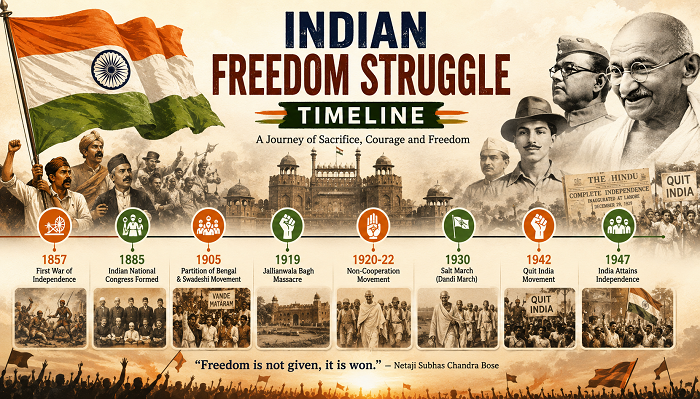
The Indian freedom struggle timeline is more than a sequence of protests, political meetings, and famous leaders. Between 1857 and 1947, resistance to colonial rule evolved from regional uprisings and early political associations into organized nationalism and mass movements involving millions of Indians.
Historical records show that this journey was neither linear nor driven by one organization. Constitutional reformers, revolutionaries, peasants, workers, students, women, tribal communities, the Indian National Congress, the Muslim League, the Indian National Army, and many regional groups influenced its direction.
Following the struggle chronologically helps explain not only what happened but also why each major event changed India’s political future.
Indian Freedom Struggle Timeline: 1857 and Its Aftermath
The Revolt of 1857 began among East India Company soldiers at Meerut in May before spreading to Delhi, Kanpur, Lucknow, Jhansi, and other areas.
Military grievances helped trigger the revolt, but its causes were broader. Political annexations, economic pressures, land policies, social concerns, and resentment among sections of soldiers, rulers, landholders, and civilians all contributed.
Prominent figures included Rani Lakshmibai, Bahadur Shah Zafar, Nana Sahib, Tantia Tope, Kunwar Singh, and Begum Hazrat Mahal.
Although the revolt was suppressed, it transformed colonial governance. The Government of India Act 1858 ended East India Company rule and transferred authority directly to the British Crown.
1885–1905: Growth of Organized Nationalism
The founding of the Indian National Congress in 1885 created an important platform for political discussion. Early nationalist leaders including Dadabhai Naoroji, Gopal Krishna Gokhale, and Pherozeshah Mehta sought greater Indian participation in administration and political reforms.
Dadabhai Naoroji’s economic critique of colonialism, particularly his discussion of the “drain of wealth,” helped connect British rule with India’s economic problems.
A major turning point came with the Partition of Bengal in 1905. Opposition encouraged the Swadeshi movement, which promoted indigenous goods and the boycott of selected British products.
Indian Freedom Struggle Timeline: Rise of Mass Movements
Mahatma Gandhi returned to India from South Africa in 1915. His early campaigns in Champaran, Ahmedabad, and Kheda demonstrated methods of nonviolent resistance connected to local economic and social grievances.
In 1919, the Jallianwala Bagh massacre in Amritsar intensified public anger against British rule. British troops under Brigadier-General Reginald Dyer fired on an unarmed gathering, causing extensive casualties.
The event became a powerful symbol of colonial repression and influenced attitudes toward British authority.
1920–1935: Non-Cooperation and Civil Disobedience
Gandhi launched the Non-Cooperation Movement in 1920, encouraging Indians to withdraw cooperation from colonial institutions and boycott foreign goods. The movement was suspended in 1922 following the violent incident at Chauri Chaura.
The next major phase began in 1930 with the Dandi March. Gandhi walked from Sabarmati Ashram to Dandi to challenge the British salt laws. The symbolic act helped turn salt—a basic everyday necessity—into a powerful political issue.
Civil disobedience expanded across India through demonstrations, boycotts, refusal to obey certain colonial laws, and other forms of protest.
The Government of India Act 1935 later introduced significant constitutional changes, including greater provincial autonomy, though ultimate authority remained with the British.
Revolutionary Nationalism and Subhas Chandra Bose
Nonviolent movements were only one part of India’s independence struggle. Revolutionaries such as Bhagat Singh, Chandrashekhar Azad, Rajguru, and Sukhdev pursued different strategies against colonial rule.
During the Second World War, Subhas Chandra Bose became associated with the Indian National Army (INA), which sought to fight British power militarily with Japanese support.
These movements differed significantly in ideology and strategy, illustrating the political diversity within the wider independence struggle.
1942–1947: Final Phase of the Indian Freedom Struggle Timeline
In August 1942, the Indian National Congress launched the Quit India Movement, demanding an end to British rule. Gandhi’s call to “Do or Die” became closely associated with the campaign.
British authorities arrested leading Congress figures almost immediately, but protests, strikes, and underground political activities continued.
After World War II, Britain faced changing economic and political circumstances. Negotiations over transferring power accelerated, while disagreements between the Congress and Muslim League over India’s constitutional future became increasingly difficult to resolve.
On 15 August 1947, British colonial rule ended and India became independent. Independence came alongside Partition, creating India and Pakistan and triggering enormous population displacement and communal violence.
Quick Timeline of Major Events:
- 1857: Revolt against East India Company rule
- 1885: Indian National Congress founded
- 1905: Partition of Bengal and Swadeshi movement
- 1919: Jallianwala Bagh massacre
- 1920: Non-Cooperation Movement
- 1930: Dandi March and Civil Disobedience Movement
- 1942: Quit India Movement
- 1947: Independence and Partition
Practical Tips for Studying India’s Freedom Struggle
Instead of memorizing dates separately, connect each event through cause, action, and consequence. For example, study the Partition of Bengal alongside the growth of Swadeshi politics.
Students can also create parallel timelines for constitutional reforms, Gandhian movements, revolutionary activities, and major political negotiations. This reveals how different strands of the freedom struggle developed simultaneously.
A common mistake is attributing independence entirely to one leader, movement, or event. Historians examine multiple political, economic, international, and social factors when explaining the end of colonial rule.
Conclusion
The Indian freedom struggle timeline from 1857 to 1947 reveals how resistance developed from major uprisings and early political organizations into nationwide movements, revolutionary campaigns, negotiations, and demands for self-government. Leaders such as Mahatma Gandhi, Subhas Chandra Bose, Jawaharlal Nehru, Sardar Patel, Bhagat Singh, and many others followed different paths while influencing India’s political transformation.
For deeper study, explore biographies, archival records, speeches, historical maps, contemporary newspapers, and scholarly research alongside this timeline. Understanding why events occurred—and what changed afterward—offers a far richer picture of India’s journey to independence.
History
Modern History of India: Important Events and Timeline
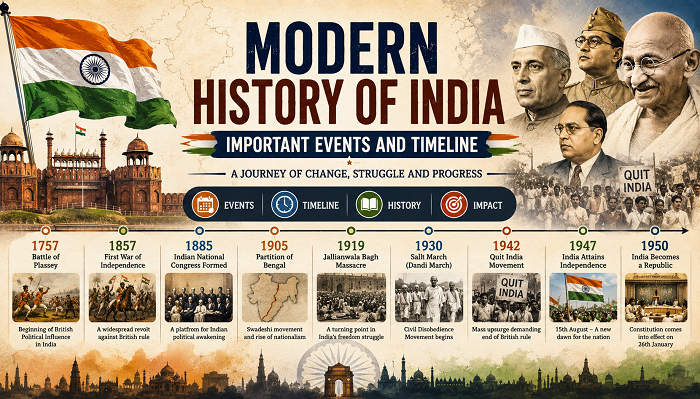
The modern history of India is best understood through connections rather than isolated dates. Colonial expansion changed political authority, taxation, trade, education, and administration. Those changes generated different forms of resistance, which eventually developed into organized movements for political rights and independence.
Historians generally examine this period using government records, newspapers, speeches, letters, memoirs, economic data, and accounts produced by Indian reformers and political leaders. Comparing these sources is important because colonial officials, nationalist leaders, revolutionaries, and ordinary citizens often experienced the same events differently.
From the Battle of Plassey in 1757 to independence in 1947, several turning points fundamentally changed India’s political and social landscape.
Early Modern History of India and British Expansion
European trading companies arrived in India primarily for commerce. Over time, however, the English East India Company became increasingly involved in regional politics.
The Battle of Plassey (1757) was an important turning point. Robert Clive’s forces defeated Siraj-ud-Daulah, the Nawab of Bengal. The Battle of Buxar (1764) further strengthened Company influence, and in 1765 the Company obtained Diwani rights to collect revenue in Bengal, Bihar, and Orissa.
British territorial expansion continued through warfare, alliances, annexations, and policies such as the Subsidiary Alliance and Doctrine of Lapse.
These developments mattered beyond politics. New revenue systems affected agriculture, while colonial trade policies reshaped traditional industries and India’s relationship with global markets.
The Revolt of 1857: A Turning Point
The Revolt of 1857 was one of the most significant events of nineteenth-century India. It began among Company soldiers at Meerut in May and quickly spread to important centers including Delhi, Kanpur, Lucknow, and Jhansi.
The causes were complex. Military grievances contributed to the outbreak, but political annexations, economic pressures, social anxieties, and dissatisfaction among sections of rulers, soldiers, landholders, and civilians also played important roles.
Figures associated with the uprising include Rani Lakshmibai, Bahadur Shah Zafar, Nana Sahib, Tantia Tope, and Begum Hazrat Mahal.
After the rebellion was suppressed, the British Parliament passed the Government of India Act 1858. Company rule ended, and authority was transferred directly to the British Crown.
Rise of Nationalism in the Modern History of India
The later nineteenth century witnessed the growth of political associations, newspapers, public debate, and demands for greater Indian participation in government.
The Indian National Congress was established in 1885. Early leaders such as Dadabhai Naoroji, Gopal Krishna Gokhale, and Surendranath Banerjee often used petitions, public meetings, and constitutional methods to seek reform.
The Partition of Bengal in 1905 intensified nationalist politics. The Swadeshi movement encouraged people to support Indian-made goods and boycott selected British products.
Major Movements in the Modern History of India
Mahatma Gandhi’s return to India in 1915 introduced new methods of mass political mobilization. His early campaigns at Champaran, Ahmedabad, and Kheda connected political action with local grievances.
The Non-Cooperation Movement (1920–22) encouraged withdrawal from colonial institutions. The Civil Disobedience Movement, launched in 1930, became closely associated with Gandhi’s Salt March to Dandi.
In August 1942, the Indian National Congress launched the Quit India Movement, demanding an end to British rule. Its senior leadership was quickly arrested, but protests continued in different parts of the country.
Other political forces also shaped the independence struggle, including revolutionary organizations, Subhas Chandra Bose and the Indian National Army, socialist groups, workers’ movements, princely-state movements, and the All-India Muslim League.
Important Timeline of Modern Indian History
A simple timeline helps readers connect major developments:
- 1757: Battle of Plassey
- 1764: Battle of Buxar
- 1857: Major uprising against Company rule
- 1858: British Crown assumes direct control
- 1885: Indian National Congress founded
- 1905: Partition of Bengal and Swadeshi agitation
- 1919: Jallianwala Bagh massacre
- 1920: Non-Cooperation Movement begins
- 1930: Dandi March and Civil Disobedience Movement
- 1942: Quit India Movement
- 1947: Independence and Partition
This chronology is useful for students because it shows how colonial expansion gradually gave way to increasingly organized resistance.
Social Reform, Education and Intellectual Change
The period was not defined by political movements alone. Reformers debated practices related to education, caste, women’s rights, widow remarriage, religion, and social inequality.
Raja Ram Mohan Roy campaigned against sati and supported educational and social reform. Ishwar Chandra Vidyasagar advocated widow remarriage and women’s education. Jyotirao and Savitribai Phule challenged caste discrimination and worked to expand education among marginalized communities.
These reform efforts demonstrate that modern India’s transformation occurred socially and intellectually as well as politically.
Common Mistakes When Studying Modern Indian History
One common mistake is treating the independence movement as the work of a single leader or organization. India’s freedom struggle involved people with different political ideas, regional experiences, and methods.
Another is memorizing dates without understanding cause and effect. For example, instead of remembering 1857 alone, examine why the revolt happened and how its aftermath changed colonial governance.
Reliable historical study should also distinguish evidence from popular myths. Primary documents are valuable, but expert historical interpretation helps explain their context and limitations.
Conclusion
The modern history of India traces a profound transformation from East India Company expansion and British Crown rule to mass nationalism, social reform, political negotiation, independence, and Partition in 1947. Events such as Plassey, the Revolt of 1857, the Swadeshi movement, Civil Disobedience, and Quit India become far more meaningful when studied as connected developments.
To deepen your understanding, explore historical maps, archival documents, biographies, speeches, newspapers, and scholarly research alongside a chronological timeline. This evidence-based approach makes modern Indian history easier to remember, evaluate, and understand.
History
Medieval History of India: Dynasties, Rulers and Events
Studying the medieval history of India becomes much easier when we stop viewing it as a long list of kings and battles. Historians examine inscriptions, coins, monuments, court chronicles, regional literature, administrative records, and archaeological evidence to understand how people actually lived and how political power changed.
The medieval period, broadly placed between the early medieval centuries and the beginning of British colonial dominance, witnessed major political transformations. Regional kingdoms expanded, the Delhi Sultanate established powerful administrations, the Vijayanagara Empire became an important southern power, and the Mughal Empire developed one of the subcontinent’s most influential imperial systems.
Just as importantly, this period transformed architecture, trade, languages, agriculture, religion, music, and everyday culture.
Early Medieval History of India and Regional Kingdoms
Early medieval India was politically diverse. Rather than being controlled by a single authority, different regions were governed by powerful dynasties.
The Cholas became particularly influential in southern India between the ninth and thirteenth centuries. Rulers such as Rajaraja I and Rajendra I expanded Chola influence while supporting temples, administration, irrigation, and maritime activity. The Brihadisvara Temple at Thanjavur remains an extraordinary example of Chola architecture.
Other important powers included the Palas in eastern India, the Rashtrakutas in the Deccan, and several Rajput kingdoms in northern and western India.
These regional states demonstrate why medieval Indian history should not be studied only through events in Delhi.
Delhi Sultanate: A Major Phase in the Medieval History of India
The establishment of the Delhi Sultanate in 1206 marked an important political development in northern India. Five major dynasties—the Mamluk or Slave, Khalji, Tughlaq, Sayyid, and Lodi dynasties—ruled Delhi at different times until 1526.
Alauddin Khalji is remembered for territorial expansion as well as market and revenue measures. Muhammad bin Tughlaq, meanwhile, introduced ambitious administrative experiments, some of which created serious practical difficulties.
The Sultanate also influenced architecture. Structures such as the Qutub Minar complex illustrate the development of new architectural forms alongside existing Indian craftsmanship.
Key Rulers in the Medieval History of India
Understanding a few major rulers makes the medieval history of India easier to follow.
Rajaraja Chola I strengthened Chola power and sponsored monumental architecture. Alauddin Khalji expanded the Delhi Sultanate and introduced significant economic measures. Krishnadevaraya presided over a prosperous phase of the Vijayanagara Empire.
Later, Akbar expanded and consolidated Mughal authority while developing administrative arrangements and policies designed to govern a diverse empire. Aurangzeb extended Mughal territorial control to its greatest extent, although prolonged warfare, especially in the Deccan, placed considerable pressure on imperial resources.
Studying these rulers through their policies—not merely their victories—provides a clearer understanding of their historical significance.
The Vijayanagara Empire and Southern India
Founded in the fourteenth century, the Vijayanagara Empire became one of South India’s most significant political powers. Its capital, whose ruins survive at Hampi, developed into an important commercial and cultural center.
Krishnadevaraya, who ruled from 1509 to 1529, is widely regarded as one of its most successful rulers. His reign saw military campaigns, literary patronage, temple construction, and commercial activity.
The empire’s history also illustrates India’s connections with international trade networks involving horses, textiles, spices, precious materials, and other commodities.
Mughal Empire: Politics, Culture and Administration
The First Battle of Panipat in 1526, in which Babur defeated Ibrahim Lodi, established Mughal rule in northern India.
Akbar later strengthened the empire through military expansion, alliances, administrative reforms, and an organized revenue system. Mughal governance relied on institutions such as the mansabdari system, which helped structure imperial service and military responsibilities.
The period also produced remarkable architecture and art. Fatehpur Sikri, Humayun’s Tomb, the Red Fort, and the Taj Mahal demonstrate different stages of Mughal architectural development.
Painting, Persian literature, gardens, textiles, and court culture also flourished under imperial patronage.
Major Cultural and Social Developments
Medieval India experienced important religious and cultural interactions. The Bhakti movement included diverse poet-saints who emphasized personal devotion, while Sufi traditions developed around spiritual teachers and khanqahs.
Figures such as Kabir, Guru Nanak, Mirabai, and Chaitanya are associated with influential devotional traditions, although their teachings and historical contexts differed considerably.
Languages also evolved through interaction among Sanskrit, Persian, Arabic, and regional traditions. Literature expanded in Bengali, Marathi, Tamil, Telugu, Hindi-related vernaculars, and several other languages.
Practical Tips for Studying Medieval Indian History
Instead of memorizing isolated dates, create a timeline divided into regions and dynasties. Connect each ruler with three things: political developments, administrative policies, and cultural contributions.
Maps are equally useful. Tracking the territories of the Delhi Sultanate, Vijayanagara Empire, Mughal Empire, Rajput states, and Maratha power makes political change easier to visualize.
Also compare primary evidence with modern historical scholarship. Inscriptions, coins, architecture, and chronicles may provide different perspectives on the same event.
Common Mistakes to Avoid
One common error is treating medieval India as a continuous conflict between fixed religious communities. Political alliances were often shaped by territory, revenue, family interests, military needs, and regional rivalries.
Another mistake is assuming every source is completely objective. Court historians often wrote for royal patrons, so historians compare chronicles with archaeological evidence, inscriptions, and other independent records.
Conclusion
The medieval history of India is a complex story of regional kingdoms, imperial expansion, administration, commerce, cultural exchange, religious movements, architecture, and changing social structures. From the Cholas and Delhi Sultanate to Vijayanagara and the Mughals, each political tradition contributed differently to the development of the subcontinent.
To explore medieval India more deeply, study its dynasties alongside maps, monuments, inscriptions, primary texts, and modern historical research. Doing so turns history from a collection of dates into a clearer understanding of how India’s political and cultural landscape evolved.
History
Ancient Indian Civilizations: History, Culture and Achievements
When historians study early urban societies, philosophical traditions, mathematics, medicine, and systems of governance, India occupies an important place in the discussion. The ancient Indian civilization was not a single culture that appeared at one moment. It developed through different regions, communities, kingdoms, languages, and intellectual traditions over thousands of years.
Archaeological remains from Harappa and Mohenjo-daro reveal sophisticated urban planning, while later literary and material evidence provides insight into Vedic society, expanding kingdoms, religious thought, trade, education, and scientific inquiry.
Understanding this history is valuable because many ideas associated with Indian culture today have roots in these early periods, even though they evolved considerably over time.
Origins and Development of Ancient Indian Civilization
One of the earliest major chapters is the Indus or Harappan Civilization, which flourished mainly during approximately 2600–1900 BCE. Its settlements extended across parts of present-day India and Pakistan.
Excavations at Harappa, Mohenjo-daro, Dholavira, and other sites demonstrate impressive knowledge of city planning. Many settlements featured carefully arranged streets, drainage infrastructure, standardized bricks, storage areas, craft production, and systems for managing water.
Dholavira is particularly important for understanding how communities adapted to challenging environments through sophisticated water conservation and storage.
What Makes Ancient Indian Civilization Historically Important?
The significance of ancient Indian civilization goes far beyond its age. Archaeological and textual evidence points to long-distance trade, specialized crafts, changing political institutions, philosophical debate, and increasingly complex social structures.
A useful way to study the period is to avoid treating ancient India as one uninterrupted empire. Instead, readers should examine different periods independently—the Harappan era, Vedic period, Mahajanapadas, Mauryan Empire, Gupta period, and numerous regional kingdoms.
This approach provides a more accurate picture of how Indian civilization changed over centuries.
Culture, Religion and Philosophy in Ancient Indian Civilization
The Vedic period contributed substantially to the development of religious, social, and philosophical traditions in South Asia. The Vedas became foundational texts, while later works such as the Upanishads explored questions about knowledge, consciousness, existence, and the nature of reality.
Buddhism and Jainism also emerged in ancient India and offered influential approaches to ethics, spiritual practice, non-violence, and liberation. Their ideas spread far beyond their places of origin through teachers, merchants, monasteries, and political patronage.
Ancient India was therefore not intellectually uniform. Different philosophical schools debated subjects ranging from metaphysics and logic to ethics and methods of acquiring reliable knowledge.
Major Scientific and Intellectual Achievements
Mathematics became one of ancient India’s most influential intellectual fields. Indian scholars made major contributions to numeral systems, arithmetic, algebra, geometry, and astronomical calculation.
Aryabhata, writing in the fifth and sixth centuries CE, produced important work on mathematics and astronomy. Later Indian mathematical traditions further developed systematic rules involving zero and negative numbers.
Medicine also developed through Ayurveda. Classical works associated with Charaka and Sushruta discuss diagnosis, medicinal substances, anatomy, disease management, and surgical procedures. These texts demonstrate attempts to organize medical knowledge systematically, although ancient treatments should be understood in their historical context rather than automatically equated with modern clinical medicine.
Art, Architecture and Literature
Ancient Indian art provides another window into social and religious life. The pillars associated with Emperor Ashoka, Buddhist stupas, rock-cut caves, sculptures, coins, and temple traditions illustrate changing artistic techniques and beliefs.
Sites such as Sanchi and the Ajanta caves remain particularly valuable for studying Buddhist architecture and visual culture.
Literature was equally diverse. Sanskrit, Prakrit, Pali, Tamil, and other linguistic traditions produced religious texts, poetry, philosophical works, drama, grammar, political thought, and scientific literature.
Practical Tips for Studying Ancient Indian History
Students and general readers should compare archaeology with written evidence rather than relying on a single source. Create a chronological timeline and connect important sites, rulers, texts, and developments to their approximate periods.
For example, place Harappan urbanism before the major Mauryan political expansion rather than discussing both as though they were contemporary.
Another useful technique is to use maps. Locating Dholavira, Pataliputra, Sanchi, Taxila, and other important centers makes patterns of trade, political expansion, and cultural exchange much easier to understand.
Common Mistakes to Avoid
A frequent mistake is describing every historical achievement as belonging to the same period. Ancient Indian history covers a vast span of time, and developments occurred in different centuries and regions.
Readers should also be cautious about sensational claims circulated online. Reliable understanding comes from comparing archaeological findings, inscriptions, manuscripts, peer-reviewed scholarship, and research from recognized historical institutions.
Conclusion
The ancient Indian civilization represents a long and diverse historical journey encompassing urban development, philosophy, religion, mathematics, medicine, literature, governance, trade, and artistic expression. From Harappan cities to later intellectual and cultural traditions, ancient India contributed ideas and institutions whose influence can still be studied today.
For a deeper understanding, explore individual archaeological sites, primary texts, museum collections, and scholarly histories rather than stopping at broad summaries. Each offers another piece of the complex story of India’s ancient past.
History
Interesting Facts About Indian History
When we study Indian history beyond familiar dates and dynasties, unexpected connections begin to appear. Archaeological sites reveal sophisticated urban planning thousands of years ago, inscriptions show how rulers communicated across vast territories, and surviving manuscripts demonstrate major developments in mathematics, medicine and astronomy.
Some widely shared “facts” about India are exaggerated online, which makes evidence-based history especially important. The most interesting facts about Indian history are often impressive enough without embellishment.
Here are 15 historically significant facts that offer a fascinating look at India’s ancient civilizations, political history, scholarship and cultural heritage.
Interesting Facts About Indian History From Ancient Times
1. The Indus Civilization Had Sophisticated Urban Planning
Cities of the Indus or Harappan Civilization, which flourished during the third millennium BCE, displayed remarkable urban organization.
Archaeological sites such as Mohenjo-daro, Harappa and Dholavira reveal planned streets, drainage systems, standardized bricks and carefully designed residential areas.
The Great Bath at Mohenjo-daro is one of the civilization’s best-known structures.
2. Dholavira Developed an Impressive Water System
Dholavira, located in present-day Gujarat, shows how Harappan communities adapted to challenging environmental conditions.
Archaeologists have identified reservoirs, channels and water-management structures designed to collect and conserve water. This makes Dholavira particularly valuable for understanding ancient engineering and urban adaptation.
3. India’s Historical Record Includes Ashoka’s Own Messages
Emperor Ashoka of the Mauryan dynasty left inscriptions on rocks and pillars across different parts of his empire.
These edicts discussed governance, morality, religious communities and dhamma. For historians, they are especially valuable because they provide direct evidence of how a third-century BCE emperor presented his policies to his subjects.
4. Ancient India Was Connected to International Trade
Long before modern globalization, merchants from the Indian subcontinent participated in extensive trade networks.
Indian textiles, spices, precious stones and other commodities travelled across the Indian Ocean and beyond. Archaeological and literary evidence demonstrates commercial connections with the Roman world, Southeast Asia and other regions.
Ports on India’s western and southern coasts became important centres of exchange.
5. Nalanda Attracted Scholars From Different Regions
Nalanda in present-day Bihar became one of ancient India’s most important centres of Buddhist learning.
Beginning around the Gupta period and flourishing for centuries, the institution attracted scholars from India and abroad. Chinese pilgrims such as Xuanzang studied there and left valuable accounts connected with Indian society and Buddhist scholarship.
Subjects extended beyond religious philosophy to areas such as logic, grammar and medicine.
More Interesting Facts About Indian History and Knowledge
India’s historical influence cannot be understood only through kings and wars. Intellectual developments also travelled across cultural and linguistic boundaries.
6. Zero’s Mathematical Development Has Deep Indian Roots
Ancient Indian mathematicians made crucial contributions to the development of the decimal place-value system and the mathematical treatment of zero.
Brahmagupta, writing in the seventh century CE, formulated rules for calculations involving zero and negative numbers.
The ideas associated with Indian numerals later travelled through the Islamic world and became foundational to modern mathematics.
7. Aryabhata Calculated the Length of the Year With Impressive Accuracy
Mathematician and astronomer Aryabhata composed the Aryabhatiya in 499 CE.
His work addressed arithmetic, algebra, trigonometry and astronomy. He provided an impressively close calculation of the length of the year and explained the apparent daily movement of celestial objects in relation to Earth’s rotation.
8. Sushruta’s Text Describes Surgical Procedures
The Sushruta Samhita is an important Sanskrit medical work associated with the ancient Indian medical tradition.
It contains descriptions of surgical instruments, procedures, wound treatment and reconstructive techniques.
Historians of medicine study the text as important evidence for the development of medical knowledge in South Asia.
9. The Iron Pillar of Delhi Shows Advanced Metallurgy
The famous Iron Pillar located in Delhi’s Qutb complex dates to the Gupta period, generally around the fourth or fifth century CE.
It is particularly well known for its resistance to extensive corrosion despite centuries of exposure.
Scientific analysis has linked this durability to the composition of the iron and the protective layer that developed on its surface.
10. The Cholas Projected Power Across the Sea
The Chola dynasty was not merely a land-based South Indian power.
Under Rajaraja Chola I and Rajendra Chola I, the empire developed significant maritime capabilities. Rajendra’s forces launched an eleventh-century naval expedition against the Srivijaya realm in Southeast Asia.
This episode highlights the importance of the Bay of Bengal as a zone of political and commercial interaction.
Surprising Historical Facts About Indian Rulers and Monuments
11. Akbar Created a Complex System of Imperial Service
Mughal emperor Akbar expanded his empire partly through military success, but administration was equally important.
The mansabdari system ranked imperial officials and connected status with military and administrative responsibilities.
His government also incorporated people from different regional, ethnic and religious backgrounds into imperial service.
12. The Taj Mahal Took More Than Two Decades to Complete as a Complex
Shah Jahan commissioned the Taj Mahal in memory of Mumtaz Mahal after her death in 1631.
The main mausoleum was substantially completed in the 1640s, while work on the wider complex continued for years. Thousands of artisans and workers contributed to the project.
Its design combines architectural traditions that developed within the Mughal world.
13. India Had Powerful Women Rulers Before Modern Times
Political authority was not exclusively male.
Razia ruled the Delhi Sultanate in the thirteenth century, Rani Durgavati governed Gondwana in the sixteenth century, and Ahilyabai Holkar became renowned for her eighteenth-century administration and public works.
Their histories challenge simplistic assumptions about women’s political roles in pre-modern India.
14. Resistance to European Expansion Began Long Before 1857
The Revolt of 1857 is one of the most famous challenges to British power, but resistance to European and Company expansion had much earlier roots.
Rani Abbakka Chowta resisted Portuguese power on the Karnataka coast during the sixteenth century. Later rulers and local communities also challenged the East India Company’s growing influence.
This wider timeline helps explain why colonial resistance cannot be reduced to a single uprising.
15. India’s Constitution Was Handwritten and Decorated
The original English and Hindi copies of the Constitution of India were handwritten rather than mechanically typeset.
Prem Behari Narain Raizada produced the calligraphy of the English version, while artists associated with Nandalal Bose decorated the manuscript with illustrations inspired by different periods of Indian history and culture.
The Constitution was adopted on 26 November 1949 and came into effect on 26 January 1950.
Common Mistakes When Exploring Indian History Facts
A frequent mistake is accepting viral claims without checking their historical context. Statements such as “India invented everything” may sound impressive but often oversimplify complex developments that occurred across civilizations.
Another problem is applying modern borders and identities directly to ancient societies.
A better approach is to check archaeological evidence, inscriptions, peer-reviewed historical research, museum collections and translations of primary sources. When researching a surprising claim, ask three simple questions: What is the original source? When was it created? Do reputable historians agree on its interpretation?
This method is especially useful for students, bloggers and content creators who want accurate material rather than recycled internet myths.
Conclusion: Why Interesting Facts About Indian History Matter
These interesting facts about Indian history reveal a past shaped by far more than wars and royal dynasties. Urban planning at Dholavira, mathematical advances associated with Brahmagupta, scholarship at Nalanda, Chola maritime campaigns, Mughal administration and India’s beautifully handwritten Constitution all represent different dimensions of the country’s historical development.
The most rewarding way to explore history is to remain curious while checking the evidence behind every extraordinary claim.
Visit museums and archaeological sites, explore reliable historical publications and read translated inscriptions and primary sources. Each piece of evidence can reveal another chapter in India’s remarkably diverse past.
History
Famous Queens of India Who Changed History
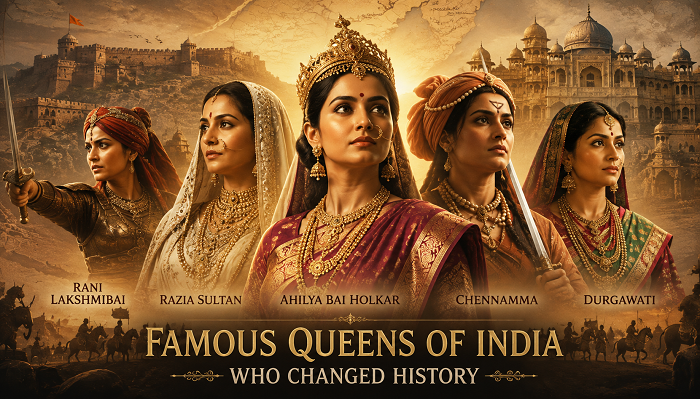
Indian history becomes far more interesting when we look beyond dynasties and battles to examine the people who actually exercised power. Among them were women who governed kingdoms, commanded armies, negotiated political crises, supported architecture and trade, and resisted invading or colonial forces.
The famous queens of India were not all rulers in the same sense. Some governed independently, others acted as regents, and several emerged as military leaders during moments of extraordinary political instability. Their stories span centuries and regions, from Delhi and Gondwana to Kittur, Travancore and Jhansi.
Looking at what these women actually accomplished, rather than relying solely on legends, gives us a richer understanding of women’s political leadership in Indian history.
Why Are the Famous Queens of India Historically Important?
Queens often operated within political structures dominated by men, yet some managed to exercise considerable authority. Their influence can be seen in military strategy, taxation, diplomacy, succession, public works and cultural patronage.
Historians assess these rulers using inscriptions, chronicles, coins, administrative records, architecture and other surviving evidence. Such sources also help distinguish documented achievements from stories added to popular memory centuries later.
Here are some of India’s most remarkable queens and women rulers.
1. Razia Sultan – A Woman on the Delhi Throne
Razia, who ruled the Delhi Sultanate from 1236 to 1240, occupies a distinctive place in medieval Indian history. Although commonly called Razia Sultana today, historical accounts indicate that she ruled as a sovereign rather than simply as a royal consort.
She succeeded her father, Iltutmish, but faced resistance from sections of the Turkish nobility.
Her reign was short, yet her attempt to exercise direct sovereign authority challenged established political expectations and made her one of medieval India’s most notable female rulers.
2. Rani Durgavati – Defender of Gondwana
Rani Durgavati became associated with the Gond kingdom after marrying Dalpat Shah. Following his death, she governed as regent for their young son, Vir Narayan.
Her administration is remembered alongside her military leadership.
In 1564, Mughal forces led by Asaf Khan invaded her territory. Durgavati resisted despite facing a stronger army and died during the conflict rather than surrender.
Her story remains particularly important to the history of central India.
3. Rani Abbakka Chowta – The Queen Who Resisted the Portuguese
Among the famous queens of India, Abbakka Chowta deserves greater recognition for her resistance to Portuguese expansion on India’s western coast.
Associated with Ullal in present-day Karnataka, she resisted Portuguese attempts to dominate the region and its maritime trade.
Accounts of her struggle reflect the importance of coastal politics and commerce during the sixteenth century. Her resistance also reminds us that India’s encounters with European powers began centuries before British colonial dominance.
Famous Queens of India Known for Courageous Leadership
Some queens became historically significant because a political crisis forced them to assume responsibilities normally controlled by male rulers.
Rani Lakshmibai: One of the Most Famous Queens of India
Rani Lakshmibai of Jhansi became one of the defining figures of the Revolt of 1857.
After her husband Maharaja Gangadhar Rao died, the East India Company refused to recognize their adopted son Damodar Rao as the legitimate successor and annexed Jhansi under the Doctrine of Lapse.
During the uprising of 1857–58, Lakshmibai eventually became a leading figure in armed resistance. She defended Jhansi against British forces, escaped after the city’s fall and continued fighting alongside other rebel leaders.
She died near Gwalior on 18 June 1858. Her courage subsequently made her an enduring symbol of resistance to colonial rule.
5. Ahilyabai Holkar – A Remarkable Administrator
Not every powerful queen built her reputation through warfare.
Ahilyabai Holkar ruled the Malwa kingdom from 1767 until 1795 and became respected for her administration, public works and religious patronage.
From Maheshwar, she governed her territory while supporting the construction and restoration of temples, ghats, wells and other facilities in different parts of India.
Her reign demonstrates an important historical principle: effective governance can leave a legacy just as significant as military conquest.
6. Kittur Rani Chennamma – An Early Anti-British Leader
Decades before the Revolt of 1857, Kittur Rani Chennamma resisted British interference in her kingdom.
Following succession problems after the deaths of her husband and son, she sought recognition for an adopted heir. The East India Company refused to accept the succession.
Conflict followed in 1824. Although Chennamma’s forces initially achieved success, the British ultimately defeated the resistance. She was captured and imprisoned at Bailhongal, where she died in 1829.
Her struggle makes her an important early figure in resistance to Company expansion.
7. Begum Hazrat Mahal – Leading Awadh’s Resistance
Begum Hazrat Mahal played a major political role during the uprising of 1857 after her husband, Wajid Ali Shah, had been exiled following the British annexation of Awadh.
During the rebellion, her son Birjis Qadr was proclaimed ruler, while Hazrat Mahal helped lead resistance in Lucknow.
After British forces regained control, she eventually took refuge in Nepal.
Her contribution shows how women could become central political actors during periods when established systems of authority collapsed.
8. Rani Velu Nachiyar – Resistance in Southern India
Velu Nachiyar was an eighteenth-century ruler associated with Sivaganga in present-day Tamil Nadu.
After her husband was killed during conflict involving East India Company forces and their allies, she spent years building alliances and preparing to regain her kingdom.
She eventually returned to power.
Her story is especially valuable because it places organized resistance to Company influence in southern India well before the major nineteenth-century uprisings.
9. Rani Gaidinliu – Young Leader Against British Rule
Rani Gaidinliu came from the Zeliangrong Naga community and joined the movement associated with Haipou Jadonang while still very young.
After Jadonang’s execution, she emerged as an important leader opposing British authority.
She was arrested in 1932 and sentenced to life imprisonment. Jawaharlal Nehru later met her in prison and referred to her as the “Rani” of the Nagas.
She was released after Indian independence in 1947.
10. Rani Sethu Lakshmi Bayi – Reform and Administration
Rani Sethu Lakshmi Bayi served as Regent Maharani of Travancore between 1924 and 1931.
Unlike warrior queens remembered primarily for battlefield resistance, her historical significance lies in governance and social change. Her regency was associated with administrative modernization and reforms affecting women’s lives and public institutions.
Including rulers like her provides a broader understanding of female leadership beyond warfare.
Common Mistakes When Studying Indian Queens
One common mistake is treating every royal woman as a warrior queen. Their influence was much more diverse.
Ahilyabai Holkar’s administrative legacy, for example, should not be judged using the same criteria as Lakshmibai’s military leadership.
Another problem is relying on movies and viral stories as historical evidence. Popular retellings frequently combine fact, folklore and later interpretation.
For better research, compare museum resources, inscriptions, academic histories, archival documents and archaeological evidence. Creating a timeline of each ruler’s reign, kingdom, major challenge and contribution is also a practical way for students to understand how their historical roles differed.
Conclusion: Remembering the Famous Queens of India
The famous queens of India demonstrate that women’s political influence appeared across many periods of the subcontinent’s history.
Razia exercised sovereign authority in Delhi, Durgavati defended Gondwana, Abbakka challenged Portuguese ambitions, Ahilyabai became known for governance, Chennamma resisted Company expansion, and Lakshmibai became an enduring symbol of the 1857 uprising.
Their achievements deserve to be understood through evidence rather than legend alone.
Explore credible biographies, historical museums, archives and monuments connected with these remarkable women. Their stories offer a deeper understanding of how leadership, resistance and governance shaped India’s past.
History
Powerful Kings in Indian History
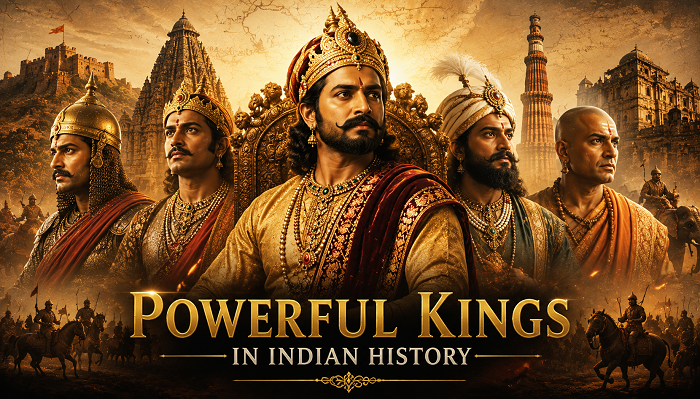
Looking across more than two millennia of Indian history, one lesson becomes clear: political power cannot be measured by battlefield victories alone. Some rulers built enormous empires, while others created administrative systems, trade networks, cultural institutions, or military structures that survived long after their deaths.
That makes ranking the powerful kings in Indian history challenging. Comparing Chandragupta Maurya with Rajaraja Chola I, for example, means comparing rulers separated by more than a thousand years and very different political environments.
Rather than creating a simple strongest-to-weakest ranking, this list examines ten rulers through the scale of their kingdoms, military achievements, governance, diplomacy, economic influence, and historical legacy.
How Do We Identify the Most Powerful Kings in Indian History?
Historians rarely judge a ruler’s importance through territory alone. A more useful approach considers several factors: the ability to establish or consolidate a kingdom, defend it, administer diverse populations, generate revenue, influence neighbouring regions, and leave institutions that endured.
Using those broader measures provides a more balanced picture of royal power in Indian history.
1. Chandragupta Maurya – Founder of the Mauryan Empire
Reign: c. 321–297 BCE
Empire: Mauryan Empire
Chandragupta Maurya established one of the first great territorial empires of the Indian subcontinent.
With the guidance traditionally associated with Chanakya, or Kautilya, Chandragupta overthrew the Nanda dynasty and consolidated power in northern India. He later fought Seleucus I Nicator, one of Alexander the Great’s successors.
The settlement that followed strengthened Mauryan control in the northwest and demonstrated the empire’s diplomatic as well as military power.
2. Ashoka – Emperor Who Transformed Mauryan Rule
Reign: c. 268–232 BCE
Empire: Mauryan Empire
Ashoka inherited and expanded an already formidable empire. His conquest of Kalinga became a defining episode of his reign.
What distinguishes Ashoka, however, is what followed. His inscriptions record his commitment to dhamma, ethical governance, welfare measures, and religious tolerance.
The survival of his rock and pillar edicts gives historians unusually direct evidence about how an ancient Indian emperor communicated political and moral ideas across a vast territory.
3. Samudragupta – Architect of Gupta Expansion
Reign: c. 335–375 CE
Empire: Gupta Empire
Samudragupta substantially expanded Gupta political influence through military campaigns and diplomacy.
Much of what historians know about his conquests comes from the Prayaga Prashasti, or Allahabad Pillar inscription, composed by his court poet Harisena.
The inscription describes defeated rulers, tributary relationships, and different forms of political control. This suggests a sophisticated strategy: direct annexation was not always necessary when tribute and allegiance could extend imperial influence.
Powerful Kings in Indian History Who Built Lasting Empires
India’s strongest rulers did more than conquer territory. Maintaining power required taxation, administration, infrastructure, alliances, and control over strategic trade routes.
4. Harshavardhana – A Powerful King in Indian History
Reign: 606–647 CE
Kingdom: Pushyabhuti/Vardhana realm
Harshavardhana established a major kingdom across much of northern India after political turmoil affected his family.
His reign is particularly valuable to historians because the Chinese Buddhist traveller Xuanzang visited India during this period and recorded observations about the kingdom.
Harsha also supported scholarship and religious institutions, showing how royal authority could combine military, political, and cultural influence.
5. Rajaraja Chola I – Builder of Chola Imperial Power
Reign: 985–1014 CE
Empire: Chola Empire
Rajaraja Chola I transformed the Chola kingdom into a major imperial power in southern India.
His campaigns extended Chola authority across parts of southern India and Sri Lanka, while naval activity strengthened influence over maritime routes.
His reign is also remembered for the magnificent Brihadisvara Temple at Thanjavur. Chola inscriptions provide valuable evidence about taxation, donations, local administration, and temple-centered economic activity.
6. Rajendra Chola I – The Emperor Who Looked Overseas
Reign: 1014–1044 CE
Empire: Chola Empire
Rajendra Chola I carried forward his father’s expansionist policies.
His armies campaigned northward toward the Ganges, while his naval expedition against the Srivijaya realm in Southeast Asia demonstrated the Cholas’ remarkable maritime capabilities.
He established Gangaikonda Cholapuram as an imperial capital, symbolizing the geographic reach and ambitions of Chola power.
7. Krishnadevaraya – Greatest Ruler of Vijayanagara
Reign: 1509–1529 CE
Empire: Vijayanagara Empire
Krishnadevaraya presided over a period of military strength and cultural achievement in southern India.
He successfully fought rival powers, including the Deccan sultanates and the Gajapati rulers of Odisha. His reign also benefited agriculture, commerce, architecture, and literary patronage.
Krishnadevaraya himself was a scholar and is associated with the Telugu work Amuktamalyada.
8. Akbar – Master of Imperial Consolidation
Reign: 1556–1605 CE
Empire: Mughal Empire
Akbar inherited the Mughal throne as a teenager and eventually created one of South Asia’s strongest imperial systems.
Military expansion was only part of his achievement. His administration incorporated diverse regional elites, including Rajput rulers, while the mansabdari system helped organize imperial service.
Revenue reforms associated with Raja Todar Mal further strengthened Mughal administration.
Akbar’s policies toward religious communities and political integration became defining characteristics of his reign.
9. Shivaji Maharaj – Founder of Maratha Power
Reign as Chhatrapati: 1674–1680 CE
Kingdom: Maratha Kingdom
Shivaji established an independent Maratha state while confronting powerful regional rivals, including the Mughal Empire and the Adil Shahi Sultanate.
He is particularly associated with strategic use of hill forts, mobile warfare, intelligence, and carefully chosen military engagements.
His coronation at Raigad in 1674 formally established his position as Chhatrapati. His political and military foundations later contributed to the wider expansion of Maratha power.
10. Maharaja Ranjit Singh – The Lion of Punjab
Reign: 1801–1839 CE
Empire: Sikh Empire
Ranjit Singh unified competing Sikh misls and established a powerful state centred in Punjab.
His empire eventually extended across strategically important territories including Lahore, Multan, Kashmir, and Peshawar.
Ranjit Singh also modernized his army, employing European officers to help train sections of his forces while maintaining a diverse administration. His ability to balance military strength with diplomacy made the Sikh Empire a major nineteenth-century power.
Common Mistakes When Comparing Indian Kings
One frequent mistake is declaring a single ruler the “greatest king of India” using modern national boundaries. Ancient and medieval kingdoms operated within very different political systems.
Another is relying entirely on legends, films, or viral social-media claims. Serious historical comparison should examine inscriptions, coins, archaeological evidence, chronicles, contemporary accounts, and modern scholarship.
For students, a useful method is to create a timeline and compare rulers according to territory, military strategy, administration, economy, diplomacy, architecture, and cultural influence. This produces a far more meaningful analysis than comparing battle counts alone.
Conclusion: Understanding Powerful Kings in Indian History
The powerful kings in Indian history built their influence in remarkably different ways. Chandragupta Maurya established imperial foundations, Ashoka experimented with ethical governance, the Cholas projected power across maritime networks, Akbar consolidated a diverse empire, Shivaji created the foundations of Maratha power, and Ranjit Singh built a formidable state in Punjab.
Their achievements should be studied in their own historical contexts rather than reduced to a simple ranking.
Explore inscriptions, archaeological sites, museums, academic histories, and primary sources to learn more about these rulers. Understanding how they governed—not simply what they conquered—offers a much richer view of India’s political history.
History
Women Freedom Fighters of India Contributions
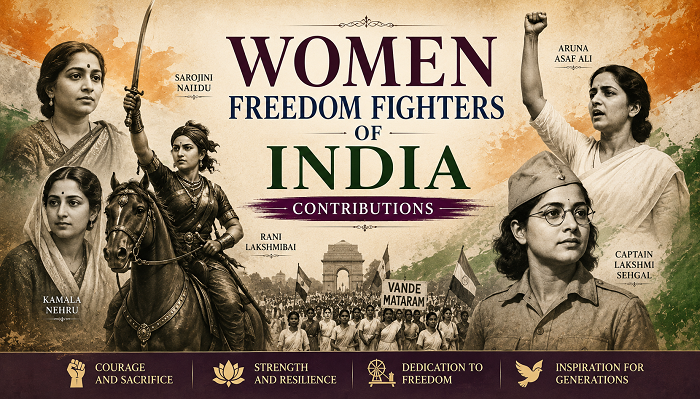
A closer study of India’s independence movement reveals something that short textbook summaries can easily miss: women were not simply supporters standing behind prominent male leaders. They organized protests, commanded armies, ran underground networks, faced imprisonment, raised funds, and challenged colonial authority directly.
The stories of the women freedom fighters of India also show how resistance evolved over time. Rani Lakshmibai fought during the uprising of 1857, Sarojini Naidu became a leading voice of mass nationalism, and Aruna Asaf Ali emerged as an important figure during the Quit India Movement.
Looking at their individual contributions gives us a more complete understanding of how women helped shape India’s long struggle against British rule.
Why Women Freedom Fighters of India Deserve Greater Recognition
Women participated in the freedom movement under difficult social and political circumstances. Public leadership itself challenged many expectations placed on women during the nineteenth and early twentieth centuries.
Some worked within the Indian National Congress and Gandhian movements, while others chose revolutionary or armed resistance. Many endured prison sentences, surveillance, exile, or physical danger.
The following ten women represent different periods, regions, and approaches to the independence struggle.
1. Rani Lakshmibai – The Queen Who Defended Jhansi
Rani Lakshmibai remains one of the best-known figures of the Revolt of 1857.
After the East India Company annexed Jhansi under the Doctrine of Lapse, her relationship with British authorities deteriorated. During the 1857 uprising, she eventually became a central leader in Jhansi’s resistance.
When British forces attacked the city in 1858, Lakshmibai participated in its defence. She later joined other rebel forces and died fighting near Gwalior on 18 June 1858.
Her leadership transformed her into a lasting symbol of resistance.
2. Begum Hazrat Mahal – The Leader of Resistance in Awadh
Begum Hazrat Mahal played a significant role in the 1857 uprising in Lucknow and the wider Awadh region.
After the British annexed Awadh and her husband, Wajid Ali Shah, was exiled, she emerged as an influential political figure. During the rebellion, her young son Birjis Qadr was proclaimed ruler, while she helped organize opposition to British authority.
When British forces regained Lucknow, she eventually sought refuge in Nepal.
3. Sarojini Naidu – The Voice of Indian Nationalism
Poet and political leader Sarojini Naidu combined public speaking with active political participation.
She supported major nationalist campaigns, including the Non-Cooperation and Civil Disobedience movements. In 1925, she became the first Indian woman to preside over the Indian National Congress.
Following Gandhi’s arrest during the Salt Satyagraha, Naidu also took a prominent role in the Dharasana campaign. After independence, she became the first woman governor of an Indian state, serving in the United Provinces.
Women Freedom Fighters of India Who Challenged Colonial Rule
The independence struggle involved far more than speeches and formal negotiations. Women participated in demonstrations, revolutionary organizations, underground communication networks, and armed resistance.
4. Aruna Asaf Ali – A Woman Freedom Fighter of India During Quit India
Aruna Asaf Ali became closely associated with the Quit India Movement of 1942.
On 9 August 1942, when many senior Congress leaders had already been arrested, she hoisted the Indian National Congress flag at Gowalia Tank Maidan in Bombay.
She subsequently went underground and continued supporting resistance activities despite colonial efforts to arrest her.
Her actions made her one of the most recognizable female figures of the Quit India period.
5. Madam Bhikaji Cama – Taking India’s Cause Overseas
Bhikaji Cama carried the demand for Indian freedom to an international audience.
Living for extended periods in Europe, she worked with Indian nationalists abroad and criticized British colonial rule.
At the International Socialist Congress in Stuttgart in 1907, she unfurled an early version of an Indian nationalist flag. Her activism illustrates how the freedom struggle extended beyond India’s geographical borders.
6. Kasturba Gandhi – Strength Through Satyagraha
Kasturba Gandhi’s contribution is sometimes reduced to her identity as Mahatma Gandhi’s wife, but she was an activist in her own right.
Her involvement in political resistance began in South Africa and continued in India. She participated in civil disobedience campaigns, worked with women and communities, and was imprisoned multiple times.
During the Quit India Movement, she was detained at the Aga Khan Palace in Pune, where she died in 1944.
7. Usha Mehta – The Voice Behind Congress Radio
Usha Mehta demonstrated how communication could become an instrument of resistance.
During the Quit India Movement, she helped operate the underground Congress Radio in 1942. Its broadcasts circulated nationalist messages and information at a time when colonial censorship attempted to restrict communication.
British authorities eventually discovered the operation, and Mehta was arrested and imprisoned.
8. Matangini Hazra – Courage at the Grassroots
Matangini Hazra was a Gandhian activist from Bengal who participated in the Civil Disobedience and Quit India movements.
In September 1942, the elderly activist led a procession in Tamluk. She was shot during police firing while carrying the national flag.
Her sacrifice demonstrates that the independence struggle involved ordinary citizens across age groups and social backgrounds, not merely nationally prominent politicians.
9. Kanaklata Barua – A Teenage Symbol of Courage
Kanaklata Barua was only 17 when she participated in the Quit India Movement in Assam.
On 20 September 1942, she led a procession toward Gohpur police station with the intention of hoisting the national flag. Police opened fire, killing her.
Her brief life remains a striking example of youth participation in India’s anti-colonial movement.
10. Captain Lakshmi Sahgal – Leadership in the INA
Dr. Lakshmi Sahgal joined Subhas Chandra Bose’s Indian National Army during World War II.
She became commander of the Rani of Jhansi Regiment, an all-women combat unit associated with the INA.
Her role was significant not only politically but socially: the regiment challenged assumptions about women’s participation in military and nationalist movements.
What Can We Learn From Their Contributions?
A common mistake is to describe all female freedom fighters as if they followed the same path. They did not.
Lakshmibai and Hazrat Mahal were associated with armed resistance in 1857. Sarojini Naidu and Kasturba Gandhi participated prominently in mass political movements. Usha Mehta used underground broadcasting, while Bhikaji Cama advocated for Indian independence internationally.
Students researching these figures should compare reputable biographies, archival documents, government museum resources, scholarly histories, and contemporary records. Films and social-media posts can spark interest, but they should not be treated as substitutes for historical evidence.
This approach helps separate documented contributions from legends that developed later.
Conclusion: Remembering the Women Freedom Fighters of India
The women freedom fighters of India did not play a single supporting role in the independence movement. They were political leaders, revolutionaries, organizers, communicators, soldiers, and grassroots activists.
From Rani Lakshmibai’s defence of Jhansi and Begum Hazrat Mahal’s leadership in Awadh to Usha Mehta’s underground broadcasts and Lakshmi Sahgal’s role in the INA, each woman contributed in a distinct way.
Their stories make India’s history richer and more accurate.
Explore credible biographies, museums, archives, and historical records, and share these women’s stories with younger generations. Remembering their contributions ensures that India’s freedom struggle is understood as the broad, diverse movement it truly was.
History
Rani Lakshmibai Story Life Courage Legacy
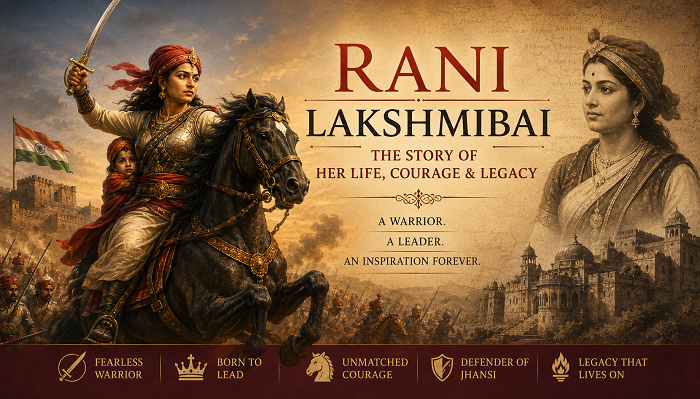
When researching the Revolt of 1857, one figure repeatedly stands out—not simply because she fought the British, but because she became a ruler, military leader, and enduring political symbol during one of the most turbulent periods of nineteenth-century India. The Rani Lakshmibai story is therefore much more than the famous image of a warrior queen riding into battle.
Born as Manikarnika Tambe, she experienced personal loss, a succession dispute, British annexation, rebellion, and eventually war—all before her death at around 29 years of age.
Understanding her real journey helps separate historical evidence from popular legend while revealing why the Queen of Jhansi continues to occupy such an important place in Indian history.
Rani Lakshmibai Story: From Manikarnika to Queen of Jhansi
Rani Lakshmibai was born Manikarnika Tambe, commonly believed to have been born in Varanasi in 1828. She was affectionately known as Manu.
After losing her mother at an early age, she grew up in an environment that exposed her to activities not always associated with conventional female education of that period. Popular accounts describe her learning horse riding, swordsmanship, and other physical skills.
In 1842, Manikarnika married Maharaja Gangadhar Rao Newalkar, ruler of Jhansi, and became Lakshmibai.
The couple had a biological son who died in infancy. Later, shortly before Gangadhar Rao’s death in 1853, they adopted a boy named Anand Rao, who was renamed Damodar Rao.
This succession became central to Lakshmibai’s confrontation with the East India Company.
Rani Lakshmibai Story and the Doctrine of Lapse
Under Governor-General Lord Dalhousie, the East India Company applied a controversial annexation policy known as the Doctrine of Lapse. In territories where the British did not recognize an adopted heir as the legitimate successor, they could annex the princely state.
After Gangadhar Rao died, British authorities refused to recognize Damodar Rao’s claim to the throne and annexed Jhansi in 1854.
Lakshmibai contested the decision and sought recognition of her adopted son’s rights. The dispute demonstrates an important aspect of her life sometimes overshadowed by battlefield stories: before becoming a military resistance leader, she attempted to defend Jhansi through political and legal means.
How the Rani Lakshmibai Story Changed During the Revolt of 1857
The uprising of 1857 transformed the political situation across northern and central India.
In June 1857, sepoys in Jhansi rebelled against British authority. European officers and civilians were subsequently killed. The exact degree of Lakshmibai’s involvement in those killings has long been debated, and historians have examined correspondence and colonial records when assessing the episode.
What is clearer is that, amid the collapse of British administration, Lakshmibai assumed responsibility for governing Jhansi and defending the state.
As conflict intensified, she organized forces and prepared the fortified city against attack.
The Siege of Jhansi and Her Military Leadership
British forces under Sir Hugh Rose reached Jhansi in March 1858. A fierce siege followed.
Lakshmibai participated in the defence of the city while rebel forces commanded by Tatya Tope attempted to relieve Jhansi. The relief effort failed, and British troops eventually breached the city’s defences.
Rather than surrender, Lakshmibai escaped from Jhansi and travelled toward Kalpi, where she joined other resistance leaders.
This stage of the Rani Lakshmibai story is important because it shows that losing Jhansi did not end her campaign. She remained active in the rebellion and continued coordinating with forces opposing British rule.
From Kalpi to Gwalior: The Final Campaign
After the rebels were defeated at Kalpi, Lakshmibai and her allies moved toward Gwalior.
Rebel forces gained control of Gwalior in June 1858, creating a serious challenge for the British. However, Hugh Rose’s troops soon advanced to retake the strategically important city.
Lakshmibai participated in the fighting near Gwalior and was killed on 18 June 1858 near Kotah-ki-Serai.
Accounts of the precise circumstances of her death differ. This is where responsible historical writing matters: later stories sometimes add dramatic details that cannot always be independently verified.
What is beyond dispute is that she died during active resistance to British forces.
Courage Beyond the Battlefield
Lakshmibai’s courage should not be reduced to her ability to use weapons.
She faced political pressure after becoming a widow, challenged the annexation of her kingdom, governed during a period of instability, and made military decisions when Jhansi came under threat.
For a woman operating within the political structures of nineteenth-century India, assuming such public authority was itself remarkable.
British commander Hugh Rose famously acknowledged her courage, describing her in his assessment of the rebellion as one of the most dangerous rebel leaders. Historical interpretations of such colonial descriptions require context, but they demonstrate the impression her leadership made even on her opponents.
Common Myths About Rani Lakshmibai
Popular culture has preserved Lakshmibai’s memory, but it has also blurred the boundary between documented history and legend.
One common mistake is assuming she led an anti-British rebellion from the beginning of 1857. Her position evolved within a complicated political crisis.
Similarly, dramatic descriptions of her escaping Jhansi on horseback with Damodar Rao tied to her back are deeply embedded in popular memory, but individual details vary between historical and later narrative accounts.
Recognizing these distinctions does not diminish her bravery. In fact, the documented events are extraordinary without embellishment.
Why Rani Lakshmibai’s Legacy Still Matters
After her death, Lakshmibai gradually became one of the most powerful symbols of resistance to colonial rule.
Later nationalist movements remembered her as an example of courage and sacrifice. Subhadra Kumari Chauhan’s famous Hindi poem about the Queen of Jhansi further carried her story into popular consciousness.
Her name has since appeared in literature, memorials, educational institutions, military references, films, and public commemorations.
For students researching her life, the best approach is to compare credible historical works, archival evidence, correspondence, and scholarly accounts instead of relying solely on films or social-media summaries.
Conclusion: Why the Rani Lakshmibai Story Must Be Remembered
The Rani Lakshmibai story combines political resistance, personal tragedy, leadership, military struggle, and an extraordinary historical legacy.
She began life as Manikarnika, became the Queen of Jhansi, fought to protect her adopted son’s succession, defended her kingdom during the Revolt of 1857, and continued resisting after Jhansi fell. Her death near Gwalior at a remarkably young age transformed her into an enduring symbol of courage.
Yet remembering Lakshmibai responsibly means looking beyond legend. Her documented decisions and actions reveal a leader navigating an exceptionally complex political crisis.
Explore credible biographies, historical archives, museums, and records of the Revolt of 1857 to discover more about Rani Lakshmibai and the many men and women whose lives shaped India’s struggle against colonial rule.
History
Forgotten Freedom Fighters of India
India’s independence was not achieved by a handful of famous leaders alone. It emerged from decades of resistance involving revolutionaries, tribal leaders, underground organizers, soldiers, farmers, women activists, and local communities across the country.
Yet when the freedom struggle is discussed, attention often settles on a relatively small group of nationally recognized figures. Looking deeper into regional histories reveals many forgotten freedom fighters of India whose contributions deserve wider recognition.
Some challenged British authority decades before the Revolt of 1857, while others organized armed resistance, mobilized marginalized communities, or worked secretly to support revolutionary movements. Their stories broaden our understanding of what India’s struggle for freedom actually looked like.
Why Should We Remember the Forgotten Freedom Fighters of India?
Remembering lesser-known freedom fighters is not simply about adding more names to a history lesson. It helps us understand that resistance to colonial rule took different forms in different regions.
Tribal uprisings challenged exploitation of land and forests. Revolutionary networks confronted colonial institutions. Women carried messages, raised funds, sheltered activists, and sometimes took up arms themselves.
Studying these individuals also helps students and readers understand independence as a collective achievement rather than the work of a few personalities.
Here are ten remarkable figures worth knowing.
1. Alluri Sitarama Raju
Alluri Sitarama Raju became a prominent leader of the Rampa Rebellion of 1922–1924 in the present-day Andhra Pradesh region.
He worked among tribal communities affected by restrictive colonial forest policies. Raju and his followers used guerrilla tactics and attacked police stations to obtain weapons.
British authorities eventually captured and executed him in 1924. His role remains especially significant in the history of tribal resistance against colonial rule.
2. Matangini Hazra
Matangini Hazra demonstrates why the story of India’s independence movement cannot be told without acknowledging women at the grassroots.
A committed Gandhian from Bengal, she participated in the Civil Disobedience and Quit India movements. In 1942, while leading a procession toward a government establishment in Tamluk, she was shot by British Indian police.
She reportedly continued holding the Indian national flag as she fell, making her a powerful symbol of courage in Bengal’s freedom movement.
3. Kanaklata Barua
Kanaklata Barua was only 17 when she joined the Quit India Movement in Assam.
On 20 September 1942, she led a procession seeking to hoist the national flag at the Gohpur police station. Police opened fire on the demonstrators, killing Kanaklata.
Her story shows how deeply the independence movement had inspired young Indians far beyond major political centres.
Forgotten Freedom Fighters of India Who Led Armed Resistance
Several revolutionaries believed that direct confrontation was necessary to weaken colonial authority. Their methods differed from nonviolent movements, but their objective was the same: ending foreign rule.
4. Surya Sen: A Forgotten Freedom Fighter of India
Known as Masterda Surya Sen, he was a teacher and revolutionary associated with the Chittagong armoury raid of 1930.
Surya Sen and his associates planned to seize British armouries, disrupt communication systems, and isolate Chittagong from colonial administration. Although the uprising could not achieve its long-term military objectives, it became an important episode in revolutionary resistance.
After remaining underground, Surya Sen was arrested, tried, and executed in 1934.
5. Peer Ali Khan
Peer Ali Khan was one of the notable revolutionaries associated with the uprising of 1857 in Bihar.
A bookseller in Patna, he was involved in anti-British revolutionary activity and was arrested by colonial authorities. He refused to reveal information about fellow revolutionaries and was executed in July 1857.
His life is a reminder that ordinary professions and local networks often provided the infrastructure behind resistance movements.
6. Begum Hazrat Mahal
Begum Hazrat Mahal emerged as an important leader during the Revolt of 1857 after the British annexation of Awadh.
She played a major political role in Lucknow and supported resistance against British rule while her young son, Birjis Qadr, was proclaimed ruler.
After British forces regained control, she eventually took refuge in Nepal. Her leadership makes her one of the most significant women associated with the 1857 uprising.
7. Veerapandiya Kattabomman
Resistance to the East India Company existed well before 1857.
Veerapandiya Kattabomman, a Palayakkarar chieftain in present-day Tamil Nadu, opposed the Company’s revenue demands in the late eighteenth century.
Conflict with British forces followed, and Kattabomman was captured and executed in 1799. His resistance remains an important chapter in the history of early anti-colonial struggles in southern India.
8. Rani Gaidinliu
Rani Gaidinliu joined the Heraka movement while still very young and became associated with resistance to British authority among the Zeliangrong Naga communities.
She was arrested in 1932 and received a life sentence. Jawaharlal Nehru later met her in prison and helped bring wider attention to her story.
She was released in 1947 after India became independent.
9. Tirupur Kumaran
Kumaran, popularly remembered as Kodi Kaatha Kumaran, was a young activist from Tamil Nadu.
In 1932, he participated in a protest against British rule while carrying a nationalist flag that had been prohibited by colonial authorities. He died after being injured during police action but continued holding the flag.
His story became associated with determination and devotion to the independence movement.
10. Birsa Munda
Birsa Munda was a tribal leader whose movement challenged exploitation and colonial interference in the Chotanagpur region during the late nineteenth century.
The uprising associated with him, commonly known as Ulgulan, addressed issues including land alienation and the disruption of traditional tribal systems.
Birsa was arrested and died in Ranchi jail in 1900 at just 25 years old. His influence, however, continued far beyond his short life.
What Can We Learn From These Lesser-Known Heroes?
One common mistake when studying Indian independence is treating the movement as a single campaign led only from major cities. Regional and tribal histories tell a much richer story.
Students, teachers, researchers, and travellers can explore local museums, government archives, biographies, memorials, and reputable historical publications to learn how the freedom movement developed in individual regions.
Comparing events is equally useful. For example, examining Kattabomman’s eighteenth-century resistance alongside Birsa Munda’s tribal movement and the Quit India activism of Kanaklata Barua reveals how resistance changed across generations.
Conclusion: Remembering the Forgotten Freedom Fighters of India
The stories of these forgotten freedom fighters of India remind us that independence resulted from sacrifices made across regions, communities, genders, and generations.
Alluri Sitarama Raju, Matangini Hazra, Kanaklata Barua, Surya Sen, Peer Ali Khan, Begum Hazrat Mahal, Veerapandiya Kattabomman, Rani Gaidinliu, Tirupur Kumaran, and Birsa Munda followed different paths, but each contributed to a larger history of resistance.
Their names deserve more than an occasional mention. Explore their biographies, visit historical memorials, and share their stories with younger generations so that these important chapters of India’s freedom struggle remain part of our collective memory.