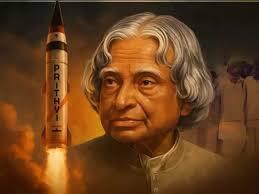
The Life & Legacy
(Missile Man of India & 11th President of India)
Full Name
Dr. Avul Pakir Jainulabdeen Abdul Kalam
Birth
15 October 1931
Place: Rameswaram, Tamil Nadu, India
Death
27 July 2015
Place: Shillong, Meghalaya, India
Age: 83 years
Early Life and Childhood (1931–1950)
Dr. A. P. J. Abdul Kalam was born on 15 October 1931 in the small coastal town of Rameswaram in Tamil Nadu. He came from a humble and deeply religious family. His father, Jainulabdeen, was a boat owner and imam of a local mosque. His mother, Ashiamma, was a kind and generous homemaker.
The family was not wealthy, but it was rich in values such as honesty, discipline, faith, and compassion. From a very young age, Kalam learned the importance of hard work and simplicity. During his school years, he helped his family by selling newspapers to support household expenses.
Kalam was an average student in his early school days but showed a strong interest in mathematics and science. His teachers recognized his curiosity and encouraged him to pursue learning with dedication.
Education and Higher Studies (1950–1960)
After completing his schooling in Rameswaram, Kalam moved to Tiruchirappalli to attend St. Joseph’s College, where he graduated in Physics in 1954.
His dream was to become a fighter pilot. To move closer to this goal, he enrolled at the Madras Institute of Technology (MIT) in 1955, specializing in Aeronautical Engineering. Life during this period was financially challenging, but Kalam remained focused and disciplined.
In 1958, he successfully completed his engineering degree. Although he narrowly missed becoming a fighter pilot in the Indian Air Force in 1959, he did not let this disappointment break his spirit. Instead, he chose a new path—scientific research and development.
Early Career as a Scientist (1960–1969)
In 1960, Abdul Kalam joined the Defence Research and Development Organisation (DRDO) as a scientist. His early work focused on designing helicopters for the Indian Army.
In 1962, he was transferred to the Indian Space Research Organisation (ISRO), where his life took a historic turn. Under the leadership of Dr. Vikram Sarabhai, Kalam worked on India’s space launch vehicle program.
India’s Space Success – SLV-III (1969–1980)
One of Kalam’s greatest achievements came in 1980, when India successfully launched the Satellite Launch Vehicle-III (SLV-III). This mission placed the Rohini satellite into Earth’s orbit on 18 July 1980.
This success made India a member of an elite group of space-faring nations. Kalam was widely praised for his leadership, technical brilliance, and ability to motivate his team. This period established him as one of India’s most respected scientists.
Missile Development and National Defense (1980–1990)
In 1982, Abdul Kalam returned to DRDO as the Director of the Integrated Guided Missile Development Programme (IGMDP).
Under his leadership, India developed several strategic missiles, including:
-
Agni (Intermediate-range ballistic missile)
-
Prithvi (Surface-to-surface missile)
-
Akash
-
Trishul
-
Nag
Because of these achievements, he earned the title:
“Missile Man of India”
His work greatly strengthened India’s defense capabilities and reduced dependence on foreign technology.
Pokhran Nuclear Tests (1998)
One of the most significant moments in Kalam’s career came in May 1998.
On 11 and 13 May 1998, India conducted Pokhran-II nuclear tests under the leadership of Prime Minister Atal Bihari Vajpayee. Dr. Kalam played a crucial role as Chief Scientific Adviser to the Government of India.
These tests established India as a nuclear power, enhancing national security and global standing.
Awards and Honors
Dr. Kalam received numerous national and international honors:
-
Padma Bhushan – 1981
-
Padma Vibhushan – 1990
-
Bharat Ratna – 1997 (India’s highest civilian award)
He also received honorary doctorates from over 40 universities worldwide.
Presidency of India (2002–2007)
In 2002, Dr. A. P. J. Abdul Kalam was elected as the 11th President of India.
Term:
-
25 July 2002 – 25 July 2007
He was known as the “People’s President” because of his humility, accessibility, and deep connection with students and youth. He frequently visited schools and colleges, inspiring millions to dream big and work hard.
During his presidency, he focused on:
-
Education
-
Youth empowerment
-
Science and technology
-
National development
Vision 2020 and Youth Inspiration
Dr. Kalam strongly believed that India could become a developed nation by 2020. He presented his vision in his famous book:
“India 2020: A Vision for the New Millennium”
He emphasized five key areas:
-
Agriculture and food processing
-
Education and healthcare
-
Information technology
-
Infrastructure
-
Self-reliance in defense
Author and Thinker
Dr. Kalam was also a prolific writer. His most famous books include:
-
Wings of Fire (Autobiography, 1999)
-
Ignited Minds
-
Turning Points
-
My Journey
His writings continue to inspire students, teachers, and professionals.
Final Years and Death (2007–2015)
After completing his presidential term in 2007, Kalam returned to academic life. He became a visiting professor at institutions such as:
-
Indian Institute of Management (IIM)
-
Indian Institute of Space Science and Technology (IIST)
On 27 July 2015, while delivering a lecture at the Indian Institute of Management Shillong, Dr. Kalam collapsed due to cardiac arrest and passed away.
He died doing what he loved most—teaching and inspiring students.
Legacy
Dr. A. P. J. Abdul Kalam remains a symbol of:
-
Simplicity
-
Integrity
-
Knowledge
-
Patriotism
His life proves that great dreams, combined with hard work and discipline, can transform a nation.
Famous Quotes by Dr. Kalam
“Dream, dream, dream. Dreams transform into thoughts and thoughts result in action.”
“If you want to shine like a sun, first burn like a sun.”
⭐ Conclusion
From a small town in Rameswaram to the Rashtrapati Bhavan, Dr. A. P. J. Abdul Kalam’s journey is one of dedication, resilience, and vision. His life story continues to guide generations toward knowledge, service, and excellence.