Introduction
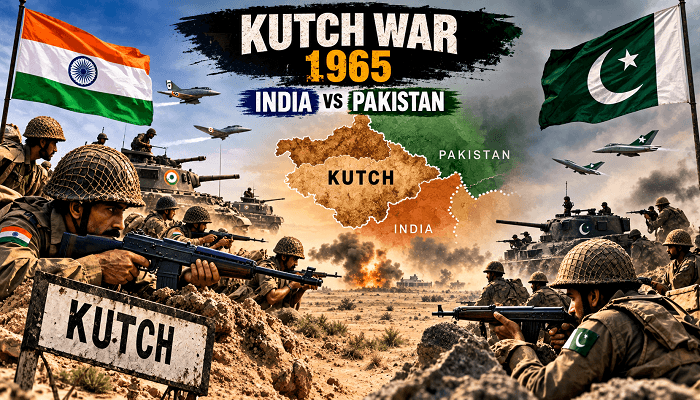
The Kutch War was a border conflict between India and Pakistan that occurred from April to June 1965 in the Rann of Kutch, a salt marsh in the Kutch district of Gujarat. Though brief, the conflict was significant as it was a prelude to the larger Indo-Pak War of 1965.
The war involved skirmishes and artillery duels along the disputed Indo-Pak border, highlighting the strategic importance of Kutch and the unresolved border disputes from Partition (1947). A United Nations-mediated settlement ended the hostilities, with India gaining most of the disputed territory.
Background of the Conflict
1. Partition and Border Ambiguity
-
At the time of India-Pakistan partition in 1947, the Rann of Kutch was left as a disputed territory due to unclear demarcation of the border.
-
Both India and Pakistan claimed the area, but it remained administratively under India, leading to frequent tensions.
2. Strategic Importance of Kutch
-
Kutch connects Gujarat with Sindh (Pakistan) and is close to the Arabian Sea, giving strategic access to ports.
-
Control of Kutch would influence trade routes, security of coastal regions, and border defense.
3. Pre-1965 Tensions
-
Pakistan attempted to assert control over parts of Kutch via armed incursions in April 1965.
-
India mobilized troops to defend the border and repel Pakistani advances.
Causes of the War
1. Territorial Dispute
-
The border line between India and Pakistan in Kutch was not clearly demarcated, leading to overlapping claims.
-
Both countries deployed border police and military units in disputed areas, increasing friction.
2. Strategic and Political Factors
-
Pakistan sought to test Indian defenses and gain territorial advantage before escalating to Kashmir.
-
India aimed to protect national sovereignty and prevent encroachment into Gujarat.
3. Precursor to Larger Conflict
-
The Rann of Kutch skirmishes are seen as a testing ground for military strategies later used in the 1965 Indo-Pak War.
Timeline of the Conflict
| Date | Event |
|---|---|
| 8 April 1965 | Initial Pakistani incursions in Rann of Kutch reported. |
| 10–18 April 1965 | Skirmishes escalate; artillery fire exchanged. |
| 19–20 April 1965 | India deploys additional troops, reinforcing positions. |
| May 1965 | Several clashes and counterattacks along disputed territory. |
| 30 June 1965 | UN-mandated ceasefire negotiated; hostilities end. |
| 19 February 1968 | International arbitration award gives India most of the disputed territory. |
Major Battles and Engagements
1. Skirmishes at Sir Creek and Adjacent Areas
-
Pakistan attempted to occupy outposts near Sir Creek.
-
Indian Border Security Force (BSF) and military units responded, repelling the incursions.
2. Artillery Duels
-
Both sides engaged in heavy artillery firing, particularly in Chhachro, Sindh (Pakistan side) and Kutch (India side).
-
Indian forces successfully maintained defensive positions, preventing Pakistan from gaining a foothold.
3. Use of Armored and Infantry Units
-
India deployed infantry and armored units to patrol the marshy terrain.
-
Pakistan faced difficulty navigating the Rann’s salt flats, giving India a tactical advantage.
Leaders and Commanders
India
-
Lt. Gen. Harbaksh Singh – Commanded Indian forces in Gujarat sector.
-
Col. S.S. Bhullar – Key officer defending forward positions.
-
Indian Navy and Air Force provided logistical and aerial reconnaissance support.
Pakistan
-
Lt. Gen. Abdul Hamid Khan – Oversaw Pakistani operations in Kutch.
-
Pakistani units faced logistical challenges in the marshy terrain.
Casualties and Losses
| Country | Killed | Wounded | Notes |
|---|---|---|---|
| India | ~200 | ~500 | Artillery and infantry skirmishes in marshy terrain |
| Pakistan | ~350 | ~700 | Losses higher due to terrain disadvantage |
-
The casualties were limited compared to later wars, but the conflict had strategic significance.
Outcome of the War
1. Ceasefire and UN Intervention
-
On 30 June 1965, a ceasefire was enforced after diplomatic intervention by the United Nations.
-
Both nations withdrew from immediate conflict zones, pending arbitration.
2. Arbitration and Territorial Settlement
-
In 1968, the UN-appointed tribunal awarded 90% of disputed Kutch territory to India.
-
Pakistan retained a small portion in the western Rann of Kutch.
3. Strategic Lessons
-
India demonstrated effective border defense in marshy terrain.
-
Pakistan learned that territorial incursions without preparation were costly.
Military and Strategic Consequences
1. Strengthening of Border Security
-
India reinforced military and paramilitary presence along the Gujarat border.
-
New border posts, roads, and infrastructure improved surveillance and rapid deployment capability.
2. Precursor to 1965 War
-
The Kutch conflict served as testing ground for artillery tactics and armored operations used later in Punjab and Kashmir sectors.
-
Both nations refined strategy, logistics, and coordination in preparation for full-scale war.
3. Confidence and Morale
-
India’s successful defense boosted national morale and armed forces’ confidence.
-
Pakistan faced political embarrassment due to failure to secure territory.
Political and Diplomatic Consequences
1. India-Pakistan Relations
-
Kutch war exacerbated tensions, setting the stage for full-scale war in August 1965.
-
Diplomatic channels, including the United Nations, became crucial in preventing escalation.
2. International Implications
-
The United Nations’ arbitration reinforced international norms in resolving border disputes.
-
Demonstrated the importance of diplomatic resolution to prevent regional wars.
Lessons from the Kutch War
-
Importance of Terrain Knowledge
-
Marshy, salt-flat terrain required specialized planning and logistics.
-
-
Border Infrastructure and Surveillance
-
Effective deployment and monitoring of troops can prevent incursions.
-
-
Early Warning and Rapid Response
-
Timely mobilization and artillery readiness were key to India’s defense.
-
-
Diplomatic Resolution
-
International arbitration helped settle disputes peacefully, avoiding prolonged conflict.
-
Conclusion
The Kutch War of 1965 was a short but strategically significant border conflict between India and Pakistan. Though smaller in scale compared to the 1965 and 1971 wars, it highlighted the importance of territorial integrity, tactical preparation, and effective diplomacy.
The conflict demonstrated India’s ability to defend its borders in challenging terrain, boosted military confidence, and underscored the critical role of international mediation in resolving disputes. It also acted as a prelude to the larger 1965 Indo-Pak War, providing both nations with lessons in strategy, logistics, and combat preparedness.
Key Dates to Remember:
-
8 April 1965 – Pakistani incursions begin in Rann of Kutch
-
30 June 1965 – Ceasefire enforced under UN mediation
-
19 February 1968 – International tribunal awards most of disputed territory to India